
News + Media
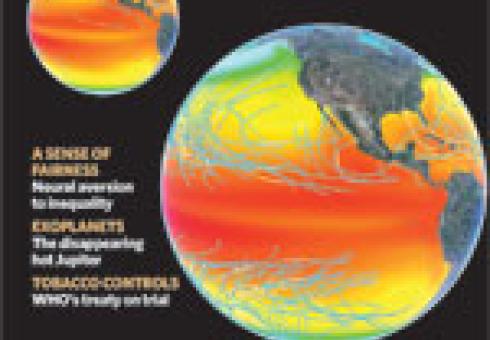
Intense hurricane activity millions of years ago may have caused and sustained warmer climate conditions, new research suggests
A question central to research on global warming is how warmer temperatures caused by increased greenhouse gases could influence climate. Probing the past for clues about this potential effect, MIT and Yale climate scientists examined the Pliocene period, which began five million years ago and which some consider to be a potential analog to modern greenhouse conditions. They found that hurricanes influenced by weakened atmospheric circulation — possibly related to high levels of carbon dioxide — contributed to very warm temperatures in the Pacific Ocean, which in turn led to more frequent and intense hurricanes. The research indicates that Earth's climate may have multiple states based on this feedback cycle, meaning that the climate could change qualitatively in response to the effects of global warming.
Although scientists know that the early Pliocene had carbon dioxide concentrations similar to those of today, it has remained a mystery what caused the high levels of greenhouse gas and how the Pliocene's warm conditions, including an extensive warm pool in the Pacific Ocean and temperatures that were roughly 4 degrees C higher than today's, were maintained.
In a paper published Feb. 25 in Nature, Kerry Emanuel, the Breene M. Kerr Professor of Atmospheric Science in the Department of Earth, Atmospheric and Planetary Science, and two colleagues from Yale University's Department of Geology and Geophysics suggest that a positive feedback between tropical cyclones — commonly called hurricanes and typhoons — and the circulation in the Pacific could have been the mechanism that enabled the Pliocene's warm climate.
The Pliocene ended around three million years ago with the onset of large ice sheets in the Northern Hemisphere. There has been a slow reduction in carbon dioxide levels in the atmosphere for about 15 million years, and it is thought that the start of the glacial cycles was the climate's response once those levels reached a certain threshold, according to co-author Chris Brierley. While that level remains unknown, this research indicates that by increasing carbon dioxide levels, humans could reach the threshold that would induce a Pliocene-like climate.
More...
Moderator: Ernest J. Moniz
Robert N. Stavins
Michael Greenstone
Stephen Ansolabehere
Edward S. Steinfeld
Henry D. Jacoby
John Sterman PhD '82

VIDEO of Climategate discussion
Event and participant details
At Dec. 10 forum, MIT faculty experts discussed what 'Climategate' really means for climate science and the ongoing policy negotiations in the Congress and at Copenhagen.
The leaked e-mails from the climate scientists at the University of East Anglia (UEA) have caused a huge public relations headache. The e-mails, in which the scientists seemed to question or even exaggerate their research, have provided new fodder for climate-change skeptics, who now feel they have "proof" that global warming is a hoax. The e-mails may be proof of nothing other than frustrated or impatient scientists, but the scientific community nonetheless has to deal with the fallout — the public’s increasing doubt about the validity of climate science, and maybe even doubt about scientific research in general.
"The Great Climategate Debate," held on Dec. 10 (see event and participant details) featured a panel of MIT faculty addressing the issues — both scientific and political — surrounding the controversy in the hopes that it wouldn't become the main focus of this month's United Nations Climate Change Conference in Copenhagen, Denmark. The debate involved the many issues raised by the scandal: the validity of climate science, the motives of the hackers who leaked the e-mails, the need for responsible scientific reporting and ethical standards, and the way the public interprets and understands information from the scientific community.
Kerry Emanuel, the Breene M. Kerr Professor of Meteorology, fears that Climategate was a "premeditated distraction from the main issues" of climate science. Emanuel said he's concerned with the identity and motives of the hackers, citing the very rich "machine" of global warming deniers as a possible culprit. As for the e-mails, he thinks they show nothing more than "humans — a few with failings. Mostly, it shows scientists hard at work."
Richard Lindzen, the A. P. Sloan Professor of Meteorology, believes the e-mails were leaked by a whistleblower within the Climate Research Unit who, like Lindzen, is disillusioned by what he sees as the scientific community’s one-sided argument over climate change. "Undeniably," he said, "we are dealing with issues illegal and unethical." The debate, he said, is whose illegal and unethical behavior is the larger issue: the scientists or the hackers?
Although Ron Prinn, the TEPCO Professor of Atmospheric Science and director of the Center for Global Change Science, thinks the e-mails are unethical and unprofessional, he believes this means little for the validity of the UEA scientists' studies. This controversy, he said, should not cause us to reevaluate our concern over global warming. Prinn notes that the larger body of evidence remains robust: The UEA scientists represent just a few of the many scientists from institutions around the world who are studying climate-change issues.
More...
Moderator: Henry D. Jacoby
Kerry Emanuel '76, PhD '78
Judith Layzer PhD '99
Stephen Ansolabehere
Ronald G. Prinn SCD '71
Richard Lindzen

Henry "Jake" Jacoby, co-director of MIT's Global Change program, discusses what to expect from the U.N. Climate Change Conference, and the effects of 'Climategate'

A recent MIT analysis found that the 2009 Waxman-Markey bill would cost each U.S. household $400 per year on average. But how does that compare with the cost of damages that would result from unmitigated climate change, air pollution, or water pollution?
Thomas Karl, Tim Lenton, Philip Boyd, Joyce Penner, David Battisti, David Keith, James Fleming, Judy Layzer, Catherine Redgewell, Carl Wunsch, Cornelia Dean, Kerry Emanuel, Dara Entekhabi, Ronald Prinn

New analysis shows that without proper regulation, biofuels programs aimed at curbing greenhouse gases could do just the opposite
A global push toward production of biofuels, advocated by many as a measure to curb greenhouse gas emissions, could have exactly the opposite effect unless adequate controls are put in place, a new study has found. Because forests, which remove carbon dioxide from the atmosphere, could end up being cut down to create new cropland as a result of intensive agriculture for fuels, a gallon of biofuel could ironically end up being responsible for twice as much greenhouse gas emission as a gallon of gasoline.
This indirect impact from biofuels production is "an inescapable effect" unless regulations control it, but it cannot directly be measured, says John Reilly, associate director of the MIT Joint Program on the Science and Policy of Global Change. Reilly, along with five other MIT researchers, is a co-author of the new study published Oct. 23 in Science. The lead author is Jerry Melillo of the Marine Biological Laboratory in Woods Hole, Mass.
The study found that a massive campaign to substitute biofuels for petroleum could result in a net doubling of the amount of land devoted to agriculture worldwide - and that, perhaps surprisingly, there is enough land available to sustain that. But this change in land use, unless coupled to regulations that either specifically protect forestland, or that tax the destruction of forest sufficiently to render that uneconomic, would lead to a net increase in carbon emissions. In addition, the increase in intensive agriculture would require an enormous addition of nitrogen fertilizers to the soil, producing emissions of nitrous oxide, a much more potent greenhouse gas than CO2. Together, these two effects could double the overall emissions attributable to land use. However, with proper controls in place, the use of biofuels instead of petroleum could reduce carbon emission by almost four-fifths, Reilly says.
More...

Comprehensive analysis of the odds of climate outcomes under different policy scenarios shows significant benefits from early actions.
A new analysis shows that even moderate carbon-reduction policies now can substantially lower the risk of future climate change. But without prompt action, extreme changes could soon become much more difficult, if not impossible, to control.

Analysis shows climate change to yield more extreme rainfall — Heavier rainstorms lie in our future. That's the clear conclusion of a new MIT and Caltech study on the impact that global climate change will have on precipitation patterns. But the increase in extreme downpours is not uniformly spread around the world, the analysis shows.
Overall, previous studies have shown that average annual precipitation will increase in both the deep tropics and in temperate zones, but will decrease in the subtropics. However, it's important to know how the magnitude of extreme precipitation events will be affected, as these heavy downpours can lead to increased flooding and soil erosion. It is the magnitude of these extreme events that was the subject of this new research, which will appear online in the Proceedings of the National Academy of Sciences this week. The report was written by Paul O'Gorman, assistant professor in the Department of Earth, Atmospheric and Planetary Sciences at MIT, and Tapio Schneider, professor of environmental science and engineering at Caltech. (View article.)
Model simulations used in the study suggest that precipitation in extreme events will go up by about 5 to 6 percent for every one degree Celsius increase in temperature. Separate projections published earlier this year by MIT's Joint Program on the Science and Policy of Global Change indicate that without rapid and massive policy changes, there is a median probability of global surface warming of 5.2 degrees Celsius by 2100, with a 90 percent probability range of 3.5 to 7.4 degrees.
Specialists in the field called the new report by O'Gorman and Schneider a significant advance. Richard Allan, a senior research fellow at the Environmental Systems Science Centre at Reading University in Britain, says, "O'Gorman's analysis is an important step in understanding the physical basis for future increases in the most intense rainfall projected by climate models." He adds, however, that "more work is required in reconciling these simulations with observed changes in extreme rainfall events."
The reason the climate models are less consistent about what will happen to precipitation extremes in the tropics, O'Gorman explains, is that typical weather systems there fall below the size limitations of the models. While high and low pressure areas in temperate zones may span 1,000 kilometers, typical storm circulations in the tropics are too small for models to account for directly.
More...

Fed by MIT data, display shows extent of human-caused emissions
The latest ominous number to appear on the side of a New York building is a real-time count of the tons of carbon dioxide (and equivalents of other greenhouse gases) emitted each day, based on MIT calculations. The 70-foot-tall display, unveiled last week by Deutsche Bank outside New York's Madison Square Garden, is modeled after the familiar Times Square Debt Clock, which keeps a running tally of the U.S. national debt. The new display's rapidly rising red digits are based on data collected and analyzed by MIT's Joint Program on the Science and Policy of Global Change, using a global network of monitoring stations. The display not only shows the level of greenhouse gases entering the atmosphere but also underscores how businesses and financial institutions are starting to grow concerned about the economic impacts of climate change. More...