News + Media
Progress report underscores strong collaboration across campus to address climate change
Vice President for Research Maria Zuber today released a report outlining progress in several key areas of MIT’s five-year Plan for Action on Climate Change, underscoring strong collaboration across campus in addressing what the report calls “the urgent problem of global climate change.”
The Institute first announced the multifaceted plan last October, presenting steps MIT will take to fight global climate change. The five-year plan will enhance efforts in five key areas of climate action, now called the “five pillars”:
- improving understanding of climate change and advancing novel, targeted mitigation and adaptation solutions;
- accelerating progress toward low- and zero-carbon energy technologies;
- educating a new generation of climate, energy, and environmental innovators;
- sharing knowledge about climate change, and learning from others around the world; and
- using the MIT community as a “test bed” for change.
Today’s report provides updates on new and continuing initiatives that directly support those five pillars, including research grants, MIT’s Environmental Solutions Initiative (ESI), low-carbon energy centers, energy-industry partnerships, academic conferences and contests focused on climate-change solutions, and tools to improve energy efficiency on campus.
The report also highlights a new Climate Action Advisory Committee (CAAC), methods for engaging external partners, and ways to communicate the plan’s progress, including through a website and annual report.
“As we said in our climate action plan, our goal is for MIT to seize a position of leadership in the urgent fight against climate change,” Zuber says. “Thanks to the talents and energy of people across the MIT community, we are making steady progress in activating our plan. Seeing the gathering of world leaders in New York on Earth Day to begin to put the Paris Agreement into effect gives us reason for optimism — and reminds us that we have a lot of work ahead of us.”
Assembling the CAAC
Zuber is now finalizing membership of the CAAC, first announced in March in an agreement reached between MIT and the student-led group Fossil Free MIT. The CAAC, headed by Zuber, aims “to bring to bear on climate action the full depth and breadth of the MIT community’s talent, experience, expertise, and creativity,” the report says.
According to the report, CAAC membership will include: one director or representative each from the ESI, the MIT Energy Initiative (MITEI), the Center for Global Change Science, the Center for Energy and Environmental Policy Research, the Climate CoLab, the Joint Program on the Science and Policy of Global Change, the MIT Office of Sustainability, the Sloan Sustainability Initiative; two undergraduates, two graduate students, two postdocs, and two alumni; one additional faculty member; two additional staff members; and any interested MIT Corporation members.
The primary responsibilities of the CAAC are to: consult on the implementation of the plan; develop a set of strategies and benchmarks for MIT’s engagement with industry, government, and other institutions; and assist in finding ways to engage the broader MIT community in climate action. Plans are for the first CAAC meeting to take place in early May.
Building the five pillars
The report provides updates to many MIT initiatives that now support the plan’s five pillars.
Toward the goal of understanding of climate change and advancing mitigation and adaptation solutions, the ESI will announce a second round of environmental-solution seed grants in fall 2016. (Seed grants were also awarded last year.) In keeping with the ESI’s five-school approach, seed grants will support faculty partnerships across multiple departments to pursue critical climate and environmental research questions.
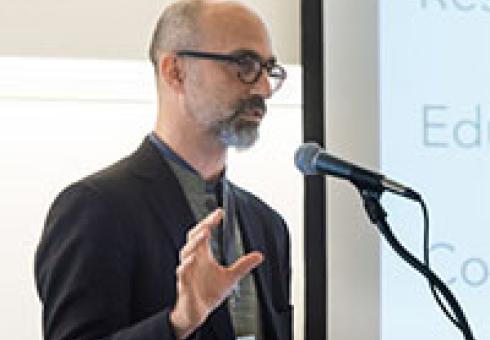
Additionally, at an Earth Day event held on campus on April 22, ESI Director John Fernandez detailed his vision for the ESI’s three key areas of focus: research, education, and convening. Primary research topics include climate science and earth systems, cities and infrastructure, and sustainable society and economy. Education initiatives will include new problem sets, lectures, and modules focused on environmental issues in required undergraduate classes, and the formation of a student “corps” for environmental action. Convening means more collaborative events across campus, such as the Hackathon for Climate, organized in January by the ESI and Climate CoLab.
“We’re at an inflection point [for climate action], both globally and institutionally,” Fernandez says. Globally, the Paris climate agreement succeeded in rallying world leaders around reducing greenhouse gas emissions. At MIT, he said, “an environmental initiative is 30 years in the making. We’re really at a point where all the planets are aligning and, from upper administration to Fossil Free MIT, the community is really engaged in ways that we can really do something substantial.”
To help accelerate progress toward large-scale deployment of low- and zero-carbon energy technologies, MITEI has been setting up its eight new Low-Carbon Energy Centers (LCECs), each focused on advancing a specific technology area key to addressing climate change; it has named two co-directors for four of the centers, with others to follow. In February, national energy provider Exelon announced plans to join several LCECs.
Last November, MITEI’s Utility of the Future Study workshop brought together faculty from MIT and the Institute for Research in Technology in Madrid, along with leaders from 20 energy companies, and members of government energy bodies, to examine alternative business models and technologies in the power sector. In May, MITEI hosts the final workshop to prepare for the study’s conclusion and report release this fall. One of the LCECs, the Center for Electric Power Systems, will launch as the study concludes, leveraging the study’s findings for further research. MITEI is also launching the Mobility of the Future Study this spring to explore ways to decarbonize the transportation sector.
“As MITEI is developing the eight Low-Carbon Energy Centers, it’s a great time to both reflect on and build on the wealth of energy research across the Institute dedicated to advancing technologies that can help address climate change,” MITEI Director Robert Armstrong says. “Our team is enjoying working with such innovative faculty members and students to shape these centers, and we’re simultaneously having many productive conversations with industry and government representatives interested in getting involved in this collaborative research initiative.”
As part of the third pillar, educating a new generation of climate, energy, and environmental innovators, ESI is working with faculty and students to design a minor in environment and sustainability. It will include four main components: earth system and climate science, environmental governance, engineering for sustainability, and environmental history and culture.
To help share knowledge about climate change, the Climate CoLab last October launched a contest soliciting ideas on how MIT alumni can help implement the plan. Winners are being selected now, and may present their proposals at MIT and beyond. Earlier this year, the Climate CoLab launched 13 open contests calling for expert strategies in addressing climate change in many areas, including decarbonizing energy supply, shifting public attitudes and behaviors, infrastructure, waste management, and information technologies.
Furthering the fifth pillar, using the MIT community as a “test bed” for change, Zuber and Fossil Free MIT recently underscored that a 32 percent reduction in carbon emissions on campus is the minimum; the campus will strive to be carbon neutral. In January, the Office of Sustainability released MIT’s first comprehensive greenhouse gas inventory. The Office of Sustainability will report findings of the Energy and Greenhouse Gas Working Group, tasked with finding ways to reach 32 percent emissions reduction and beyond.
In March, the Office of Sustainability and Climate CoLab launched a contest for ideas from MIT and outside to reduce emissions on the MIT campus. MIT has finalized a gas supply agreement with Eversource for the campus cogeneration plant to run entirely on natural gas by 2020, with the exception of emergencies and testing. The Department of Facilities has adopted Leadership in Energy and Environmental Design (LEED) Gold version 4 as the standard for all new construction and major renovations; the department is also assessing any roof’s suitability for solar panels. A Sustainability Data Hub, an open data platform for campus energy use, is being designed, and the Department of Facilities is finalizing a carbon calculator for MIT capital projects. In November, Zuber announced MIT will soon enact “shadow” — or “internal” — carbon pricing at MIT.
Office of Sustainability Director Julie Newman heads up many initiatives of the fifth pillar, which she calls an “ambitious” undertaking. But, she says, the MIT community has quickly rallied around the idea of considering carbon reduction in all new campus projects. “Carbon reduction is not a second thought anymore,” she says. “It’s becoming integrated into the decision process. I don’t think I’ve seen a campus move so quickly to incorporate changes.”
Sustained engagement
The report stresses the need for more sustained engagement with governments, industries, and other institutions of higher education in combating climate change. “While this strategy of engagement is reflected clearly in the plan’s action items, it must go beyond these to fully leverage MIT’s convening power,” the report says.
Potential engagement opportunities include: direct interactions with other stakeholders, facilitated gatherings of industry and other partners in Cambridge and beyond, and town hall-style events with the MIT community.
The upcoming Global Change Forum hosted by the MIT Joint Program on the Science and Policy of Global Change will focus on “Corporate Strategy and Climate Change” to examine how public and private sectors can adapt to climate change. And the Center for Energy and Environmental Policy Research will host a workshop in May for industry participants, academics, and policymakers to examine research on energy and environmental policy.
The report says Zuber also plans to convene a forum in the coming months to explore ethical responsibilities of countries, industries, companies, institutions, and individuals in limiting the increase in average global temperatures to 2 degrees Celsius over preindustrial levels.
Getting the word out
Future updates of the plan will be shared via climateaction.mit.edu, which is being revamped and will relaunch in a few months. On the website, people can find information about specific roles and activities of MIT offices involved in the plan, upcoming climate-related events on campus, and contacting members of the CAAC.
The Office of the Vice President for Research plans to produce an annual report to assess MIT’s progress in implementing the plan and how the plan’s external partners are responding to the climate challenge.
Photo: ESI Director John Fernandez detailed his vision for the ESI at a recent Earth Day event held on campus on April 22 (Photo by Justin Knight)

At the United Nations conference on climate change in Paris in December 2015, 195 countries adopted the first legally binding global climate deal. A key point of discussion was the issue of responsibility. This press conference presents new research assessing the extent to which some developed and developing nations are to blame for climate change, from emissions to temperature increase contributions. This media briefing will also shed light on what the Paris agreement, and its global mean temperature limits of 2°C and 1.5°C, means for the Earth system, from glacier mass change to sea-level rise.
Cheap oil fuels other parts of the world economy
John Reilly | MarketWatch
The crash in the price of oil — from $108 a barrel in June 2014 to below $27 earlier this year — has rattled the stock market, triggered layoffs across the energy sector, and plunged many oil producing countries into crisis.
Oil has since rebounded significantly from its lows, to above $40 a barrel, but the price plunge since 2014 has put much pressure on oil companies. Reports have pointed to an increase in debt among oil producers, raising the specter of default on bankruptcy and default on debt, with follow-on effects beyond oil producers.
The upheaval also has sparked fears that oil’s troubles will spread across the globe, echoing the crash in U.S. housing markets that pushed the world economy to the brink of collapse in 2008. Yet despite the woes oil is experiencing, it is unlikely that the repercussions will trigger another global financial crisis.
Looking at the numbers, the mortgage-debt crisis dwarfs what is currently happening in oil. According to a report in the Financial Times, the global oil and gas industry’s debts rose to $3 trillion from $1.1 trillion between 2006 and 2014. Compare that to the $10 trillion of housing debt weighing on Americans in 2008.
Aside from the numbers, the impact will be different because of the nature of the oil industry and the role oil plays in the world economy. Boom and bust have been features of the oil business for many years. Companies that have been around for a while understand this, and have learned to adapt. Responding to earlier crises, they made significant cuts and improved efficiency. Because they run lean operations, these companies are better prepared to weather downturns. Also, the major players in the oil industry are not highly leveraged, and thus we have not seen anything like the cascade of failures among lenders and suppliers that made the housing bust so damaging.
It is also important to note that the marginal cost of extracting oil from the ground is relatively low once the initial cost of developing a field is sunk. Even if prices are low, companies can continue to make money. It won’t be as much as they would make in good times, but the businesses can still generate revenue and profits. When oil companies cut back, they halt or delay investments in new fields, but their existing wells continue to produce.
Although some smaller or newer oil companies have been forced out of business by the price collapse, the larger, established players are unlikely candidates for bankruptcy. What tends to happen in the oil business is consolidation, which has been a feature of the industry for nearly two decades: look at Exxon XOM, +0.71% and Mobil; Chevron CVX, +0.39% and Texaco; BP BP, -1.46% and Amoco, and other mergers that occurred in the 1990s and early 2000s — another time when oil prices were extremely low.
That round of mergers and acquisitions reduced the number of companies considerably, and so room for further consolidation may be limited. Also, many of the remaining companies are state-owned or state-controlled and thus not candidates for acquisition or merger unless governments that owned them decided to privatize the assets — an unlikely scenario. But smaller operators with potentially valuable mineral rights will become candidates for acquisition by cash-rich larger companies.
When weighing the fallout from the oil price collapse, it is important to remember that whatever direction oil prices move, there will be winners and losers. While today the oil industry struggles, other industries, including transportation and manufacturing, are enjoying the benefits of low-cost oil. The fortunes of regions also rise and fall with the price of oil. When the price is high, Texas booms and New England struggles. Falling prices bring the reverse.
Perhaps the most serious consequence of today’s cheap oil is the damage done to governments that rely heavily on tax revenue from oil production. Many of the big oil-producing countries depend heavily on oil revenue to deliver basic services. With the collapse in prices, governments have to cut support for everything from medical care to housing to road repair. Tight budgets, in turn, can fuel political unrest, which may destabilize governments.
The damage to governments is easy to see in Venezuela, Nigeria, and Russia. But it also is apparent in wealthy countries such as Saudi Arabia, which has had to trim its domestic budget and pull back on investment outside of the country. Foreign nationals who traditionally have made up a large part of the Saudi work force may find less opportunity there, which creates a spillover effect in their home countries.
But for most of the world, assessing the effects of the oil price collapse is a process of calculating the many pluses and minuses. Oil industry workers may have much lighter paychecks these days, but consumers have a bit more in their wallets after filling the gas tank.
John Reilly is a senior lecturer at the MIT Sloan School of Management and co-director of the MIT Joint Program on the Science and Policy of Global Change, Center for Energy and Environmental Policy Research.
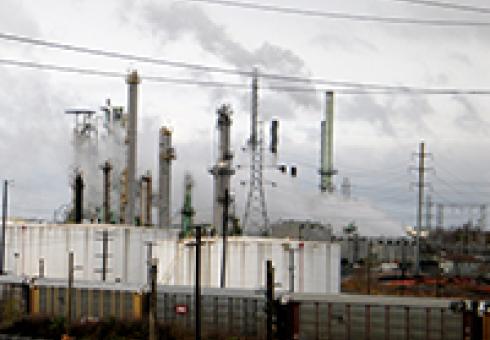
Photo: Detroit oil refinery (Photo courtesy of Grangernite)

Valerie Karplus, Sloan School of Management
Andrea Carter | Poets and Quants
Valerie Karplus
Assistant Professor, Global Economics and Management
MIT, Sloan School of Management
Forecasts suggest that rapidly developing nations such as China will be responsible for most of the growth in greenhouse gas emissions over the next 50 years. Valerie Karplus isn’t sitting back waiting for it to happen. Instead, she’s doing something about it now and using her expertise on China’s energy system – including technology and business model innovation, energy system governance, and the management of air pollution and climate change – to help correct the course we’re on. From 2011 to 2015, she directed the MIT-Tsinghua China Energy and Climate Project, a five-year research effort that focused on analyzing the design of energy and climate change policy in China, along with its domestic and global impacts.
Alongside her research, Professor Karplas teaches Entrepreneurship Without Borders and New Models for Global Business, along with co-developing an all new course at MIT on Global Energy Markets and Policy. She also serves the university as a faculty affiliate of the MIT Joint Program on the Science and Policy of Global Change and the MIT Energy Initiative.
Age: 35
At current institution since: 2006
Education: B.S. Molecular Biophysics and Biochemistry and Political Science, Yale University, 2002; M.S. Technology and Policy / Civil and Environmental Engineering, Massachusetts Institute of Technology, 2008; Ph.D. Engineering Systems, Massachusetts Institute of Technology, 2011
Courses you currently teach: New Models for Global Business, Entrepreneurship without Borders, Mentor for Global Entrepreneurship Lab, China Lab, and Global Organizations Lab
Professor you most admire: Elinor Ostrom
“I knew I wanted to be a b-school professor when…I discovered I could apply my diverse interests in the management of technology and innovation, the natural sciences and engineering, and global affairs and policy to advance solutions to major challenges facing society—a hallmark of scholarship at MIT.”
“If I weren’t a b-school professor…I would spend my days painting and writing novels.”
Most memorable moment in the classroom or in general as a professor: Leading the CEOs of the MIT Sloan Global Entrepreneurship Lab companies in the Marshmallow Challenge (a game that requires building a structure out of tape, string, and pasta, then placing the marshmallow on top within 18 minutes)—this exercise led to an abundance of creative designs and unexpected insights.
What professional achievement are you most proud of? Building a cross-border, multi-disciplinary research team involving energy economics researchers at MIT and Tsinghua University. Our team contributed to analysis that supported U.S.-China cooperation on climate change ahead of the 2014 Asia-Pacific Economic Cooperation Summit, where Presidents Obama and Xi jointly announced their intended pledges for climate action ahead of the Paris Climate Talks.
What do you enjoy most about being a business school professor? I thoroughly enjoy the variety of topics and challenges I am able to tackle as a business school professor. I also enjoy experimenting with a variety of interactive classroom formats, including simulations, business cases, and debates.
What do you enjoy least about being a business school professor? The fact that a day only has 24 hours—I could easily fill twice that much time with all of the exciting opportu
Fun fact about yourself: When I was young I used to draw cartoons everywhere.
Favorite book: The Giver
Favorite movie: The King’s Speech
Favorite type of music: Classical
Favorite television show: Top Gear
Favorite vacation spot: Big Sur, California
What are your hobbies? Skiing, Painting, Running, Yoga
Website: vkarplus.com
“If I had my way, the business school of the future would have…even closer integration between the classroom and practice. It would also serve jianbing (a Chinese fried-egg pancake often eaten for breakfast) in the canteen.”
Students Say…
“Prof Valerie Karplus, who served as my mentor, is highly approachable and supportive. She always inspires us to approach problems from different perspectives, and with an eye for detail. She teaches us how to think rather than what to think.”
Yuting Fang, MIT Sloan Master of Finance Program, Class of 2016
“At MIT Sloan, students typically have significant industry experience in addition to the required academic background. Accordingly, each student brings with them domain-specific knowledge from a variety of different disciplines, the benefit of having been exposed to a wide range of teaching styles, and varied life experiences. Given this diversity, finding ways to effectively reach all students is a challenge – Professor Karplus continually rose to the challenge. She made a concerted effort to connect the class to the subject matter using her insight, inclusive teaching style and current case studies, thus making the class concepts both meaningful and relevant. She also excelled at connecting us with our fellow classmates. I found her to be an extremely effective educator.”
Dave Whyte, MIT Sloan Ph.D.; currently Head of Cyber Security, Bank for International Settlements
“Professor Valerie Karplus is truly the guru of international strategy. Her classroom is always filled with the most dynamic and interesting discussions (and sometimes debates) of international strategy and culture. Drawing from examples as diverse as Xiaomi, CEMEX and Uniqlo, Professor Karplus helps students build the necessary frameworks to better analyze and think through different internationalization strategies. She challenges students to not only determine HOW companies should go global, but also answer the question of IF companies should go global at all. Professor Karplus is one of the most engaging and thoughtful professors, and her class – New Models for Global Business should be on the shortlist of must take classes.”
Jake Chen, MIT Sloan MBA Class of 2016
DON’T MISS: THE COMPLETE LIST: POETS&QUANTS’ 2016 MOST OUTSTANDING B-SCHOOL PROFS UNDER 40
Photo: Valerie Karplus
A new study points to the risk that China and India will be facing severe water shortages by 2050 due to a perfect storm of economic growth, climate change, and fast growing populations. Joint Program Deputy Director Adam Schlosser comments on the future of water stress in Asia.
Here's how to read the tea leaves
The latest numbers show China is using more coal and energy than previously thought, but the last two years of data suggest China’s coal use may be peaking earlier than expected.