
CS3 In the Media

MIT Joint Program Co-Director John Reilly, former U.S. Vice President Albert Gore and other experts explore extreme implications of climate change in a video in the NowThis: Apocalypse online series

Harry Brekelmans says Shell has significant commitment to renewable energy, carbon pricing

Colorado forest study provides clearest-ever picture of gases released into the atmosphere and how they change

MIT Joint Program Co-Director Ronald Prinn, in India to deliver climate change lecture, comments in The Economic Times. (Related: Times of India, Business Standard)

It’s a challenge to attribute any one storm or heat wave to climate change, but scientists are getting closer. MIT Joint Program Deputy Director C. Adam Schlosser comments in Smithsonian.com.

In The Conversation, MIT Joint Program Research Scientist Jennifer Morris makes an economic case for why U.S. electricity providers should increase their investments in non-carbon power sources. Additional coverage: Salon

Simons Foundation supports enhanced computer infrastructure for MIT's Darwin Project, which focuses on marine microbes and microbial communities that impact the ocean's food web and global carbon cycle

Various studies suggest the problem of rising temperatures is growing. Joint Program Co-Director John Reilly and CEEPR Deputy Director Michael Mehling comment in US News & World Report.
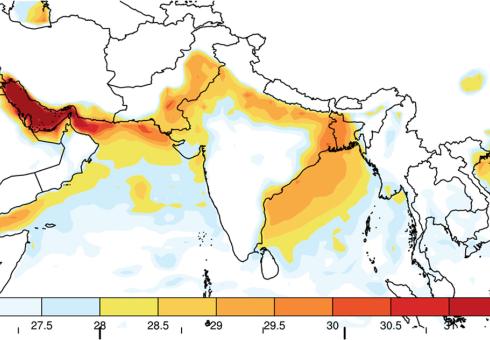
Without action, climate change could devastate a region home to one-fifth of humanity, study finds

Study finds ocean circulation, coupled with trade wind changes, efficiently limits shifting of tropical rainfall patterns

MIT Joint Program-affiliated professor of atmospheric chemistry honored for her contributions to atmospheric science

Boston Globe: Study is one of the first to examine how the warming climate could affect the availability and distribution of the water basins that farmers depend on for irrigation (Additional coverage: KJZZ, Environmental Leader)