
News & Media: Managed Resources


In The Media
The Economist
The largest hydroelectric project in Africa has so far produced only discord
The Economist
WHEN Egyptian politicians discussed sabotaging the Grand Ethiopian Renaissance Dam in 2013, they naturally assumed it was a private meeting. But amid all the scheming, and with a big chuckle, Muhammad Morsi, then president, informed his colleagues that their discussion was being broadcast live on a state-owned television channel.
Embarrassment apart, it was already no secret that Egypt wanted to stop the largest hydroelectric project in Africa. When Ethiopia completes construction of the dam in 2017, it will stand 170 metres tall (550 feet) and 1.8km (1.1 miles) wide. Its reservoir will be able to hold more than the volume of the entire Blue Nile, the tributary on which it sits (see map). And it will produce 6,000 megawatts of electricity, more than double Ethiopia’s current measly output, which leaves three out of four people in the dark...
EXCERPTS:
. . . A sense of mistrust hangs over the dam’s ultimate use. Ethiopia insists that it will produce only power and that the water pushing its turbines (less some evaporation during storage) will ultimately come out the other side. But Egypt fears it will also be used for irrigation, cutting downstream supply. Experts are sceptical. “It makes no technological or economic sense [for Ethiopia] to irrigate land with that water,” as it would involve pumping it back upstream, says Kenneth Strzepek of the Massachusetts Institute of Technology. . .
. . . How much water Sudan uses in the future, and other variables such as changes in rainfall and water quality, should determine how the dam is operated. That will require more co-operation and a willingness to compromise. Disagreement between Egypt and Sudan over such things as the definition of “significant harm” bodes ill. But all three countries will benefit if they work together, claims Mr Strzepek, citing the dam’s capacity to store water for use in drought years and its potential to produce cheap energy for export once transmission lines are built. . .
Read the article in The Economist.
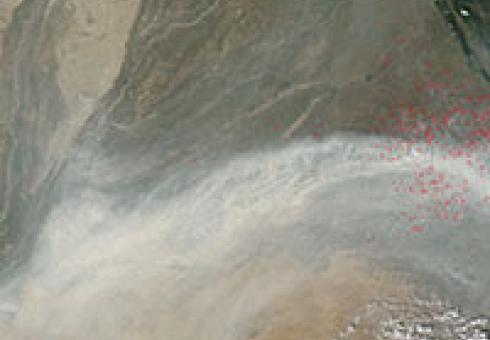
Photo: Landsat-7 satellite image of the bend in the Nile River and adjacent farmland (Photo courtesy of Jesse Allen, NASA)
Commentary
NY Times
MIT researchers explain how technical analysis can avoid potential conflict.
CAMBRIDGE, Mass. — On the Blue Nile in Ethiopia, construction is underway on a public works project of gigantic physical proportions and exquisite political delicacy. The Grand Ethiopian Renaissance Dam, now about halfway finished, amounts to a test: With water becoming precious enough to be the stuff of war, can nations find ways to share it?
So far, so good. The project is moving toward completion, and a recent joint declaration of principles by the leaders of Egypt, Ethiopia and Sudan pledges cooperation and no “significant” downstream harm. That is critical, given that the dam will control nearly two-thirds of the water on which Egypt depends. But for the cooperation to be meaningful, these three countries will need serious technical analysis. Poor assessment of such matters as the variability of annual rainfall or minimum flows required to maintain downstream water quality could undermine a decent agreement, leading to conflict of unpredictable intensity.
That’s because the flow of the Nile is climatic roulette. It experiences periods of plentiful water and periods of extended drought, and it always has: Remember the story (in both the Bible and the Quran) of seven years of plenty, and then seven lean years? But now the stakes are much higher: Egypt’s population is 90 million, and growing. That country’s Aswan High Dam, downstream from the Ethiopian dam, helps to moderate these fluctuations, but a second large dam and its reservoir higher upriver are going to complicate things.
Egypt now receives virtually all its water from the Nile — about 60 billion cubic meters a year, slightly above the amount provided for in its treaty agreement with Sudan. That amounts to the withdrawal of 700 cubic meters per capita per year. Compare that with California, which annually withdraws about 1,400 cubic meters per capita from multiple sources, including 30 percent of the Colorado River’s annual flow, and you understand just how scarce and precious the Nile’s water is to Egypt’s welfare.
California depends heavily on Lake Powell and Lake Mead, the reservoirs behind dams on the Colorado River, which together store slightly more than three years’ worth of that river’s total flow. The new dam in Ethiopia will have an even larger storage capacity than that of Powell and Mead combined, but still amounts to just 1.5 years of the flow of the Blue Nile alone. Adding in the very large reservoir behind Egypt’s Aswan High Dam gives a storage of about 1.75 years of the total flow of the Nile. It’s not a wide margin of safety for a long drought — as Californians will attest.
The monsoon rains in Ethiopia that will feed the new dam come mainly during just three months, so by storing that water, the new dam will moderate and smooth out the flow of the Blue Nile, the 900-mile-long headstream of the Nile itself. It will also generate huge amounts of electricity, the sale of which could finance much-needed development in Ethiopia — except that transmission lines to export the power are not yet being built.
Just as California has used stored water to become an agricultural powerhouse, Sudan will benefit by using the more stable flow of water from the new dam to raise its agricultural productivity. This will allow Sudan, which sits between Ethiopia and Egypt, to finally employ its full treaty allotment of river water, which in turn will reduce what is available to Egypt.
It’s clear that a cooperative agreement among Ethiopia, Sudan and Egypt is needed to avoid conflict and downstream harm. This includes agreement on what amounts to “significant” harm, given that, in the past, Egypt has been willing to go to war to protect its water.
All three countries stand to benefit if they work together. The dam’s huge storage capacity could help both Sudan and Egypt during drought years. And if Egypt were to agree to buy the power that the new dam will generate (and to build the transmission lines to connect to it, perhaps with international help), then Ethiopia will benefit economically from stored water that has to flow downstream eventually.
Here is where the technical issues will be critical. Last November, the Abdul Latif Jameel World Water and Food Security Lab at M.I.T. convened experts on Nile Basin water resources. They pointed out that management of a river system with multiple dams required sophisticated joint management with a shared knowledge base and scientific modeling framework. The hard negotiations ahead to achieve detailed agreements on such things as reservoir operation policy, power trading, dam safety and irrigation practices will require that foreign policy and water experts from each of the three countries have a shared understanding of the technical issues and a willingness to compromise.
In May 2015, the three countries engaged technical consultants to assist with these problems, but that arrangement has since collapsed over disagreements about project management. It behooves the international community to help, through support of regional efforts like the Nile Basin Initiative, to build scientific and engineering coordination and knowledge among the three countries, provide impartial expertise, set up a management system and perhaps offer a process to resolve disputes.
The world needs to get good at sharing water, and right away. The alternative is frequent regional conflicts of unknowable proportions.
John H. Lienhard V is a professor at M.I.T. and director of the Abdul Latif Jameel World Water and Food Security Lab. Kenneth M. Strzepek is a research scientist at the M.I.T. Joint Program on the Science and Policy of Global Change.
Around Campus
MIT News
A new study describes how irrigation development modifies local and regional climate.
Kelsey Damrad | Department of Civil and Environmental Engineering
With approximately 70 percent of all freshwater consumption worldwide used for agriculture, the reliance on large-scale irrigation development continues to spread and ultimately augments crop yields in many regions.
But the ongoing expansion of cropland irrigation, just as with any human-made land-cover change, holds potential for unintended consequences. The consequences of such human activity should be well understood before being implemented.
In a new paper, an MIT team in the department of Civil and Environmental Engineering (CEE) investigates the impacts of large-scale cropland irrigation on rainfall patterns in the East African Sahel around the Gezira Irrigation Scheme, now considered one of the largest irrigation projects in the world. The researchers piloted their exploration by combining theoretical modeling analyses with observational evidence gathered over several decades since 1930 — an unprecedented approach in previous studies.
The CEE team studied 60 years' worth of data of rainfall, temperature, and river flow to empirically deduce the atmospheric impacts of irrigation development.
"Large-scale development of irrigation systems is a good example of human activity that has changed land cover and the environment significantly in many regions of the world,” says co-author Professor Elfatih Eltahir, associate department head of CEE. “In all development projects, we need to better understand the potential impacts of our actions on the environment before we mindlessly develop.”
According to the theory developed by the researchers based on their investigation, when a large area is irrigated, surface air temperature is cooled and surface pressure increased. This reaction was conjectured to reduce rainfall over the irrigated land while generating a clockwise circulation that interacts with the prevailing regional wind. Depending on that interaction, the theory predicts that specific areas of convergence would be created, which would boost the rainfall in some of the surrounding areas.
After the researchers concluded their deep analysis of regional climate data, they concurred that large-scale irrigation development in the East African Sahel has consistently enhanced rainfall in areas to the east of the irrigated lands, while reducing rainfall directly over them.
Spatially and over time, the changes in rainfall and temperature matched up in a way that exceeded the group’s expectations and almost perfectly aligned with the original theory, says co-first author of the paper and CEE postdoc Ross Alter.
"You don’t often achieve that type of clear-cut match when attributing regional climate change from both theory and observations,” Alter says.
The team’s findings, says Eltahir, are indicative of the need for further consideration of potential agricultural, hydrological, and economic repercussions from irrigation expansion.
The paper was published today in the journal Nature Geoscience, by Alter, co-first author Eun-Soon Im of the Singapore-MIT Alliance for Research and Technology (SMART), and Eltahir.
Quantifying impacts
To define a climate, one must consider a breadth of at least 30 years' worth of data. Therefore, the team studied records gathered from 1930 to 1999, with a 10-year gap for irrigation system erection, in order to quantify the environmental impacts of irrigation.
The study’s first step was to employ a complementary analysis of numerical simulations and modeling. Using a sophisticated regional climate model — developed in the Eltahir group over the past 25 years, and which represents conditions in the atmosphere as well as over land — the authors conducted simulations using both irrigated and non-irrigated settings.
Their objective, in this regard, was to enumerate the effects of the irrigated land in the Gezira Scheme on the rainfall in a theoretical sense. The researchers then verified their conjectures by comparing with real occurrences observed throughout the 60-year span of time.
When the research team cross-compared their simulations to the collected empirical evidence, the mapped depictions of the changes in rainfall from pre- to post-irrigation expansion revealed strong decreases over the Gezira Scheme and distinct increases in eastern lands. The effects of enhanced rainfall are particularly apparent in Gedaref — a region east of Gezira. For the past half-century, concurrent with the irrigation expansion in the Gezira Scheme, Gedaref has received plenty of rainfall and has emerged as a successful rain-fed agricultural region.
This climate behavior is a stark contrast to the ongoing drought experienced by the majority of the African Sahel.
To pinpoint the impacts of irrigation on climate, it is important to identify areas of relative change, not absolute change,” Alter explains. “Because rainfall in that region strongly decreased overall, any larger changes in rainfall — even zero change between the two periods in question — would still be seen as increases.” Stable rainfall, in this case, is still better in comparison to the lands experiencing droughts.
Optimizing efficiency
Though the researchers acknowledge irrigation as an ideal solution to agricultural challenges, all agree that comprehension of human-made land-cover change and its influence on the natural environment is necessary for sustainable development.
“The knowledge gained from this study provides a more fundamental understanding of the impacts of land use and land cover changes on the atmosphere,” Alter says.
The researchers specify that their study does not take into account other possible processes than irrigation development that disturb the climate such as changes in the chemical composition of the atmosphere and the resulting global climate change.
Now with an established spectrum of probable impacts from significant irrigation development, the researchers suggest that this new knowledge about the impacts of land cover change on the climate system should help in achieving more rigorous attribution of the regional and local impacts of global climate change.
“While there are many studies that show landscape has such effects, the use of real-world observed data makes this a particularly important research contribution,” says Roger Pielke Sr., a senior research scientist of the University of Colorado not involved in this study. “Irrigated landscapes worldwide, indeed all human modified landscapes, based on the Alter et al. study, should be expected to play a major role in local and regional weather and climate. This human effect on the climate system has been underestimated in past assessments of climate change. The Alter et al. paper is a very significant contribution in expanding our understanding of the human role on the climate system."
“There is undoubtedly a pressing need for large-scale irrigation in Africa and other regions,” Eltahir says. “We now have a foundation of the likely impacts of human-induced land-cover changes, and can use this new knowledge in the design stage of irrigation systems as opposed to after the fact.”
Funding for this research was provided by the Cooperative Agreement between the Masdar Institute and MIT, and by the Singapore-MIT Alliance for Research and Technology.
In The Media
Study finds many species may die out and others may migrate significantly as ocean acidification intensifies.
by Jennifer Chu | MIT News Office
Oceans have absorbed up to 30 percent of human-made carbon dioxide around the world, storing dissolved carbon for hundreds of years. As the uptake of carbon dioxide has increased in the last century, so has the acidity of oceans worldwide. Since pre-industrial times, the pH of the oceans has dropped from an average of 8.2 to 8.1 today. Projections of climate change estimate that by the year 2100, this number will drop further, to around 7.8 — significantly lower than any levels seen in open ocean marine communities today.
Now a team of researchers from MIT, the University of Alabama, and elsewhere has found that such increased ocean acidification will dramatically affect global populations of phytoplankton — microorganisms on the ocean surface that make up the base of the marine food chain.
In a study published today in the journal Nature Climate Change, the researchers report that increased ocean acidification by 2100 will spur a range of responses in phytoplankton: Some species will die out, while others will flourish, changing the balance of plankton species around the world.
The researchers also compared phytoplankton’s response not only to ocean acidification, but also to other projected drivers of climate change, such as warming temperatures and lower nutrient supplies. For instance, the team used a numerical model to see how phytoplankton as a whole will migrate significantly, with most populations shifting toward the poles as the planet warms. Based on global simulations, however, they found the most dramatic effects stemmed from ocean acidification.
Stephanie Dutkiewicz, a principal research scientist in MIT’s Center for Global Change Science, says that while scientists have suspected ocean acidification might affect marine populations, the group’s results suggest a much larger upheaval of phytoplankton — and therefore probably the species that feed on them — than previously estimated.
“I’ve always been a total believer in climate change, and I try not to be an alarmist, because it’s not good for anyone,” says Dutkiewicz, who is the paper’s lead author. “But I was actually quite shocked by the results. The fact that there are so many different possible changes, that different phytoplankton respond differently, means there might be some quite traumatic changes in the communities over the course of the 21st century. A whole rearrangement of the communities means something to both the food web further up, but also for things like cycling of carbon.”
The paper’s co-authors include Mick Follows, an associate professor in MIT’s Department of Earth, Atmospheric and Planetary Sciences.
Winners and losers
To get a sense for how individual species of phytoplankton react to a more acidic environment, the team performed a meta-analysis, compiling data from 49 papers in which others have studied how single species grow at lower pH levels. Such experiments typically involve placing organisms in a flask and recording their biomass in solutions of varying acidity.
In all, the papers examined 154 experiments of phytoplankton. The researchers divided the species into six general, functional groups, including diatoms, Prochlorococcus, and coccolithophores, then charted the growth rates under more acidic conditions. They found a whole range of responses to increasing acidity, even within functional groups, with some “winners” that grew faster than normal, while other “losers” died out.
The experimental data largely reflected individual species’ response in a controlled laboratory environment. The researchers then worked the experimental data into a global ocean circulation model to see how multiple species, competing with each other, responded to rising acidity levels.
The researchers paired MIT’s global circulation model — which simulates physical phenomena such as ocean currents, temperatures, and salinity — with an ecosystem model that simulates the behavior of 96 species of phytoplankton. As with the experimental data, the researchers grouped the 96 species into six functional groups, then assigned each group a range of responses to ocean acidification, based on the ranges observed in the experiments.
Natural competition off balance
After running the global simulation several times with different combinations of responses for the 96 species, the researchers observed that as ocean acidification prompted some species to grow faster, and others slower, it also changed the natural competition between species.
“Normally, over evolutionary time, things come to a stable point where multiple species can live together,” Dutkiewicz says. “But if one of them gets a boost, even though the other might get a boost, but not as big, it might get outcompeted. So you might get whole species just disappearing because responses are slightly different.”
Dutkiewicz says shifting competition at the plankton level may have big ramifications further up in the food chain.
“Generally, a polar bear eats things that start feeding on a diatom, and is probably not fed by something that feeds on Prochlorococcus, for example,” Dutkiewicz says. “The whole food chain is going to be different.”
By 2100, the local composition of the oceans may also look very different due to warming water: The model predicts that many phytoplankton species will move toward the poles. That means that in New England, for instance, marine communities may look very different in the next century.
“If you went to Boston Harbor and pulled up a cup of water and looked under a microscope, you’d see very different species later on,” Dutkiewicz says. “By 2100, you’d see ones that were living maybe closer to North Carolina now, up near Boston.”
Dutkiewicz says the model gives a broad-brush picture of how ocean acidification may change the marine world. To get a more accurate picture, she says, more experiments are needed, involving multiple species to encourage competition in a natural environment.
“Bottom line is, we need to know how competition is important as oceans become more acidic,” she says.
This research was funded in part by the National Science Foundation, and the Gordon and Betty Moore Foundation.
In The Media
MIT Spectrum interviews MIT alumnus Kenneth Strzepek, who led a nonpartisan panel of 17 experts to investigate the international water debate between Egypt and Ethiopia in the hopes of forging a common solution.
For millennia, Egypt has relied on the Nile River for its agriculture. So Egyptians were understandably upset in 2011 when their upstream neighbor, Ethiopia, announced plans to build a hydroelectric dam that threatened to reduce the flow out of the spigot: the Grand Ethiopian Renaissance Dam (GERD), sited along a major tributary that contributes most of the water flowing into the Nile. Two years ago, then prime minister Mohammed Morsi even threatened to go to war.
In an effort to break the stalemate, Kenneth Strzepek ’75, SM ’77, PhD ’80 led a nonpartisan panel of 17 experts convened last November through MIT’s new Abdul Latif Jameel World Water and Food Security Lab (J-WAFS) to investigate the issue and forge a common solution. MIT Spectrum spoke this spring with the alumnus—who is currently a research scientist with the MIT Joint Program on the Science and Policy of Global Change and the MIT Center for Global Change Science—about the “great moral dilemma” at the heart of the conflict, and the value of objective advice.
What is your background on water issues in the Nile Basin?
I did my PhD at MIT on water issues in Egypt. For the last 10 years, I’ve been working with the World Bank on the Nile Basin Initiative to come up with a comprehensive framework agreement between all the sovereign states in the region on how to manage the Nile.
What is it that draws you to work on water issues?
Water is such a metaphor for life. At one point, I thought I might go into the ministry. When I went to Africa as an MIT sophomore, I saw the great impact of water on people’s lives, and I realized water resources development was a way I could integrate my faith with my profession by providing physical water as well as spiritual water to people.
What are the roots of the conflict between Egypt and Ethiopia?
Rather than one principle on allocating water across boundaries, the UN has two principles—that all people should have equal access to water within their boundaries, and also that there should be no harm to anybody who is currently developed downstream. Egypt has been using all of this water for thousands of years; if anyone upstream uses some of it, that violates the “do no harm” principle. On the other hand, if 75% of their water comes from Ethiopia, how is it equitable that [Ethiopia] can’t take a drop? So we have this great moral dilemma.
What were the major questions you discussed?
When this dam is completed and filled, it is going to lead to some additional evaporation, and less water going to Egypt, though some suggest that joint operation of the GERD and the Egyptian Aswan High Dam (AHD) could reduce total losses. Could the impact of water loss on Egypt’s economy be offset by Ethiopia selling some of the GERD’s low-cost, clean electricity to Egypt so there would be benefits to both countries? We also knew that since the capacity of the dam is greater than the annual flow of the river, the issue of filling the dam was critical—if Ethiopia started filling the dam and there was a drought, could they stand to wait for years before resuming?
What kind of debates did you have among the members on your panel?
Most of the conclusions were quite universal. When you are not party to a debate, it’s not as impassioned for you. None of us have that history of distrust that the governments have. When Egypt says “We’ve been using that water for 10,000 years,” Ethiopians will say, “Yeah, our water!” Most of us saw that if this was all one country, there would still be upstream-downstream debates, but you could work out a win-win solution.
What are some of the recommendations you made?
The first conclusion is the need to manage the dam cooperatively with the AHD in Egypt. No river with two reservoirs of such size without a plan to operate them in concert will benefit both parties. Not to manage them cooperatively would be a recipe for disaster. Secondly, the dam is going to produce a lot of electricity, but right now there is no sales agreement or connection to export it out of Ethiopia. There needs to be a power plan in place to bring electricity to users or Ethiopia will have no incentive to let water out of the dam through its turbines so it can reach Egypt.
How have the countries responded to the report?
Both Egypt and Ethiopia have commented on the report, and although they expressed some reservations, a week after we presented it, the countries signed a declaration of principles, which is basically an agreement to agree. We can’t know how much impact our report had on that decision, but it was in their hands when they signed the agreement. They are still far away from agreeing to the specific plan to operate the GERD, but the report and follow-up discussions in Cairo and Addis Ababa have outlined a process to facilitate the technical steps towards developing such a plan.
What do you think your report achieved?
A nonpartisan, world-class, international group convened by MIT and including a number of MIT experts has outlined the technical issues facing Ethiopia, Sudan, and Egypt, and has helped put a boundary to negotiations among the countries. We wanted to make this public so there would be some sound technical information out there as they continue their negotiations. We have offered an objective assessment of the current situation and built connections among key water decision makers involved in the basin. I am very proud of what MIT and J-WAFS did; I pray this activity has and will continue to reduce conflict in the region.
Read more about the Grand Ethopian Renaissance Dam report at MIT News.