News & Media: Managed Resources

Around Campus
MIT News

This spring, a five-day MIT Professional Education course — Agriculture, Innovation and the Environment — showcased innovative technologies and strategies to make the agriculture industry more productive, and attracted a score of professionals from all over the world.

 

In The News
The Straits Times

A new study in Journal of Climate shows that burning coal could result in less rainfall and raise water stress in some countries - especially in developing Asia.

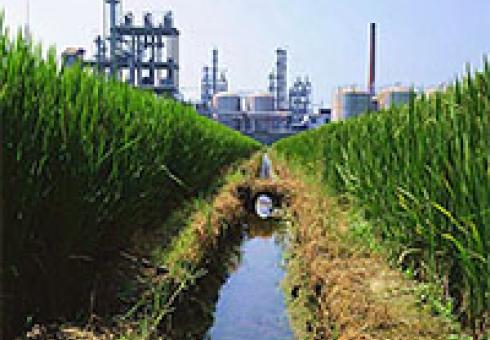
The warming effects of burning coal are well known, and studies have shown that using the dirtiest fossil fuel around can cause cooling, too. This is not good news, though. A new study, by Singapore scientists, shows that the cooling could result in less rainfall and raise water stress in some countries - especially in developing Asia - where the use of coal looks set to rise.

In The News
MIT Spectrum

Modeling the diverse world of phytoplankton opens up a predictive view of our own

mit-bwcampaign-spotlight.jpg
Around Campus
MIT News

Comprehensive fundraising initiative aims to raise $5 billion to advance Institute's work on some of the world's biggest challenges

MIT President L. Rafael Reif today announced the official launch of the MIT Campaign for a Better World, a comprehensive fundraising initiative that will amplify the Institute's distinctive strength in education, research, and innovation, and will advance MIT’s work on some of the world's biggest challenges.

MIT has a history of discovery, knowledge creation, and innovation. Through the MIT Campaign for a Better World, MIT aims to extend that track record, raising $5 billion in support of efforts that, as announced by Reif, will enable a future where fundamental science unlocks new knowledge; where climate change yields to climate action; where clean energy is universal; where everyone can count on clean water and nourishing food; where we detect disease before it has symptoms; where Alzheimer's itself is just a memory; where good ideas don’t languish in the lab but flourish in the marketplace; where daring companies create thriving industries and achieve lasting progress; where prosperity is measured not in dollars alone but in the currency of art, culture, and understanding; where quality education is radically more available; and where we offer the world's undiscovered talent a digital path to a creative future.

To ensure that MIT continues to attract a community of exceptionally talented students and faculty, and provides the infrastructure their pioneering work demands, the Campaign is also committed to strengthening the Institute's core — increasing resources for undergraduate financial aid, graduate fellowships, and professorships; reimagining residential living and educational spaces; and developing innovative research facilities such as MIT.nano.

"Humanity faces urgent challenges — challenges whose solutions depend on marrying advanced technical and scientific capabilities with a deep understanding of the world's political, cultural, and economic complexities," Reif said.

"We launch the Campaign for a Better World to rise to those challenges and accelerate positive change. In this effort, we seek the support of enthusiastic partners who share our sense of mission and infinite possibility — including our remarkable alumni, who do the great work of MIT in the world every day," he continued. "Together, through this Campaign, we will give the brilliant minds and hands of the MIT community the fuel and the focus to make inspiring progress for the world."

The Campaign is guided by six priority areas that span the full breadth of MIT:

  • Discovery Science: Transforming our world through fundamental scientific research
  • Health of the Planet: Addressing critical environmental and sustainability challenges facing humankind through science, technology, design, management, and policy
  • Human Health: Defining the future of health through advances in basic science and engineering — informed by expertise in disciplines such as management, economics, and political science
  • Innovation and Entrepreneurship: Accelerating the path from idea to impact
  • Teaching, Learning, and Living: Reimagining education for the 21st-century learner
  • The MIT Core: Attracting extraordinary students and faculty, and providing them with the resources they need to thrive

"The MIT Campaign for a Better World represents an important and historic undertaking," said Julie A. Lucas, MIT's vice president for resource development. "Its priorities transcend disciplines and reflect the breadth and depth of the Institute's commitment to bringing real change to the world. This is an extraordinary moment in the life of MIT."

As of the end of the first quarter of 2016, MIT has raised over $2.6 billion toward the Campaign goal, with gifts coming from more than 77,000 alumni and friends. The Institute's most recent comprehensive fundraising campaign ran from 1997 to 2004.

"This Campaign will have far-reaching positive implications for the world at large," said Robert B. Millard '73, chair of the MIT Corporation. "It is an opportunity to re-inspire, reenergize, and recommit the MIT community to our shared vision and values, while amplifying the power of our students, faculty, and staff to shape the future by providing them with the resources they need to do their best work.”

For more information on the MIT Campaign for a Better World, visit betterworld.mit.edu and follow #MITBetterWorld

Joint Program research highlighted in the MIT Campaign for a Better World:

https://betterworld.mit.edu/better-climate-predictions-more-resilient-agriculture/

https://betterworld.mit.edu/the-nature-of-hurricanes/

https://betterworld.mit.edu/true-costs-energy-policy/

https://betterworld.mit.edu/the-oceanclimate-connection/

http://mitsloan.mit.edu/campaign/mit-sloan-campaign-priorities/health-of-the-planet/

Video

A new study points to the risk that China and India will be facing severe water shortages by 2050 due to a perfect storm of economic growth, climate change, and fast growing populations. Joint Program Deputy Director Adam Schlosser comments on the future of water stress in Asia.

In The News
CLP New Horizons

Joint Program Co-Director John Reilly featured in CLP New Horizons

The following article appeared in CLP New Horizons, a compendium of news and perspectives on how to move the Asia-Pacific region toward a more sustainable energy future:

John Reilly | MIT Joint Program on the Science and Policy of Global Change

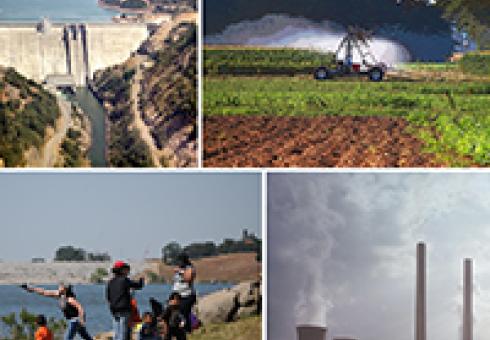
We live in a world where water, energy, land and the environment are inextricably linked. For example, water is used to produce electricity from hydropower as well as for thermal cooling. Water withdrawals for agriculture—the world’s largest consumer of water—deplete rivers and streams, thereby impacting freshwater ecosystems. Such ecosystems are also threatened by the discharge of water from power stations, which increases water temperature, and by the collection of water in large dams.  

Dams not only produce hydropower but also store water from spring snowmelt or rainy seasons for use in irrigation during dry spells, and provide recreational opportunities as well. Use of water for hydropower, irrigation and recreation requires a careful balance. The availability of water for irrigation will partly determine land use, and how land is managed can affect runoff and sedimentation in reservoirs and other bodies of water, potentially degrading water quality and ecosystems.

Other energy, industry and domestic uses of water can be substantial in areas where water resources are limited. For example, there’s concern that development of China’s shale gas resources, located in dryer western regions of China, could be constrained by water availability.
 

Global changes

In Asia, population growth and economic development are increasing demand for water, food and energy, exacerbating conflicts among land, water and energy needs. In addition, climate change is expected to significantly affect agricultural productivity worldwide and alter the supply of water. While global warming will, in general, speed the hydrological cycle and lead to more precipitation, rainfall will be unevenly spread across the globe, and many currently water-stressed areas will become more stressed.

Efforts to reduce greenhouse gas emissions will change the energy mix, and if renewable sources like wind and solar become more widely used, smaller water withdrawals will be needed for thermal cooling. On the other hand, if biomass energy is part of the mitigation solution, that could increase pressure on land and indirectly on water in order to increase food crop yields.

Rising concerns for fresh water ecosystems may lead to restrictions on the amount of water withdrawn from rivers and lakes. Many areas are already considered overused. In addition, areas relying on groundwater resources may become unsustainable. 


Building a more sustainable future

Businesses can take a number of steps to build a more sustainable future. First, by reducing greenhouse gas (GHG) emissions—ideally supported by government incentives—they can limit the amount of climate change in the coming decades. Second, they can adopt practices that improve water use efficiency and maintain water quality. Third, they can take climate change into consideration when planning the location of new facilities, while noting the uncertainties in climate models.

Our recent research indicates that water stress will increase in China and India. In China, climate change and growth are expected to exacerbate water stress; in India, climate change is projected to have a neutral effect on water supplies, although growth will likely increase water stress. In mainland Southeast Asia, climate change is expected to increase water supplies, partly offsetting the impact of growth.

In all regions, the range of possibilities are far wider than the historical variability in water resources. This highlights the difficulty involved in facilities planning.


References

Modeling U.S. water resources under climate change  Blanc, É., K. Strzepek, A. Schlosser, H. Jacoby, A. Gueneau, C. Fant, S. Rausch and J. Reilly, Earth's Future, 2(4): 197–224 (doi:10.1002/2013EF000214), 2014

Climate change impacts and greenhouse gas mitigation effects on U.S. water quality  Boehlert, B., K.M. Strzepek, S.C. Chapra, C. Fant, Y. Gebretsadik, M. Lickley, R. Swanson, A. McCluskey, J.E. Neumann and J. Martinich, Journal of Advances in Modeling Earth Systems, 7(3): 1326–1338, 2015

Impacts on Resources and Climate of Projected Economic and Population Growth Patterns  Reilly, J. , The Bridge (National Academy of Engineering), 45(2): 6–15, 2015

The future of global water stress: An integrated assessment  Schlosser, C.A., K. Strzepek, X. Gao, C. Fant, É. Blanc, S. Paltsev, H. Jacoby, J. Reilly and A. Gueneau, Earth's Future, 2(8): 341-361 (doi:10.1002/2014EF000238), 2014

A Framework for Analysis of the Uncertainty of Socioeconomic Growth and Climate Change on the Risk of Water Stress: a Case Study in Asia  Fant, C., C.A. Schlosser, X. Gao, K. Strzepek and J. Reilly, Joint Program Report Series, 48 p., 2014

Video

Evaluation of land resources by the U.N.’s Food and Agriculture Organization suggest availability of arable land itself is not a major constraint on food production at least through mid-century, assuming continued yield improvements. There are, however, some wild cards that could vastly impact agriculture in the coming decades.