
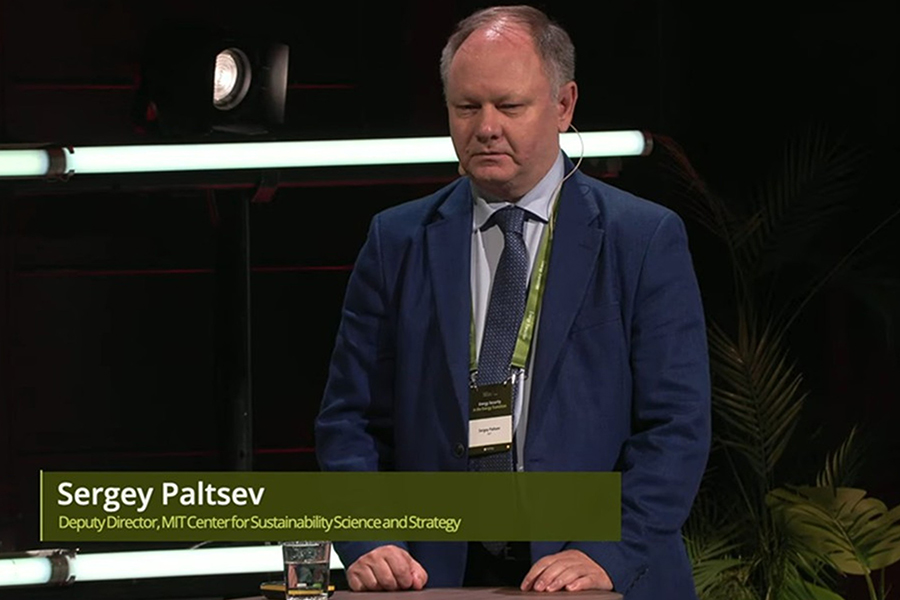
MIT CS3 Deputy Director Sergey Paltsev (Source: NTNU)
From vulnerability to resilience
At Norwegian conference, MIT CS3 Deputy Director Sergey Paltsev explores viable pathways to a more sustainable energy future
https://www.youtube.com/watch?v=NESl3BcI53IAs decision-makers around the world seek strategies for creating more resilient energy systems, they must overcome several physical, financial, geopolitical and technological challenges. To that end, The Norwegian University of Science and Technology’s (NTNU) 10th annual Energy Transition Conference convened representatives from industry, government, academia and NGOs to share their expertise on energy security during the energy transition.
On March 18, MIT Center for Sustainability Science and Strategy (CS3) Deputy Director/MIT Energy Initiative Senior Research Scientist Sergey Paltsev participated in a session on enhancing the resiliency of societies to multiple threats ranging from extreme weather events to cyberattacks. Drawing upon CS3 modeling tools and expertise, Paltsev stressed that building a resilient future involves a strategic integration of local actions with robust transition pathways that achieve regional and global outcomes. Such integration empowers local entrepreneurs and communities with a solid foundation for the development of new methods, products and services. An important aspect for creating an energy sustainability strategy lies in developing a conversion path from a traditional consumption-oriented “linear” economy to a “circular” economy that is designed to keep resources in use for as long as possible and includes technological, institutional, cultural, nature-based and market dimensions.
Watch the video here (Paltsev’s remarks start at 5:13:50).