
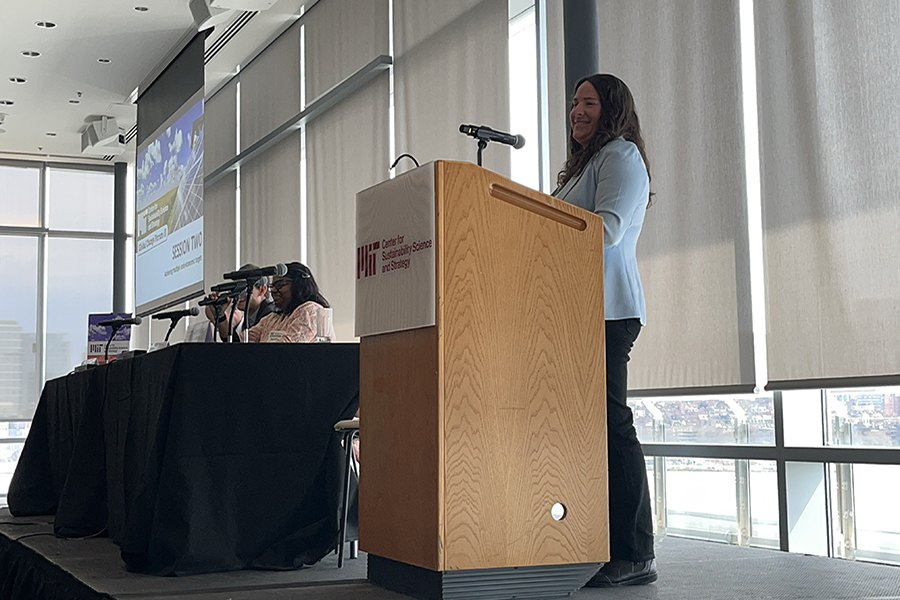
Jennifer Morris moderating a panel at the 48th Global Change Forum in March 2026 (Photo by Jamie Bartholomay)
Researcher Profile: 3 Questions with Jennifer Morris
MIT CS3 and MITEI Principal Research Scientist describes her career path and its potential impact
MIT Center for Sustainability Science and Strategy (CS3) and MITEI Principal Research Scientist Jennifer Morris’s research focuses on energy-economic modeling and linkages between human and natural systems to explore multi-sector feedbacks and implications of different development, decarbonization and investment pathways. She also focuses on uncertainty, risk analysis and decision-making in energy and environmental systems.
Can you highlight your work at MIT?
Most of what I do uses energy-economic modeling to explore different potential futures—different energy transition pathways, development pathways, and scenarios for the future. Some of that work is more narrowly focused on specific technologies, such as the potential for bioenergy with carbon capture and storage to play a major role under different potential future scenarios, or for different advanced steelmaking technologies to be deployed at scale. A lot of other work that I do, known as multi-sector dynamics, is at the intersection of natural and societal systems such as energy, land, water and climate, and how they interact. Scenarios are really critical in that space not only as a tool to explore potential futures, but also to understand the processes, connections and feedbacks between these different pieces. A third element that underlies a lot of my work is the uncertainty associated with the assumptions we make in modeling natural and societal systems. Rigorously quantifying that uncertainty as part of the modeling process helps give us insights about the likelihood of our projections, which, in turn, can be used to help inform decisions.
How did you become interested in energy-economic modeling, multi-sector dynamics and uncertainty?
I came to MIT’s Technology and Policy Program (TPP) with an undergraduate degree in public policy, and with the goal of learning more about the quantitative tools and approaches used in research that could inform policy. Inspired by a love of nature sparked by family camping experiences, and a recognition of how critical energy decisions are to the health of the planet, I focused on energy and environmental policy. While my original intent was to work for a policy organization after graduation, I discovered that I loved doing research, which I saw as another avenue to influence policy and decision-making, and I went on to pursue a PhD in MIT’s Engineering Systems Division (now IDSS) to advance my research skills. As a graduate student and as a research assistant with the Joint Program on the Science and Policy of Global Change, I had the opportunity to contribute to the analysis behind multiple proposed U.S. Congress climate bills. This involved using the EPPA (Economic Projection and Policy Analysis) model to run scenarios of what different proposed policies would mean for the U.S. economy. That solidified my passion for how this type of research and exploration of different potential futures could provide useful information about real policy and investment decisions.
How might your research enhance human well-being?
What I'm really excited about is to help push the frontier on what's been called integrated assessment modeling (IAM). IAM has historically focused on key outcomes such as GDP, emissions and climate, but over time has evolved to consider other things such as water and land, and could expand further to encompass a broader range of outcomes that humans care about, from jobs to equity to energy affordability. Different transition pathways will have very different implications for those outcomes; I'm interested in mapping out tradeoffs and synergies for different future pathways of transition, to try to identify spaces where we can achieve positive outcomes across these different dimensions that we care about. This requires: multi-sector dynamics-type modeling, which can bring in feedbacks and interactions among different natural and societal systems and scales; capturing uncertainty, to provide a robust decision-making context informed by a wide variety of potential future scenarios of how things might unfold; and modeling advances such as fast, simplified emulators, because all of this is computationally very intensive. The main goal is to help inform near-term decisions, because the decisions that we make today—such as the energy technologies we invest in and the policies we implement—will affect things well into the future. The kind of IAM framework I envision would be modular and flexible, enabling users to focus on different regions, topics and research questions. Ideally, it could be used to help ensure that the decisions and investments that we make today are as robust as possible across different potential futures and objectives.