
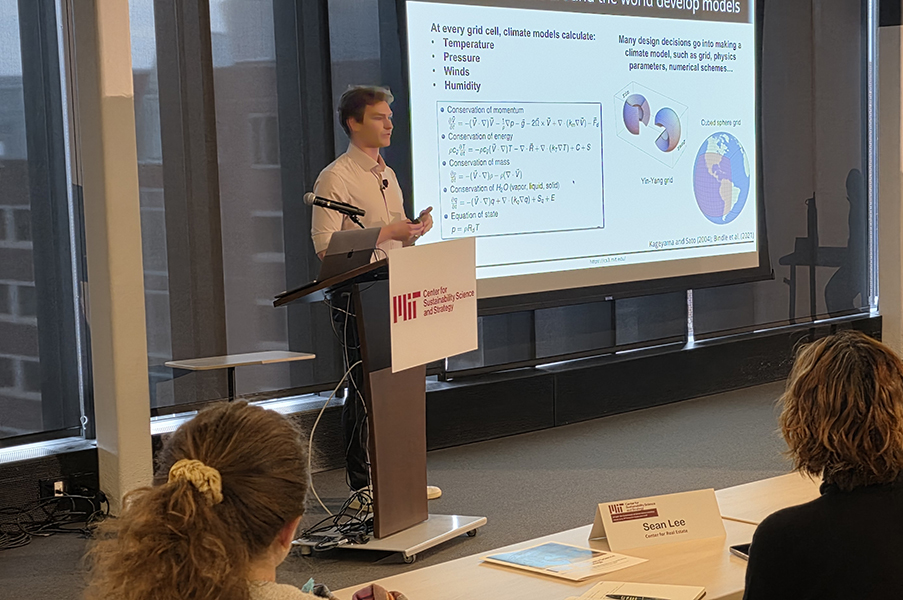
Chris Womack delivering a presentation on climate modeling for the MIT Independent Activities Period (IAP 2026) lecture series, Fundamentals of Climate Science and Policy, held in January 2026. (Photo by Dimonika Bray)
Researcher Profile: 3 Questions with Chris Womack
MIT CS3 PhD student describes his career path and its potential impact
MIT Center for Sustainability Science and Strategy (CS3) PhD student Chris Womack, a doctoral candidate in Aerospace Computational Engineering at the MIT Department of Aeronautics and Astronautics, studies efficient computational methods for emulating climate models, focusing on bridging the gap between basic and applied research. He is interested in improving numerical methods for climate simulations while focusing on the interface between research and policy-making, investigating how different stakeholders influence model development. At MIT he has earned a BS and SM in Aerospace Engineering with a focus on numerical methods for partial differential equations, and an SM in Technology and Policy.
How did you become interested in computational methods for emulating climate models?
When I was about five years old, my parents took me to an air show, and I got to see an F-22 raptor perform a sneak pass over the parking lot; it felt like being punched in the chest! Witnessing that was unlike anything I'd ever experienced, and I wanted to figure out how I could be around these machines. Conversations with my parents and other mentors, including my older brother who became a fighter pilot, set me on an aerospace career path. At the same time, I really enjoyed math and science. In middle school I participated in a math team, and in high school I took part in an engineering program. As an undergraduate aerospace engineering major at MIT, I completed three summer internships focused on everything from satellites to computer chips.
While I found aerospace applications interesting, I realized I was much more drawn to the math and physics that underpinned those applications. In my junior year I discovered computational science and engineering, which introduced a new set of problems such as how we teach a computer to do math or simulate a physical system. To explore this field more deeply, I pursued a PhD in Aerospace Computational Engineering in the MIT AeroAstro Department; and to better understand the potential impact of my research on people and decision-making, I simultaneously pursued a master’s degree in MIT’s Technology and Policy Program. That’s how I connected with Prof. Selin and ended up joining CS3.
Can you highlight your work at MIT?
First, I am one of just a few graduate students to contribute to the Bringing Computation to the Climate Challenge (BC3) project, which aims to democratize access to climate data. Having access to a room full of principal investigators and postdocs on a weekly basis has really supercharged my PhD experience and research skillset. As part of this work, I have helped contribute to a partnership between BC3 and Climate Interactive to integrate one of our very fast climate emulators into a new map in the En-ROADS simulator that displays temperature change by location.
I have also led what may be the first concerted effort to compare climate emulator methods across a common theoretical framework. Building on that study, I am now working on understanding the best ways to build these emulators so that they are accurate and reliable. The choice of dataset used to train a climate emulator plays a major role in determining its efficacy. Rather than simply assessing which training data sets produce the best results, I developed a completely new machine learning method to directly create optimal training datasets that can significantly increase the skill of these emulators.
How might your research enhance human well-being?
In collaboration with CS3, the BC3 team has advanced a new generation of models that produce very accurate, reliable projections at a fraction of the computational cost of traditional methods. The systems we're developing give communities in the U.S. and abroad the ability to visualize, in real time, how potential future climate scenarios could impact them. Using BC3’s free, open-source models, they can perform their own climate assessments in a way that wasn't possible even just a couple years ago. In addition, my work on comparing different climate emulators could lead to better understanding of, for example, what data sets are the best ones for training these models, thereby improving the efficiency, accuracy and reliability of projections used by decision-makers. Because this work is interdisciplinary, linking communities that otherwise wouldn't have interacted, it could yield new scientific developments that otherwise wouldn't have emerged.