
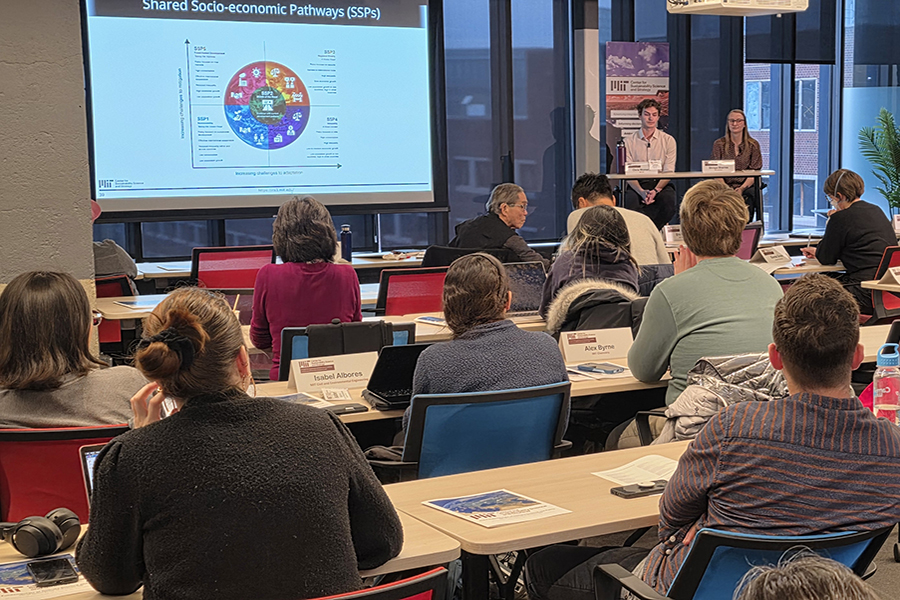
Chris Womack (AeroAstro, CS3) and Lexia Cicone (EAPS, CS3) fielding questions from MIT students during the MIT Independent Activities Period (IAP 2026) lecture series, Fundamentals of Climate Science and Policy. (Photo by Dimonika Bray)
MIT CS3 students and postdocs present IAP 2026 lecture series on climate science and policy
Series provides overview of the Earth’s climate system, its societal impacts, and efforts to minimize those impacts
On January 13-15 at MIT’s Innovation Headquarters building, MIT Center for Sustainability Science and Strategy (CS3)-affiliated students and postdocs presented an MIT Independent Activities Period (IAP 2026) lecture series, Fundamentals of Climate Science and Policy. The series focused on the science of climate change and policies aimed at stabilizing the global climate.
Climate Science 101 introduced the components of our climate system, how they interact, and what causes the climate system to change over time. Presenters explained the concept of energy balance and how it relates to a planet’s temperature, described the key components of Earth’s atmosphere and their roles in the climate system, and identified potential sources of internal variability in the climate system. Climate Science 102 explored the major impacts of climate change, the physical mechanisms that cause them, and associated social and economic costs; the key components of climate models and the processes they represent; and major sources of uncertainty in climate projections and how these uncertainties influence climate-related policy decisions.
Climate Policy 101 introduced climate policy and concepts such as externalities, public goods, and emissions trading schemes, and economic theory for climate change. Presenters showed how environmental policy and economics can be integrated through resource demand reduction, climate adaptation and mitigation, carbon dioxide removal, and geoengineering. Climate Policy 102 explored multiple examples of environmental policies around the world and their effectiveness, including carbon taxes, emissions trading systems, carbon border adjustment mechanisms and clean energy subsidies.
Climate Science and Policy in Action featured an interactive demonstration of concepts from the above sessions, highlighting challenges and opportunities for climate mitigation and adaptation. Attendees participated in a game illustrating how a simplified emissions trading system might function at the farm level in an economy consisting solely of a sheep/beef farm and dairy farm. The lecture series concluded with a Panel Discussion among three experts actively working on climate policy and technology in Massachusetts: Kali Benavides, a senior analyst at National Grid; Jane Smyth, a climate scientist on the Responsible Investment Research Team at the Man Group; and Jeremy Gregory, the executive director at the MIT Climate and Sustainability Consortium.
Organized by CS3 Events Coordinator Dimonika Bray, the series was presented by Paul Nicknish (MIT Earth, Atmospheric and Planetary Sciences (EAPS)), Eric Roy (EAPS, CS3), Sandeep Chinta (CS3), Dominic White (CS3), Lucas Desport (CS3), Lexia Cicone (EAPS, CS3), Shreya Sharma (AeroAstro, CS3) and Chris Womack (AeroAstro, CS3).
The entire series was filmed by MIT Video Production. Videos of all sessions above can be viewed here.