
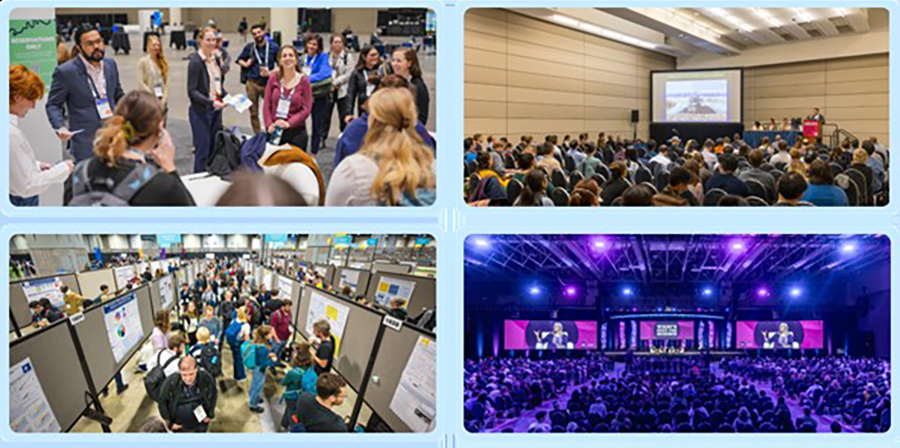
Source: AGU
AGU 2026 Fall Meeting to focus on research, discovery, action and solutions emerging from the Earth and space science community
MIT CS3 presentations and sessions explore multiple sustainability challenges and solutions
The largest gathering of Earth and space scientists, the AGU (American Geophysical Union) Fall Meeting draws more than 25,000 attendees from over 100 countries each year to share research findings and identify innovative solutions to complex problems. Organized around the theme “Where Science Connects,” the AGU 2026 Fall Meeting will take place in San Francisco and online on December 7 - 11.
Among the scientists attending this year's AGU Fall Meeting will be 19 first authors of oral and poster presentations or primary session conveners who are affiliated with the MIT Center for Sustainability Science and Strategy (CS3). Listed below, their 21 presentations and sessions span multiple CS3 research topics, including mobilizing interdisciplinary strategies to address sustainability challenges; Earth system observation and modeling; climate dynamics, land use and agriculture; atmospheric science and air quality; environmental monitoring and hazard assessment; flood risk and climate resilience; and climate mitigation technology dynamics. (Several other CS3-affiliated researchers are listed as co-authors of presentations or co-conveners of sessions in the AGU 2026 Annual Meeting Online Program.)
Categorized by research topic, these linked presentations and sessions highlight the expertise of CS3-affiliated researchers and their co-authors on a wide range of sustainability challenges and solutions.
Mobilizing interdisciplinary strategies to address sustainability challenges
Advancing science-based research collaborations to improve understanding and inform decision-making
U24A-03Lessons from three decades of global change research at MIT (Noelle Selin)
A34E-07Enhancing science-policy linkages to inform chemicals governance (Noelle Selin)
Earth system observation and modeling
The development, integration and/or application of models of the Earth’s natural and societal systems
OS34A-01 Calibrated OMIP simulations with Oceananigans (Raffaele Ferrari)
Recent Land-Ocean Warming Contrast Underestimation Linked to Historical Radiative Feedbacks (Paolo Giani)
Climate dynamics, land use and agriculture
Impacts of climate change on natural and societal systems
Coupled Effects of Climate Sensitivity and Aerosol Forcing on Future AMOC Stability: The IGSM–CESM Framework (Popat Salunke)
PP21A-06Views into tropical Indian Ocean hydroclimate variability since the Last Glacial Maximum from Madagascar stalagmites (David McGee)
GC13E-04When Agricultural and Economic Opportunities Dry Up: Drought in the Mississippi River Basin (Dominic White)
GC21E-08Easing the Tension in Land-Use Allocation Scenarios: Assessing Economic Driven Land-Use Scenarios Across Diverse Local-scale Earth-system Outcomes (C. Adam Schlosser)
Analytics of complex water, energy, food systems for strategic decisions under environmental change (Afreen Siddiqi)
Atmospheric science and air quality
The development and application of models aimed at better understanding the functioning of the Earth’s atmosphere, and its responses to emissions of greenhouse gases and ozone-depleting substances
Joint inversions of HCFC-22 and HFC-23 for partitioning emission sources of HCFC-22 in eastern China (2010-2024) (Eric Saboya)
GH34B-08Spatially Distributed Air Quality and Health Impacts of Data Center Electricity Demand in the United States (Albert Chen)
A33F-06GEO-Ring: Monitoring Extreme Methane Releases From Geostationary Orbit (Daniel Varon)
Using Stacking of Predictive Distributions to Combine Multiple Emissions Estimates (Luke Western)
Estimating Global Nitrous Oxide Emissions with a Multi-Network Atmospheric Inversion (Ke Che)
Quantifying California HFC Emissions with the AGAGE Network (Duncan Quevedo)
Environmental monitoring and hazard assessment
The development and application of models to track environmental changes and threats
ALTEMIS: Next-Generation in situ Real-time Groundwater Monitoring Strategies (Haruko Wainwright)
Flood risk and climate resilience
The development and application of models to inform decision-makers seeking to assess and respond to flood risk
Assessing Compound Flood Risk in a Low-Lying Coastal-Urban Catchment: A Case Study of East Boston (Sami Shokrana)
Climate mitigation technology dynamics
Interactions between greenhouse gas emissions-reducing technologies and the environments in which they operate
A24D-01Atmospheric boundary layer wind shear and veer reshape wind turbine aerodynamics and efficiency (Michael Howland)