News & Media: Earth Systems

In The News
New York Times

To reduce U.S. economic impacts, EAPS Prof. Kerry Emanuel recommends overhauling the nation’s flood insurance system

Kerry A. Emanuel, a climate scientist at the Massachusetts Institute of Technology, said the evidence suggested climate change would cause the strongest storms to grow even stronger, and to be more frequent. Unresolved questions surround the effect of warming on the weaker storms, but even those will dump more rain, leading over time to increased damage from flooding.

. . .

Finding the strong telltale “signal” of climate change in events is challenging, Dr. Emanuel said, because there are relatively few storms to draw data from. “If we have our numbers right,” he said, “it will be very difficult to see a signal in the actual data for a long time.”

Still, he said, prudent risk assessment calls for expecting these theories to be proved right over time, and to prepare.

. . .

A big part of preparing, Dr. Emanuel said, is overhauling the nation’s flood insurance system, which currently does little to dissuade people from living in hazardous areas.

. . .

“Climate change just makes it worse,” Dr. Emanuel said, and he predicted far greater property damage and rebuilding costs in years to come. The insurance problem, he said, “sets up for a string of Katrinas and Sandys as far as the eye can see.”


Read the full article.


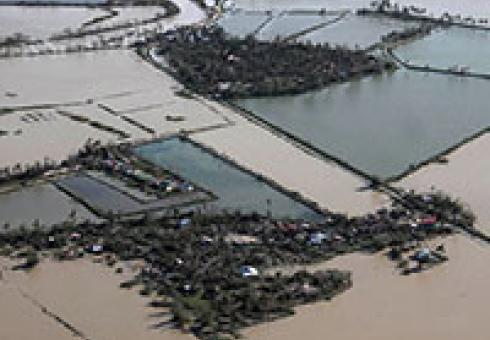
Photo: Flooding in Louisiana, 2016 (Source: Dave Malkoff)

In The News
Portland Press Herald

Kerry Emanuel of MIT suggests a new warning system and policies that account for increases in flooding, among other reforms.

“Most damage is done by Category 3 or higher hurricanes, and recent modeling by Emanuel and others strongly suggests that higher-category storms in the North Atlantic and elsewhere will become more frequent as the climate warms further. Factor in sea-level rise generating greater storm surges, and the scenarios do not look good.”
 

Photo: Hurricane Jeanne, 2004 (Source: kakela)

In The News
BBC World Service

In radio clip, Ed Butler explores these issues with MIT Professor of Civil and Environmental Engineering Elfatih Eltahir, a climatologist in the MIT Center for Global Change Science; and journalist and author Francesca de Chatel.


Photo: Arabian desert (Source: Alim Mohammed)

In The News
National Geographic

As Super Typhoon Nepartak hits Taiwan and China, National Geographic asks tropical cyclone expert Kerry Emanuel how these tempests form, and what risk they pose to people.

Around Campus
MIT News

This spring, a five-day MIT Professional Education course — Agriculture, Innovation and the Environment — showcased innovative technologies and strategies to make the agriculture industry more productive, and attracted a score of professionals from all over the world.


In The News
The Straits Times

A new study in Journal of Climate shows that burning coal could result in less rainfall and raise water stress in some countries - especially in developing Asia.

The warming effects of burning coal are well known, and studies have shown that using the dirtiest fossil fuel around can cause cooling, too. This is not good news, though. A new study, by Singapore scientists, shows that the cooling could result in less rainfall and raise water stress in some countries - especially in developing Asia - where the use of coal looks set to rise.

Around Campus
MIT News

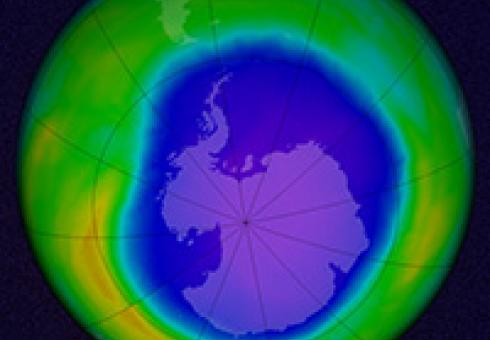
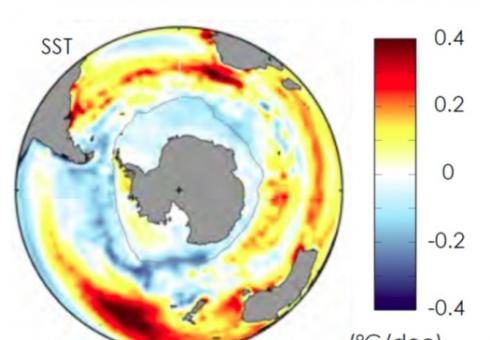
Around the world, scientists are observing evidence of climate change — record high temperatures, rising sea levels, and melting ice sheets. But new research from MIT’s Program in Atmospheres, Oceans and Climate indicates that Antarctica and the Southern Ocean may be experiencing a period of cooling before warming takes over — and the culprit might be the ozone hole rather than greenhouse gases.

In The News
MIT News

New research may explain why sea temperatures around Antarctica haven’t risen as much as surface temperatures around the globe

Around the globe, ocean surface temperatures have been rising due to global warming, but the seas around Antarctica haven’t changed much. Now, researchers may have discovered why.

In The News
MIT Spectrum

Modeling the diverse world of phytoplankton opens up a predictive view of our own

Hurricane Javier (Source: NASA/JPL)
In The News
Bloomberg

Climate scientists disagree on the impact of the Atlantic Multidecadal Oscillation—a 25-to-40-year cycle of cooling and warming of the Atlantic Ocean—on the frequency of hurricanes. Some expect the AMO to drive cooler sea surface temperatures and fewer hurricanes in coming decades, but others do not think the AMO works this way. EAPS Professor Kerry Emanuel, who is affiliated with the MIT Joint Program, believes that another factor—air pollution—has played a significant role in reducing hurricane activity.