
This one day symposium of the Stockholm Environment Institute (SEI) at Tufts University will explore how sound science and policy research can lay a foundation for new climate policies – ones that will allow us to move beyond the current climate stalemate and which offer hope that a low carbon sustainable future is possible. Scientists are reporting with increasing urgency about the impacts of unabated climate change. With the new administration taking office there is a significant opportunity to reshape the US’ role in addressing the climate challenge. SEI has been working to address the challenges of climate mitigation and adaptation for more than two decades in both the US and all around the globe. SEI staff and invited speakers from NGOs and policy makers will present relevant projects and discuss how their experience and research can inform US policy makers.
Taking Climate Change Seriously: Research and Policy Directions for the Next US Administration
Related Media
By Genevieve Wanucha
Oceans at MIT
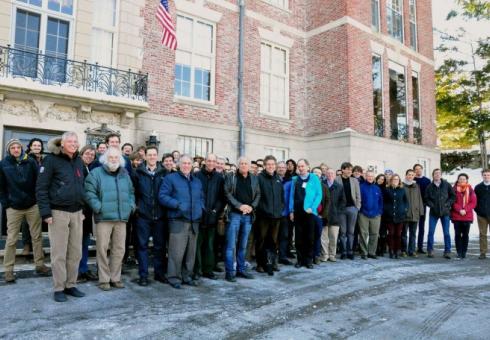
Water has a lot of say in how Earth’s climate works. And scientists often acknowledge that the uncertainty about climate’s future trajectory comes from a lack of understanding of water. This intellectual challenge filled the better part of February 10-12 for 37 leading climate researchers and graduate students and postdoctoral fellows who participated in the Lorenz Center’s first scientific workshop, “Water in the Climate System,” at the MIT Endicott House in Dedham, Massachusetts.
The Lorenz Center is a new climate research initiative founded by MIT professors Kerry Emanuel and Daniel Rothman in the Department of Earth, Atmospheric, and Planetary Sciences as a way to renew the emphasis on fundamental questions about climate. The founders dedicated the center to the late MIT professor Edward N. Lorenz, the architect of chaos theory, who shared their conviction that a better description of the underlying principles in climate will make the complex system easier to understand.
Some of the biggest names in climate-related fields presented work on climate and hydrological mechanisms to an audience packed with inquiring minds. Sessions included “Convection,” “Water Vapor, Clouds, and Climate,” “Moisture and Weather,” “Precipitation and Climate,” and “Potpourri,” an eclectic mixture of aquaplanet modeling and geomorphology. All 26 presentations are available in slide format here.
“It was a great opportunity for younger scientists to learn about the big ideas in the field and hear from voices outside of MIT,” says MIT PhD student Tim Cronin. In every discussion period, to avoid the “experts-talking-to-experts” phenomenon, Emanuel asked the graduate students and postdocs to pose the first few questions. This approach made the newer generation of researchers more than mere observers, and their questions drove the conversation, animating the experts in intense discussions of the major climate conundrums of our time: How do ocean and atmosphere circulations transport heat across the globe? How can we design models that accurately estimate regional changes in the water cycle as the globe warms? When can we expect significantly different summers and snowstorms?
This workshop was made possible by a generous gift from Colin Masson, a retired astrophysicist who appreciates the Lorenz Center’s broad view of climate science and who attended the event. Private donations like Masson’s support the Lorenz Center’s regular activities, which also include the annual John Carlson Lecture. To reach their ultimate vision, Emanuel and Rothman are currently raising funds to support graduate students, postdoctoral researchers, and visiting scientists with backgrounds in diverse areas such as applied mathematics, biology, and chemistry.
“Our idea, simply put, is both to attract the very best minds to climate science and to give them free rein to think creatively, unsaddled by the pressing practical demands of climate forecasting,” the founders write in "A Fresh Approach to Climate Science" (pdf). If the “Water in the Climate System” workshop was any indication, the Lorenz Center is already a magnet of basic research talent.