
Dr. Pat Dehmer, Deputy Director of Science Programs at the Department of Energy, will discuss science's role in energy challenges. Dr. Dehmer is the senior science official in the third-largest federal sponsor of basic research in the country, which funds research at 300 colleges and universities as well as at DoE laboratories. She previously directed the DoE's Office of Basic Energy Science, and under her leadership that office's budget more than doubled to $1.2 billion a year. She led a five-year effort there to tie basic energy research more closely to real-world energy problems. Before beginning work at the DoE's Office of Science in 1995, Dehmer already had a distinguished career in atomic, molecular, optical and chemical physics at Argonne National Laboratory in Chicago, with more than 125 peer-reviewed publications. She earned her PhD in chemical physics from the University of Chicago in 1972.
More about the speaker: Dr. Pat Dehmer has extensive experience in research and in administration. She held the position of senior scientist at Argonne National Laboratory, working in the field of atomic, molecular, and optical physics. She was recruited in 1995 to the position of Associate Director for Basic Energy Sciences in the Office of Science, with the Program budget rising from approximately $600M in FY 1994 to the President's request of $1.5B in FY 2008. During the period that she led Basic Energy Sciences, the world's most powerful spallation neutron source was conceived and built, under budget, ahead of schedule, and with increased scope. She has shepherded the construction of the Linac Coherent Light Source at the Stanford Linear Accelerator Center and the National Synchrotron Light Source II at Brookhaven National Laboratory. She has built the structure and hired the personnel that have made Basic Energy Sciences a powerful element in the nation's scientific portfolio.
MIT News Release Nov. 3, 2008
Seminar: Facing Our Energy Challenges in a New Era of Science
Related Media
By Joe McGonegal
June 12, 2013
On the slopes of Mt. Karisimbi, a 4,500-meter volcano in northwestern Rwanda, a lone MIT researcher is working this year to add new data to climate change research.
She is Katherine Potter PhD ’11, the principal investigator for the new Rwanda Climate Observatory. Working in the same area where iconic zoologist Dian Fossey studied mountain gorillas a half-century ago, Potter works just as passionately towards her goal: to empower Rwandans in becoming part of climate change research and to get Africa on the climate-change grid.
If Potter is successful, the observatory atop Mt. Karisimbi will join the Advanced Global Atmospheric Gases Experiment (AGAGE), a worldwide program funded in part by NASA and NOAA that captures climate data.
AGAGE began in 1978 and now includes eight observatories around the world that record air pollution and greenhouse gas emissions. It is a leading source of data for measuring progress against the 1987 Montreal Protocol and 1997 Kyoto Protocol benchmarks for carbon emissions.
Until now, Africa has not had an observatory feeding into AGAGE’s experiment. Covering a fifth of the world’s land mass, this is no small piece of lost data.
Potter hopes to fix that. Working for MIT’s Center for Global Change Science, Potter is training future Rwandan scientists, technicians, and academics to collaborate in the world’s efforts to monitor climate change.
Mt. Karisimbi is a perfect place for the observatory, says Potter, who blogs about her progress. “At 4,500 meters, the air reaching the station will come from a large area, getting info from much of Africa and the surrounding oceans,” she says. “Also, it shares a border with Congo and is in the same protected area that continues into Uganda. So this is unifying the East African community in doing climate research.”
Potter’s work is a result of a conversation Rwandan president Paul Kagame began with then president Susan Hockfield in 2008. Kagame was on campus for the Compton Lecture. CGCS director Ronald Prinn ScD ’71 and geophysics professor Maria Zuber have led MIT’s efforts to develop the project since.
The project has inspired other alums, like Jonathan Goldstein ’83. “My wife Kaia Miller Goldstein and I have worked with both the Rwandan and MIT leadership,” Goldstein says. “It has been exciting to see them collaborate on this worthy project. We were thrilled to meet [Potter] while in Rwanda recently. She is a real star.”
“I think the real joy for those involved comes from the cultural collaboration, where MIT scientists can really make a difference in the world and the Rwandan people can show the world that they are rapidly advancing as a society,” says Goldstein.
MIT is one of ten universities that participate in AGAGE, a venture jointly funded by British, American, and Australian government agencies. AGAGE instruments around the world measure and report on the atmospheric levels of 33 compounds.
Potter is collaborating with the Ministry of Education in Rwanda, which is recruiting top academics and analysts from within its borders to participate. The Rwandan government is also planning to construct an €18-million cable car up Karisimbi, in the hopes that the station becomes a tourist destination, too. Potter estimates that the observatory will be complete and staffed by Rwandan scientists in the next three or four years.
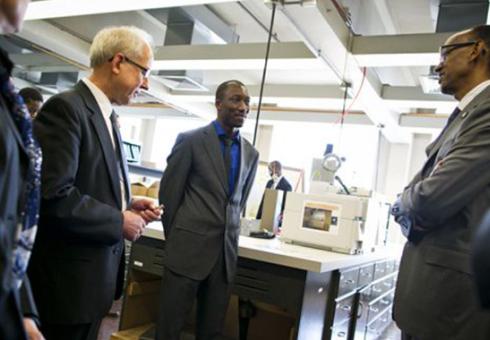
Yesterday, Paul Kagame, the president of Rwanda, visited MIT to discuss existing collaboration between his country and MIT, as well as to explore the possibility of broadening its scope. Kagame was traveling with Rwandan Ambassador to the United States Mathilde Mukantabana, Rwanda’s Permanent Secretary of the Ministry of Education Sharon Haba, and others of Rwanda’s leadership.
President Kagame and his delegation, together with Maria Zuber, MIT’s vice president for research and the E. A. Griswold Professor of Geophysics, and Philip Khoury, associate provost and the Ford International Professor of History, toured the laboratory of Professor Ronald Prinn, who leads the Rwanda-MIT Climate Change Observatory Project and is the TEPCO Professor of Atmospheric Science in the Department of Earth, Atmospheric, and Planetary Sciences.
Rwanda and MIT are collaborating to build a world-class observatory on Mt. Karisimbi measuring climate change and the atmospheric gases forcing climate change; the observatory is ultimately to be run by local researchers. The project evolved from discussions in 2008-2009 between President Kagame, his ministers, and the MIT administration.
Mt. Karisimbi will join the MIT-led multinational Advanced Global Atmospheric Gases Experiment (AGAGE) network that has been measuring atmospheric composition continuously over the globe since 1978. This unique new site can measure air coming from Rwanda and many other nations within and beyond Africa. Access to the 4,500-meter-high summit of Karisimbi will be facilitated by a new cable car being built for eco-tourism.
While the cable car is being built, an interim observatory has been set up on Mt. Mugogo to train the local technicians. Besides Prinn, Kat Potter, the station scientist, and doctoral student Jimmy Gasore are installing the first phase of instruments that measure temperature, winds, humidity, carbon dioxide, methane, carbon monoxide, ozone, and nitrous oxide. The second phase involves an automated mass spectrometer measuring over 50 other greenhouse gases and air pollutants. Rwandan researchers will gain the capability using computer codes to calculate regional greenhouse gas sources and sinks, climate change, and air pollution. The observatory data will be used for University of Rwanda student thesis projects, and Prinn is working with Rwandan faculty on a new Atmospheric and Climate Science master’s degree and undergraduate courses.
Rwanda will gain local capacity to adapt to climate change using the capability to forecast regional and local climate change to address the needs of local decision-makers; take advantage of revenue-yielding opportunities to mitigate climate change (such as reforestation and renewable energy using greenhouse gas sources and sink estimates); and grow a scientifically and technically educated work force that can address other important local and regional environmental and economic development issues.
Following the lab tour, Kagame and his delegation were received by MIT President L. Rafael Reif and Professor Zuber. Reif and Zuber were joined by leadership from parts of MIT that have active engagement or interest in Rwanda: the Jameel Poverty Action Lab (J-PAL); MIT D-Lab; and the MIT Energy Initiative (MITEI); and EAPS. In beginning the round-table discussion, Reif told Kagame and the rest of the meeting participants that an exploration of possibilities for new or enhanced collaboration would best center on three areas that bear directly on the well-being of Rwandans: the environment; online learning; and innovation and entrepreneurship.
MIT participants updated Kagame on current and possible engagements. Tavneet Suri, the Maurice F. Strong Career Development Professor and an associate professor of applied economics at the MIT Sloan School of Management, is the scientific director for Africa for J-PAL. She reminded Kagame of meetings held last year between J-PAL and Rwandan governmental ministers, and she described progress made on engagements currently under way; they include an effort to prevent HIV among adolescent girls, as well as work on a water-tank project. J-PAL is also helping Rwanda to build capacity for its senior civil servants and academics.
Robert Armstrong, the director of MITEI and the Chevron Professor of Chemical Engineering, provided an overview of MITEI’s work; he emphasized possibilities around solar research and work being done at MIT to explore how to provide energy for villages through the establishment of “microgrids.”
Kofi Taha, associate director of D-Lab, described the work of D-Lab and its focus on collaborating intensely with people to develop, side-by-side, the tools they need in order to improve lives. He expressed the hope that D-Lab might be helpful to the Rwandan government’s “Vision 2020,” an effort to transform Rwanda into a middle-income, knowledge-based economy by the year 2020.
Esther Duflo, the Abdul Latif Jameel Professor of Poverty Alleviation and Development Economics in the Department of Economics and founder and director of J-Pal, discussed the potential of online learning tools for teaching development economics and other subjects to those working to effect change. President Reif pointed out that though there are only a handful of Rwandan students at MIT, 1,700 Rwandans are taking courses through edX, the online learning platform founded by MIT and Harvard University.
President Kagame spoke of his desire to connect the discrete projects currently under way between MIT and Rwanda and to identify a clear set of further areas for collaboration, with Haba leading future discussions on behalf of his administration, and with the close involvement of the University of Rwanda. At the close of the meeting, Reif and Kagame agreed that the discussion showed good potential for greater collaboration.