
A Cambridge City Hall Forum will bring together experts from a variety of fields to discuss how to create a sustainable energy future. The forum will be led by Broad Institute Founding Director Eric Lander, a co-chair of the President's Council of Advisors on Science and Technology, and include MIT professors Henry Jacoby and Ronald Prinn (co-directors of the MIT Global Change Program), as well as MIT professor Ernest Moniz (director of the MIT Energy Initiative), Steve Morgan of the Cambridge Energy Alliance, and Prof. Stephen Ansolabehere of Harvard. Presentations and panel discussions will focus on the topics of mitigation and adaptation to climate change, the role of technical innovation, policy change, and behavioral change, and programs at the City and State levels. This event is organized by the MIT Energy Initiative, the City of Cambridge, and the Cambridge Science Festival.
Meltdown: What Everyone Needs to Know and Do About Energy
Related Media
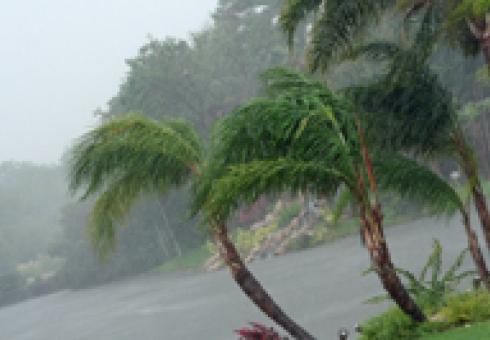
Study estimates rate of intensification of extreme tropical rainfall with global warming.
By: Jennifer Chu, MIT News Office Extreme precipitation in the tropics comes in many forms: thunderstorm complexes, flood-inducing monsoons and wide-sweeping cyclones like the recent Hurricane Isaac.
Global warming is expected to intensify extreme precipitation, but the rate at which it does so in the tropics has remained unclear. Now an MIT study has given an estimate based on model simulations and observations: With every 1 degree Celsius rise in temperature, the study finds, tropical regions will see 10 percent heavier rainfall extremes, with possible impacts for flooding in populous regions.
“The study includes some populous countries that are vulnerable to climate change,” says Paul O’Gorman, the Victor P. Starr Career Development Assistant Professor of Atmospheric Science at MIT, “and impacts of changes in rainfall could be important there.”
O’Gorman found that, compared to other regions of the world, extreme rainfall in the tropics responds differently to climate change. “It seems rainfall extremes in tropical regions are more sensitive to global warming,” O’Gorman says. “We have yet to understand the mechanism for this higher sensitivity.”
Results from the study are published online this week in the journal Nature Geoscience.
A warm rain will fall
Global warming’s effect on rainfall in general is relatively well-understood: As carbon dioxide and other greenhouse gases enter the atmosphere, they increase the temperature, which in turn leads to increases in the amount of water vapor in the atmosphere. When storm systems develop, the increased humidity prompts heavier rain events that become more extreme as the climate warms.
Scientists have been developing models and simulations of Earth’s climate that can be used to help understand the impact of global warming on extreme rainfall around the world. For the most part, O’Gorman says, existing models do a decent job of simulating rainfall outside the tropics — for instance, in mid-latitude regions such as the United States and Europe. In those regions, the models agree on the rate at which heavy rains intensify with global warming.
However, when it comes to precipitation in the tropics, these models, O’Gorman says, are not in agreement with one another. The reason may come down to resolution: Climate models simulate weather systems by dividing the globe into a grid, with each square on the grid representing a wide swath of ocean or land. Large weather systems that span multiple squares, such as those that occur in the United States and Europe in winter, are relatively easy to simulate. In contrast, smaller, more isolated storms that occur in the tropics may be trickier to track.
An intensity of extremes
To better understand global warming’s effect on tropical precipitation, O’Gorman studied satellite observations of extreme rainfall between the latitudes of 30 degrees north and 30 degrees south — just above and below the Equator. The observations spanned the last 20 years, the extent of the satellite record. He then compared the observations to results from 18 different climate models over a similar 20-year period.
“That’s not long enough to get a trend in extreme rainfall, but there are variations from year to year,” O’Gorman says. “Some years are warmer than others, and it’s known to rain more overall in those years.”
This year-to-year variability is mostly due to El Niño — a tropical weather phenomenon that warms the surface of the Eastern Pacific Ocean. El Niño causes localized warming and changes in rainfall patterns and occurs independent of global warming.
Looking through the climate models, which can simulate the effects of both El Niño and global warming, O’Gorman found a pattern. Models that showed a strong response in rainfall to El Niño also responded strongly to global warming, and vice versa. The results, he says, suggest a link between the response of tropical extreme rainfall to year-to-year temperature changes and longer-term climate change.
O’Gorman then looked at satellite observations to see what rainfall actually occurred as a result of El Niño in the past 20 years, and found that the observations were consistent with the models in that the most extreme rainfall events occurred in warmer periods. Using the observations to constrain the model results, he determined that with every 1 degree Celsius rise under global warming, the most extreme tropical rainfall would become 10 percent more intense — a more sensitive response than is expected for nontropical parts of the world.
“Unfortunately, the results of the study suggest a relatively high sensitivity of tropical extreme rainfall to global warming,” O’Gorman says. “But they also provide an estimate of what that sensitivity is, which should be of practical value for planning.”
The results of the study are in line with scientists’ current understanding of how global warming affects rainfall, says Richard Allan, an associate professor of climate science at the University of Reading in England. A warming climate, he says, adds more water vapor to the atmosphere, fueling more intense storm systems.
"However, it is important to note that computer projections indicate that although the rainfall increases in the wettest regions — or similarly, the wet season — the drier parts of the tropics … will become drier still,” Allan says. “So policymakers may have to plan for more damaging flooding, but also less reliable rains from year to year.”
Analysis shows climate change to yield more extreme rainfall — Heavier rainstorms lie in our future. That's the clear conclusion of a new MIT and Caltech study on the impact that global climate change will have on precipitation patterns. But the increase in extreme downpours is not uniformly spread around the world, the analysis shows.
Overall, previous studies have shown that average annual precipitation will increase in both the deep tropics and in temperate zones, but will decrease in the subtropics. However, it's important to know how the magnitude of extreme precipitation events will be affected, as these heavy downpours can lead to increased flooding and soil erosion. It is the magnitude of these extreme events that was the subject of this new research, which will appear online in the Proceedings of the National Academy of Sciences this week. The report was written by Paul O'Gorman, assistant professor in the Department of Earth, Atmospheric and Planetary Sciences at MIT, and Tapio Schneider, professor of environmental science and engineering at Caltech. (View article.)
Model simulations used in the study suggest that precipitation in extreme events will go up by about 5 to 6 percent for every one degree Celsius increase in temperature. Separate projections published earlier this year by MIT's Joint Program on the Science and Policy of Global Change indicate that without rapid and massive policy changes, there is a median probability of global surface warming of 5.2 degrees Celsius by 2100, with a 90 percent probability range of 3.5 to 7.4 degrees.
Specialists in the field called the new report by O'Gorman and Schneider a significant advance. Richard Allan, a senior research fellow at the Environmental Systems Science Centre at Reading University in Britain, says, "O'Gorman's analysis is an important step in understanding the physical basis for future increases in the most intense rainfall projected by climate models." He adds, however, that "more work is required in reconciling these simulations with observed changes in extreme rainfall events."
The reason the climate models are less consistent about what will happen to precipitation extremes in the tropics, O'Gorman explains, is that typical weather systems there fall below the size limitations of the models. While high and low pressure areas in temperate zones may span 1,000 kilometers, typical storm circulations in the tropics are too small for models to account for directly.
More...