Speaker: John Heywood, Sun Jae Professor of Mechanical Engineering, MIT. This seminar will summarize the findings in the recent report of the same name. The multi-year research program assessed the technology and fuels that could be developed and commercialized in light-duty vehicles over the next 25 years, their potential impact on fuel consumption and greenhouse gas emissions during the production and use of both fuels and vehicles, and the policy and fiscal measures that would be needed. This session is part of the Issues in Technology and Policy 2009 IAP Seminar Series.
IAP Seminar: On the Road in 2035: Reducing Transportation's Petroleum Consumption and GHG Emissions
Related Media and Events
By Justin Gillis
I would guess a few Green readers had the experience, over the holidays, of arguing yet again about global warming with a parent or brother-in-law who thinks it’s all a big hoax. Maybe there’s some undiscovered substance in roast turkey that makes people want to pick fights around the dinner table.
Fortunately, the M.I.T. climate scientist Kerry Emanuel has provided us with a solution to this problem: an updated edition of “What We Know About Climate Change,” his 2007 book explaining the science of global warming.
I’m happy to report that the new edition of this slender volume is an improvement — perhaps even the single best thing written about climate change for a general audience. It is a little longer than the first edition, 93 pages instead of 85, but it’s still an easy read — most people will get through it in a single sitting.
The new version updates the science to the latest numbers, of course, but it also adds a couple of chapters about the potential solutions to climate change and the bizarre politics that have cropped up around it in recent years.
The book is dead accurate, not only presenting scientifically what we know, but also leveling with readers about what we don’t. It conveys the risks posed by that ignorance. Yet Dr. Emanuel manages to keep the language so taut and simple that nobody is likely to be intimidated by the book or to feel put out at being asked to read it.
The point, he said in an interview, is to give people some ammunition when they encounter the kind of contrarianism about climate change that has become pervasive in the United States.
“Young adults who are disputing this problem with their own parents or an uncle or something — they can hand the book to them and say, ‘Will you at least read this?’ ” Dr. Emanuel said. “One at a time, you might change minds.”
The book is officially scheduled for publication on Tuesday, by M.I.T. Press, but it has long since moved into retail channels and is widely available in hardcover for $11. At Dr. Emanuel’s behest, the publisher set an especially low price, $7.50, for the digital edition.
He does not talk much about this in the book, but for anybody who plans to give it to a political conservative, it might be worth pointing out to them that Dr. Emanuel spent most of his adult life as a registered Republican. He changed his registration to independent recently, but he told me that his convictions have not shifted much — he was driven out of the Republican Party by its embrace of global warming skepticism, among other recent positions.
“I came of age in the 1960s and ’70s,” Dr. Emanuel said. “A lot of what was actually going wrong in the country was because of rigid ideology, and a lot of what I considered rigid ideology was on the left. Now I think it’s the right that’s guilty of that, that’s really gone off on this ideological tangent.”
Conservatives will find a few points in the book that especially resonate. For instance, while Dr. Emanuel assails the irrationality of dismissing an entire branch of science as some kind of elaborate hoax — many Republicans have done lately — as he also takes green groups to task on certain points, including their skepticism about nuclear power.
He sees nuclear energy as one of the few ways to reduce carbon dioxide emissions, which contribute to global warming, on a large scale. And he is doubtful that renewable energy sources like wind and solar power can be ramped up fast enough to meet the challenge.
If Dr. Emanuel has been talking about his politics more lately, so have some of his colleagues, like Richard Alley of Penn State, one of the country’s most notable explainers of climate science, who describes himself as a churchgoing Republican.
These scientists are hoping that their conservative credentials will help open some otherwise closed minds, but their ultimate point is that the science itself has nothing to do with politics — and everything to do with physics.
Research aimed at predicting future climate activity has primarily focused on large and complex numerical models. While this approach has provided some quantitative estimates of climate change, those predictions can vary greatly from one model to the next and produce doubts in the projected outcome.
In this Faculty Forum Online broadcast Professor Kerry Emanuel '76, PhD '78 discussed a new approach to climate science that emphasizes basic understanding over black box simulation. On Tuesday, Feb. 5, 2013, Emanuel presented an overview of his climate research and took questions from the worldwide MIT community via video chat. Watch the video and visit the Slice of MIT blog to continue the conversation in the comments.
About Kerry Emanuel
A Cecil and Ida Green Professor in the Department of Earth, Atmospheric and Planetary Sciences, Emanuel is a cofounder of the Lorenz Center, an MIT think tank devoted to understanding climate activity. He is the author of What We Know about Climate Change, which The New York Times called "the single best thing written about climate change for a general audience."
In 2006, Emanuel was named by Time magazine as one of the 100 most influential people in the world. He received his bachelor's degree in earth, atmospheric, and planetary sciences from MIT in 1976 and his doctorate in meteorology from MIT in 1978.
By Laura Barron-Lopez
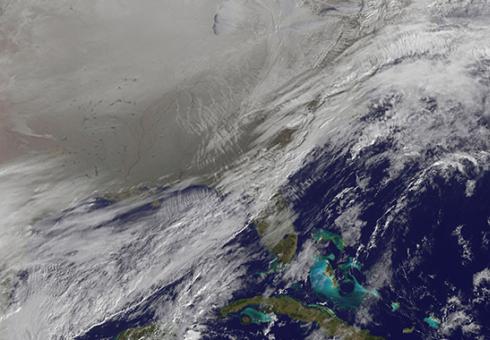
Global warming may be contributing to the "polar vortex" causing frigid temperatures across most of the nation on Monday, according to some climate change researchers.
While it seems counter-intuitive, the research argues that plunging temperatures could come from changes in the jet stream caused by climate change.
Rutgers University climate scientist Jennifer A Francis has released a number of papers about changes in the jet stream brought about by warming Arctic temperatures.
Her conclusions suggest that warming Arctic air caused by greenhouse gas emissions has caused changing to the jet stream that is pushing colder Arctic air further south, causing temperatures to plunge from the High Plains to the Deep South.
The jet stream shift has sent frigid air across the central part of the country, and deeper into the south than normal.
Alaska, meanwhile, is being hit by unusually warm conditions and California is facing record-breaking drought, Francis said.
She said the strange weather is becoming more likely because of climate change.
"We can't say that these are extremes are because of climate change but we can say that this kind of pattern is becoming more likely because of climate change," Francis said.
NASA analysis has also drawn a link between the jet stream, climate change and colder temperatures.
A 2010 NASA analysis tied colder temperatures over the course of 2009 to an event similar to the wavy jet stream, called "Arctic oscillation" — a see-sawing pressure system over the North Pole. That oscillation pushed cold air to teh south.
The NASA analysis also said that despite cold snaps, and other weather changes being a part of naturally occurring patterns, they are still in line with a "globally warming world."
According to Francis, big fluctuations in the jet stream cause extreme weather conditions to hang around longer.
She argues greenhouse gas emissions are a key factor.
"The process of warming the Arctic is intensified due to greenhouse gas emissions," Francis said. "The Arctic is warming two to three times faster than the rest of the Northern Hemisphere."
MIT atmospheric scientist Kerry Emanuel said long-term climate change can only be seen by looking at detailed statistics.
“It's certainly plausible, at lease for awhile that a changing jet stream, may cause colder winters,” Emanuel said.
But he added that it is difficult to tie a direct link between individual events like the cold snap occurring in the Midwest and East Coast to global warming.
Emanuel added that that doesn't mean you can disregard global warming.
“If you cherry pick you can always find an excuse to go against [global warming,” Emanuel said.
Image Credit: Satellite Image Shows Entry of the Polar Vortex into the Northern U.S.
In many public discussions of climate change, science takes a back seat to political agendas and rhetoric. But 12.340x (Global Warming Science), a new massive open online course from MITx now open for enrollment on the edX platform, aims to change that dynamic by providing a solid scientific view of what is really happening with global warming.
“We are trying to bring back some of the intellectual excitement that belongs to the field,” says Professor Kerry Emanuel, a co-teacher of the course whose research focuses on hurricanes. “This is a serious science course.”
The MITx course will use many of the lecture materials developed for the on-campus version of the course, along with new videos and visuals. The course will also include new exercises, problem sets, and a final exam, all tailored to the assessment tools available on the edX platform and developed with an eye on preserving the rigor of the course. “You have to have a background in mathematics up through differential equations, and a background in physics,” says Emanuel, the Cecil and Ida Green Professor of Atmospheric Science. “Our intent is that it will be as challenging as the classroom course.”
12.340x will also bring simulations used in the MIT residential course to a wider audience, including the single-column model simulation. Emanuel describes this unique tool as “a computer climate model that takes inputs such as solar radiation and atmospheric greenhouse gas content and calculates the temperatures of the surface and atmosphere, and the moisture and cloud distributions in the atmosphere. Students can change the intensity of sunlight, the time of year, the greenhouse gas concentrations, and other inputs to see how they affect climate change.”
Emanuel expects a wide range of people to take 12.340x. “You’re going to find a lot of students in climate and energy. They will want to know the physics, chemistry, and biology (of climate change).” He also expects professionals working in energy and public policy to be interested in the course. Even a politician has expressed interest in 12.340x, but Emanuel is keeping the individual’s name confidential.
Emanuel and the Department of Earth, Atmospheric and Planetary Sciences also hope to change the dynamic around the study of climate change on the MIT campus. In part because the course is not a requirement, and in part because of the perception among students that climate-change study is mostly about politics and not hard science, the on-campus course has not seen the enrollment levels Emanuel would like to see. “Part of the problem is all the publicity of global warming has sent out a message that global warming is highly politicized, and has nothing to do with science,” he says. “Nothing could be further from the truth.”
In a study published online by the journal Science, Harvard University scientists reported that some storms send water vapor miles into the stratosphere — which is normally drier than a desert — and showed how such events could rapidly set off ozone-destroying reactions with chemicals that remain in the atmosphere from CFCs, refrigerant gases that are now banned.

The risk of ozone damage, scientists said, could increase if global warming leads to more such storms.
“It’s the union between ozone loss and climate change that is really at the heart of this,” said James G. Anderson, an atmospheric scientist and the lead author of the study.
For years, Dr. Anderson said, he and other atmospheric scientists were careful to keep the two concepts separate. “Now, they’re intimately connected,” he said.
Ozone helps shield people, animals and crops from damaging ultraviolet rays from the sun. Much of the concern about the ozone layer has focused on Antarctica, where a seasonal hole, or thinning, has been seen for two decades, and the Arctic, where a hole was observed last year. But those regions have almost no population.
A thinning of the ozone layer over the United States during summers could mean an increase in ultraviolet exposure for millions of people and a rise in the incidence of skin cancer, the researchers said.
The findings were based on sound science, Dr. Anderson and other experts said, but much more research is needed, including direct measurements in the stratosphere in areas where water vapor was present after storms.
“This problem now is of deep concern to me,” Dr. Anderson said. “I never would have suspected this.”
While there is conclusive evidence that strong warm-weather storms have sent water vapor as high as 12 miles — through a process called convective injection — and while climate scientists say one effect of global warming is an increase in the intensity and frequency of storms, it is not yet clear whether the number of such injection events will rise.
“Nobody understands why this convection can penetrate as deeply as it does,” said Dr. Anderson, who has studied the atmosphere for four decades.
Mario J. Molina, a co-recipient of a Nobel Prize for research in the 1970s that uncovered the link between CFCs and damage to the ozone layer, said the study added “one more worry to the changes that society’s making to the chemical composition of the atmosphere.” Dr. Molina, who was not involved in the work, said the concern was “significant ozone depletion at latitudes where there is a lot of population, in contrast to over the poles.”
The study, which was financed by the National Aeronautics and Space Administration, focused on the United States because that is where the data was collected. But the researchers pointed out that similar conditions could exist at other midlatitude regions.
Ralph J. Cicerone, an atmospheric scientist and the president of the National Academy of Sciences, who reviewed the study for Science, also called for more research. “One of the really solid parts of this paper is that they’ve taken the chemistry that we know from other atmospheric experiments and lab experiments and put that in the picture,” he said. “The thing to do is do field work now — measure moisture amounts and whether there is any impact around it.”
“The connection with future climate is the most important issue,” Dr. Cicerone said.
Large thunderstorms of the type that occur from the Rockies to the East Coast and over the Atlantic Ocean produce updrafts, as warm moist air accelerates upward and condenses, releasing more heat. In most cases, the updrafts stop at a boundary layer between the lower atmosphere and the stratosphere called the tropopause, often producing flat-topped clouds that resemble anvils. But if there is enough energy in a storm, the updraft can continue on its own momentum, punching through the tropopause and entering the stratosphere, said Kerry Emanuel, an atmospheric scientist at the Massachusetts Institute of Technology.
When Dr. Anderson produced data about five years ago clearly showing these strong injections of water vapor, “I didn’t believe it at first,” Dr. Emanuel said. “But we’ve come to see that the evidence is pretty strong that we do get them.”
At the same time, he added, “we don’t really understand what determines the potential for convection in the atmosphere,” so it is difficult to say what the effect of climate change will be.
“We’re much further along on understanding how hurricanes respond to climate change than normal storms,” Dr. Emanuel said.
The use of CFCs, or chlorofluorocarbons, was phased out beginning in the late 1980s with the signing of an international treaty called the Montreal Protocol, but it will take decades for them to be cleansed fully from the atmosphere. It is chlorine from the CFCs that ultimately destroys ozone, upsetting what is normally a balanced system of ozone creation and decay. The chlorine has to undergo a chemical shift in the presence of sunlight that makes it more reactive, and this shift is sensitive to temperature.
Dr. Anderson and his colleagues found that a significant concentration of water vapor raises the air temperature enough in the immediate vicinity to allow the chemical shift, and the ozone-destroying process, to proceed rapidly.
“The rate of these reactions was shocking to us,” Dr. Anderson said. “It’s chemistry that was sitting there, waiting to be revealed.”
Dr. Anderson said that if climate change related to emissions of greenhouse gases like carbon dioxide and methane led to more events in which water was injected well into the stratosphere, the effect on ozone could not be halted because the chemistry would continue. “It’s irreversible,” he said.
If CFCs had not been banned, the ozone layer would be in far worse shape than it is. But by showing that CFC-related ozone destruction can occur in conditions other than the cold ones at the poles, the study suggests that the full recovery of the ozone layer may be further off than previously considered.
“The world said, ‘Oh, we’ve controlled the source of CFCs; we can move on to something else,’ ” Dr. Anderson said. “But the destruction of ozone is far more sensitive to water vapor and temperature.”
By Jennifer Chu, MIT News Office
SOURCE: NASA
If you’re planning to build that dream beach house along the East Coast of the United States, or would like to relocate to the Caribbean, a new study by economists and climate scientists suggests you may want to reconsider.
Researchers from MIT and Yale University have found that coastal regions of North America and the Caribbean, as well as East Asia, are most at risk for hurricane damage — a finding that may not surprise residents of such hurricane-prone communities. However, the researchers say by the year 2100, two factors could more than quadruple the economic damages caused by tropical storms in such regions and around the world: growing income and global warming.
In a paper published this week in Nature Climate Change, researchers developed a model to predict hurricanes around the world, looking at how hurricane activity might change in the next 100 years both with and without climate change.
Even in a world without climate change, where rates of greenhouse gas emissions remain stable, the researchers found that annual economic damages from hurricanes could double in the next century: Global population is expected to reach 9 billion by 2100, likely leading to more development along hurricane-prone coastlines. Given such growth, the researchers projected that worldwide annual damage from hurricanes — currently $26 billion — could increase to $56 billion in the next century.
Under a similar economic scenario, but with the added factor of climate change, the team found that annual hurricane damage could quadruple to $109 billion by 2100. According to the researchers’ model, proliferating greenhouse gases would likely increase the incidence of severe tropical cyclones and hurricanes, which would increase storm-related damage.
Furthermore, the researchers found that the distribution of damage is not even across the world. Their model indicates that climate change would cause the most hurricane-related damage in North America, followed by East Asia, Central America and the Caribbean. The rest of the world — particularly the Middle East, Europe and South America — would remain relatively unscathed, experiencing little to no hurricane activity.
Treading new territory
Kerry Emanuel, the Cecil and Ida Green Professor of Atmospheric Science at MIT, says results from the model developed by the team may have wide-ranging implications for regional planning and emergency preparedness.
“It could be used by lots of different people … to understand what resources to put into certain countries to mitigate or adapt to tropical cyclone changes resulting from climate change,” says Emanuel, a co-author of the paper. “For example, urban planners in cities might want to know how high to make the flood barriers if sea levels go up.”
Emanuel worked with researchers at Yale to develop the hurricane prediction model, an effort that combined two disparate disciplines: atmospheric modeling and economics. Emanuel describes the work as “treading new territory,” and the researchers had to “do a lot of back and forth to understand each other’s terminology.”
After sorting out semantics, the group set out to predict tropical cyclone and hurricane activity around the world. The researchers relied on four existing climate models commonly used by the Intergovernmental Panel on Climate Change to assess climate risks. Each of the models track and forecast certain climate variables such as wind, temperature, large-scale ocean currents and ocean temperatures. However, the models only track these variables at a relatively coarse resolution of 100 to 200 kilometers. Since a tropical cyclone that may whip into a massive hurricane under certain weather conditions requires resolutions of a few kilometers, using climate models to simulate storms is highly problematic.
Seeds of a cyclone
Instead, Emanuel and his colleagues embedded a tropical-cyclone model within each climate model. The combination allowed the team to see where storms may develop around the world, based on regional weather systems. The researchers randomly scattered hundreds of thousands of “seeds,” or potential tropical cyclones, throughout each of the four models, then ran the models to see where the seeds developed into significant storms. There was some variation between models, but in general, they revealed that 95 percent of storms simply dissipate, leaving 5 percent that were likely to turn into hurricanes under favorable conditions such as warm ocean water and high winds. They used enough seeds to generate 17,000 surviving storms in each simulation.
The team also looked at each country’s hurricane-related damage after adjusting for its gross domestic product (GDP). The researchers found that wealthier nations like the United States are able to absorb economic losses from a hurricane better than many others, such as island nations in the Caribbean.
“These are all small islands, and most of their GDPs are exposed,” Emanuel says. “In the United States , you take all this damage and divide it by the GDP of the whole country, and you get a smaller relative impact.”
Dan Osgood, a lead scientist in the financial instruments sector team for the Earth Institute at Columbia University, sees the new model as a useful tool, particularly for the insurance industry.
“Insurance companies [are] hungry for climate research such as this,” says Osgood, who was not involved in the research. “Having solid science, they can often offer more reasonable and more accurate prices, providing better deals to consumers, as well as accurate price incentives to help people [avoid] taking unreasonable building risks.”
The researchers stress that there was a fair amount of uncertainty in predictions made among the four climate models. For example, in estimating the effect of climate change on tropical-cyclone damage, the models’ predictions ranged from $14 billion to $80 billion a year.
Emanuel also points out that “looking at natural disasters strictly through an economic lens doesn’t tell you the whole story.” For example, despite a growing economy and population, if severe tropical cyclones become more frequent, people may choose to build elsewhere — a phenomenon Emanuel says an improved model will have to take into account.
Other authors on the paper are Robert Mendelsohn, Shun Chonabayashi and Laura Bakkensen from the Yale School of Forestry and Environmental Studies.
Whenever there’s an extreme weather event, from a hurricane to a record drought, the question always arises: Is it climate change?
MIT climate scientist Kerry Emanuel told Here & Now's Robin Young that it's hard to know for sure, but it is clear that as coastal waters warm up, storms will carry more rain, due to the added water vapor.
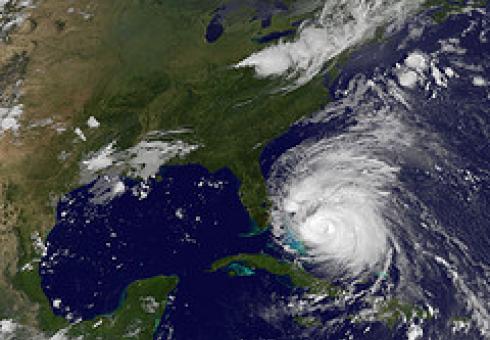
This NOAA satellite image taken on Monday shows Hurricane Sandy off the Mid
Atlantic coastline moving north. (AP/NOAA)
Research suggests ocean color is linked to formation, movement of tropical cyclones
More hurricanes may form in greener waters, where sunlight tends to be absorbed at shallower depths, than in clear seas, according to new research that draws a link between ocean color and the formation and movement of tropical cyclones.
It’s no secret that hurricanes depend on a recipe of moist air, warm water and converging winds. But in a paper due to be published this month in Geophysical Research Letters, researchers from MIT and the National Oceanic and Atmospheric Administration’s Geophysical Fluid Dynamics Laboratory say ocean color — which is typically influenced by the concentration of tiny marine organisms — may also be a factor.
By JUSTIN GILLIS
The scale of Hurricane Irene, which could cause more extensive damage along the Eastern Seaboard than any storm in decades, is reviving an old question: are hurricanes getting worse because of human-induced climate change?
The short answer from scientists is that they are still trying to figure it out. But many of them do believe that hurricanes will get more intense as the planet warms, and they see large hurricanes like Irene as a harbinger.
While the number of the most intense storms has clearly been rising since the 1970s, researchers have come to differing conclusions about whether that increase can be attributed to human activities.
“On a longer time scale, I think — but not all of my colleagues agree — that the evidence for a connection between Atlantic hurricanes and global climate change is fairly compelling,” said Kerry Emanuel, an expert on the issue at the Massachusetts Institute of Technology.
Among those who disagree is Thomas R. Knutson, a federal researcher at the government’s Geophysical Fluid Dynamics Laboratory in Princeton, N.J. The rising trend of recent decades occurred over too short a period to be sure it was not a consequence of natural variability, he said, and statistics from earlier years are not reliable enough to draw firm conclusions about any long-term trend in hurricane intensities.
“Everyone sort of agrees on this short-term trend, but then the agreement starts to break down when you go back longer-term,” Mr. Knutson said. He argues, essentially, that Dr. Emanuel’s conclusion is premature, though he adds that evidence for a human impact on hurricanes could eventually be established.
While scientists from both camps tend to think hurricanes are likely to intensify, they do not have great confidence in their ability to project the magnitude of that increase.
One climate-change projection, prepared by Mr. Knutson’s group, is that the annual number of the most intense storms will double over the course of the 21st century. But what proportion of those would actually hit land is another murky issue. Scientists say climate change could alter steering currents or other traits of the atmosphere that influence hurricane behavior.
Storms are one of nature’s ways of moving heat around, and high temperatures at the ocean surface tend to feed hurricanes and make them stronger. That appears to be a prime factor in explaining the power of Hurricane Irene, since temperatures in the Atlantic are well above their long-term average for this time of year.
The ocean has been getting warmer for decades, and most climate scientists say it is because greenhouse gases are trapping extra heat. Rising sea-surface temperatures are factored into both Mr. Knutson’s and Dr. Emanuel’s analyses, but they disagree on the effect that warming in remote areas of the tropics will have on Atlantic hurricanes.
Air temperatures are also rising because of greenhouse gases, scientists say. That causes land ice to melt, one of several factors leading to a rise in sea level. That increase, in turn, is making coastlines more vulnerable to damage from the storm surges that can accompany powerful hurricanes.
Overall damage from hurricanes has skyrocketed in recent decades, but most experts agree that is mainly due to excessive development along vulnerable coastlines.
In a statement five years ago, Dr. Emanuel, Mr. Knutson and eight colleagues called this “the main hurricane problem facing the United States,” and they pleaded for a reassessment of policies that subsidize coastal development — a reassessment that has not happened.
“We are optimistic that continued research will eventually resolve much of the current controversy over the effect of climate change on hurricanes,” they wrote at the time. “But the more urgent problem of our lemming-like march to the sea requires immediate and sustained attention.”
By Kerry Emanuel, Special to CNN
August 25, 2011 11:45 p.m. EDT
Editor's note: Kerry Emanuel is a professor of meteorology at the Massachusetts Institute of Technology.

(CNN) -- At this moment, Hurricane Irene poses a risk to almost everyone living along the Eastern Seaboard, from Florida to the Canadian Maritimes. Where will Irene track? Which communities will be affected and how badly? Millions of lives and billions of dollars are at stake in decisions made by forecasters, emergency managers and all of us who live in or own property in harm's way.
It is natural to wonder how good the forecasts are likely to be. To what extent can we trust the National Hurricane Center, local professional forecasters and emergency managers to tell us what will happen and what to do? Undeniably, enormous progress has been made in the skill with which hurricanes and other weather phenomena are predicted. Satellites and reconnaissance aircraft monitor every hurricane that threatens the U.S., collecting invaluable data that are fed into computer models whose capacity to simulate weather is one of the great wonders of modern science and technology.
And the human effort and taxpayer funds that have been invested in this endeavor have paid off handsomely: A three-day hurricane track forecast today is as skillful as a one-day forecast was just 30 years ago. This gives everyone more time to respond to the multiple threats that hurricanes pose.
And yet there are still things we don't know.
For example, we do not know for sure whether Irene will make landfall in the Carolinas, on Long Island, or in New England, or stay far enough offshore to deliver little more than a windy, rainy day to East Coast residents. Nor do we have better than a passing ability to forecast how strong Irene will get. In spite of decades of research and greatly improved observations and computer models, our skill in forecasting hurricane strength is little better than it was decades ago. Why is this so, and how should we go about making decisions in the context of uncertain forecasts?
Since the pioneering work of Edward N. Lorenz in the early 1960s, we have known that weather, including hurricanes, is an example of a chaotic process. Small fluctuations (Lorenz's "butterfly effect") that cannot be detected can quickly amplify and completely change the outcome in just a few days. Lorenz's key insight was that even in principle, one cannot forecast the evolution of some kinds of chaotic systems beyond some time horizon.
In the case of weather, meteorologists think that time horizon is around two weeks or so. Add to this fundamental limitation that we measure the atmosphere imperfectly, sparsely and not often enough, and that our computer models are imperfect, and you arrive at the circumstance that everyone knows from experience: weather forecasts are not completely reliable, and their reliability deteriorates rapidly the further out in time the forecast is made. A forecast for a week from today is dicey at best, and no one even tries to forecast two weeks out. But in the past decade or two, meteorologists have made another important advance of which few outside our profession are aware: We have learned to quantify just how uncertain any given forecast is.
This is significant, because the degree of uncertainty itself varies greatly from one day to the next. On one occasion, we might be able to forecast a blizzard five days out with great confidence; on another, we might have very little faith in tomorrow's forecast.
We estimate the level of confidence in a particular forecast by running many different computer models many times, not just once. Each time we run it, we feed it a slightly different but equally plausible estimate of the current state of the atmosphere, given that our observations are few, far between and imperfect. In each case, we get a different answer; the differences are typically small to begin with but can grow rapidly so that by a week or so, the difference between any two forecasts is as great as the difference between any two arbitrary states of the weather at that time of year. No point in going any further!
But we observe that sometimes and in some places, the differences grow slowly, while at other times and places, they may grow much more rapidly. And by using different computer models, we can take into account our imperfect understanding of the physics of the atmosphere. By these means, we can state with some accuracy how confident we are in any particular forecast for any particular time and place. Today, one of the greatest challenges faced by weather forecasters is how best to convey their estimates of forecast confidence to the public.
Ideally, we would like to be able to say with full scientific backing something like "the odds of hurricane force winds in New York City sometime between Friday and Sunday are 20%." We have far to go to perfect these, but probabilistic statements like this are the best for which we can hope.
We know from experience that everyone will deal with such probabilistic forecasts in their own way: People have a very broad range of risk aversion. But the next time you are inclined to criticize weather forecasters for assigning probabilities to their forecasts, remember this essay and consider how much better off you are than with other types of forecasters you rely on. Your stockbroker, for example. The opinions expressed in this commentary are solely those of Kerry Emanuel.