
Prof. Lonnie G. Thompson of Ohio State University will present the Ninth Annual Henry W. Kendall Memorial Lecture. A renown geologist and authority on ice-cores, Lonnie Thompson is Distinguished University Professor at Ohio State University's School of Earth Sciences, and Senior Research Scientist at the Byrd Polar Research Center. His research involves the study of ice samples he and his team have collected from drilling ice cores from mountain glaciers and ice caps in the tropical and sub-tropical regions on five continents. Among his many honors, he is a recipient of The Tyler Prize—the World Prize for Environmental Achievement (2005), the U.S. National Medal of Science (2007), and he was named a 2008 Hero of the Environment by Time Magazine.
For more information see Prof. Thompson's link at the OSU Byrd Polar Research Center.
The Henry W. Kendall Memorial Lecture is sponsored by the MIT Center for Global Change Science, the Department of Earth, Atmospheric and Planetary Sciences (EAPS), and the Department of Civil and Environmental Engineering (CEE) at the Massachusetts Institute of Technology. A reception will held be immediately following the lecture in the Ida M. Green Room, MIT Building 54, Room 923, 9th floor.
Global Climate Change: A Paleoclimate Perspective from the World's Highest Mountains
Related Media
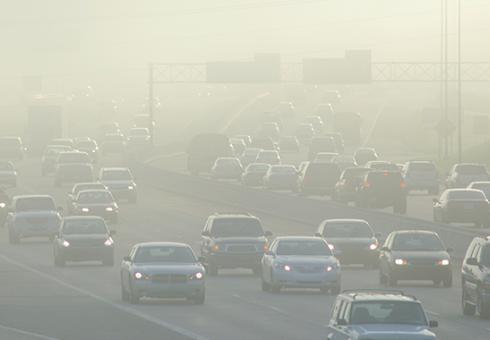
Anthropogenic emissions that lead to air pollution (particulate matter and ozone) are also large contributors to climate change. Unlike the well-mixed greenhouse gases, the spatial distribution of these emissions affects their climate impact. A better understanding of the role of aerosols and ozone in contributing to historical and projected future climate change provides insight into the relative importance of air pollutants versus well-mixed greenhouse gases, the role of uncertainties in forcing in creating uncertainties in regional climate projections, and the balance between efforts to improve air quality and mitigate climate change.

In his presentation "How Air Pollution Affects Climate and What We Can Do About It", this year's Kendall Lecturer Drew Shindell, a senior scientist at the NASA Goddard Institute for Space Studies in New York City, discussed recent progress in understanding the role of aerosols and ozone and the implications for our understanding of climate sensitivity, of the recent slowdown in global warming, and of the benefits to both climate and human health that can be obtained by taking action to reduce air pollutant emissions.
Dr. Shindell who taught atmospheric chemistry at Columbia University for more than a decade, earned his Bachelor's degree at UC Berkeley and his PhD at Stony Brook University, both in Physics. His research concerns natural and human drivers of climate change, linkages between air quality and climate change, and the interface between climate change science and policy. He has been an author on more than 100 peer-reviewed publications and received awards from Scientific American, NASA, and the NSF. He has testified on climate issues before both houses of the US Congress, the UNFCCC and the World Bank, developed a climate change course with the American Museum of Natural History, and made numerous appearances in newspapers, on radio, and on TV as part of his public outreach efforts. He chaired the 2011 Integrated Assessment of Black Carbon and Tropospheric Ozone produced by the United Nations Environment Programme and World Meteorological Organization. Most recently he was a Coordinating Lead Author on the 2013 Fifth Assessment Report of the Intergovernmental Panel on Climate Change, and chairs the Scientific Advisory Panel to the Climate and Clean Air Coalition of nations.
The Henry W. Kendall Memorial Lecture Series honors the memory of Professor Henry Kendall (1926-1999), a 1990 Nobel Laureate, a longtime member of MIT’s physics faculty, and an ardent environmentalist. A founding member and chair of the Union of Concerned Scientists, he played a leading role in organizing scientific community statements on global problems, including the World Scientists’ Warning to Humanity in 1992 and the Call for Action at the Kyoto Climate Summit in 1997.
Following the lecture there was a reception in the Green Building.
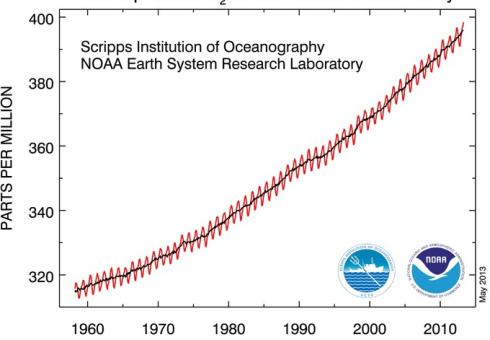
The Keeling Curve record from the NOAA-operated Mauna Loa Observatory shows that the atmospheric carbon dioxide concentration hovers around 400 ppm, a level not seen in more than 3 million years when sea levels were as much as 80 feet higher than today. Virtually every media outlet reported the passage of this climate milestone, but we suspect there’s more to the story. Oceans at MIT’s Genevieve Wanucha interviewed Ron Prinn, Professor of Atmospheric Science in MIT’s Department of Earth, Atmospheric and Planetary Sciences. Prinn is the Director of MIT’s Center for Global Change Science (CGCS) and Co-Director of MIT’s Joint Program on the Science and Policy of Global Change (JPSPGC).
Prinn leads the Advanced Global Atmospheric Gases Experiment (AGAGE), an international project that continually measures the rates of change of the air concentrations of 50 trace gases involved in the greenhouse effect. He also works with the Integrated Global System Model, which couples economics, climate physics and chemistry, and land and ocean ecosystems, to estimate uncertainty in climate predictions and analyze proposed climate policies.
What is so significant about this 400-ppm reading? 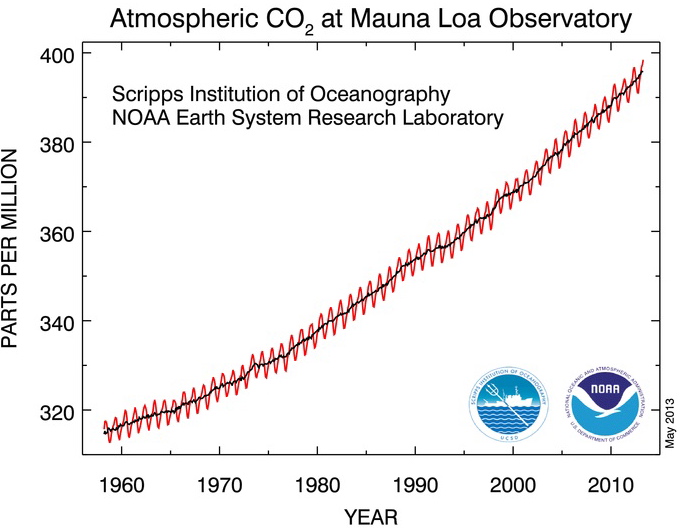
This isn’t the first time that the reading of 400 parts per million (ppm) of atmospheric CO2 was obtained. It was recorded at a NOAA’s observatory station in Barrow, Alaska, in May 2012. But the recent 400-ppm reading at Mauna Loa, Hawaii got into the news because that station produced the famous “Keeling Curve,” which is the longest continuous record of CO2 in the world, going back to 1958.
‘400’ is just a round number. It’s more of a symbol than a true threshold of climate doom. The real issue is that CO2 keeps going up and up at about 2.1 ppm a year. Even though there was a global recession in which emissions were lower in most fully-developed countries, China, and to lesser extent India and Indonesia, blew right through and continued to increase their emissions.
Has anything gone unappreciated in the news coverage of this event?
Yes. What’s not appreciated is that there are a whole lot of other greenhouse gases (GHGs) that have fundamentally changed the composition of our atmosphere since pre-industrial times: methane, nitrous oxide, chlorofluorocarbons (CFCs), and hydrofluorocarbons. The screen of your laptop is probably manufactured in Taiwan, Japan, and Eastern China by a process that releases nitrogen trifluoride—release of 1 ton of nitrogen trifluoride is equivalent to 16,800 tons of CO2. But there is a fix to that—the contaminated air in the factory could be incinerated to destroy the nitrogen trifluoride before it’s released into the environment.
Many of these other gases are increasing percentage-wise faster than CO2 . In the Advanced Global Atmospheric Gases Experiment (AGAGE), we continuously measure over 40 of these other GHGs in real time over the globe. If you convert these other GHGs into their equivalent amounts of CO2 that will have the same effect on climate, and add them to the NOAA measurements of CO2, you find that we are actually at 478 ppm of CO2 equivalents right now. In fact, we passed the 400 ppm back in about 1985. So, 478 not 400 is the real number to watch. That’s the number people should be talking about when it comes to climate change.
What has Advanced Global Atmospheric Gases Experiment (AGAGE) revealed about this greenhouse gas problem?
The non-CO2 GHGs are very powerful. One example is sulfur hexafluoride (SF6), which used to be in Nike shoes, and is now most widely used in the step-down transformers in long-distance electrical power grids. But SF6 leaks a lot, with 1 ton equivalent to 22,800 tons of CO2, and it’s increasing in our measurements. Another example is methane. We have been measuring methane for almost 30 years now, and it actually didn’t increase for almost 8 years from 1998 onwards, but we discovered in our network that it began to increase again in 2006. We published this finding in 2008, and ever since, methane has been rising at a rapid rate. Nitrous oxide, the third most important GHG, has been going up almost linearly since we started measuring it in 1978.
The worrisome thing is that almost all of these gases keep rising and, per ton, they are very powerful drivers of warming. Many of these GHGs have lifetimes of hundreds to thousands to tens of thousands of years, so they are essentially in our atmosphere forever. There is almost nothing practical we can do to vacuum these gases out again.
Is it possible to decrease the atmospheric CO2?
One well-understood method of removing CO2 from the atmosphere is carbon sequestration, in which you remove the CO2 from the biomass burnt in an electrical utility, and then bury it in subsurface saline aquifers or in the deep ocean. There are people here at MIT, Rob van der Hilst and Brad Hager and others, who study the question of just how permanent is this deep burial on land.
Carbon sequestration can also lower CO2 emissions from coal-fired power plants. It looks like the Department of Energy will reactivate a couple of these projects in Wisconsin and Texas to better understand this technology, with the goal of lowering the emissions from power plants to say 10% or less of what they were.
At the end of the day, the smart thing would be not to resort to vacuuming CO2 out of the atmosphere and putting it down deep underground. It would be better to develop new and affordable zero- or very low-emission energy technologies such as biofuels, nuclear, solar and wind.
Will switching to ‘fracked’ natural gas reduce warming?
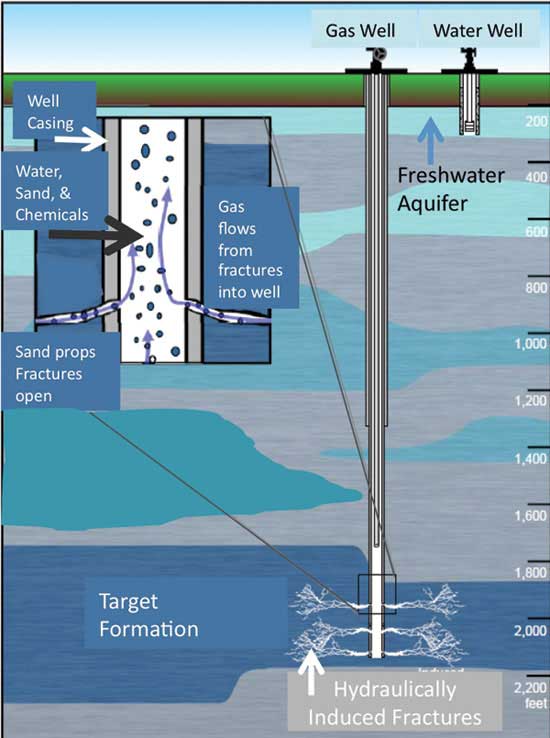
Hydraulic fracturing in a vertical well. Credit: EPA
We have run our Integrated Global System Model presuming that hydraulically fractured gas from shale deposits in the US and elsewhere around the world could begin to be used at large scale. We’ve looked at the question of if we did convert all oil usage to fracked gas usage over the next 20-30 years, would it lower the rate of warming? And the answer is yes, because you get about twice as much energy per ton of CO2 emitted from burning methane as you get from coal.
There are some serious issues about the water used to pump down and split the shale. In the fracking process, trace chemicals are added into the water to make it slippery so the water can force itself in between the layers of shale. The problem is, shale is filled with mucky stuff such as salts and heavy organics, which all ends up in the frack water and comes back up to the surface. So what do you do with that very polluted water? Then there is the concern that the water could travel horizontally and vertically through the shale layers and end up in ground water. And that’s an environmental issue that has to be addressed.
However, chemical companies are already investing in technologies that can take the frack water that’s pumped back out and literally clean out the hydrocarbons and re-use it again for fracking. So, there is an answer to the frack water problem, but there must be a strong push to make sure fracking is environmentally sound.
We did find that if you increase the use of fracked gas and didn’t repair the existing natural gas pipelines, they could leak several percent of the transferred volume because it’s old city and intercity infrastructure. It’s leaking now in all major pipeline systems in the US and Europe, which is a problem because the leaked methane is a much more powerful GHG per ton than CO2. So, repairing or replacing old gas pipelines will be a big requirement.
Addressing all these environmental concerns will add somewhat to the cost of energy. But most who study the climate issue in detail and in depth understand that the damages that are going to result from continued warming will far exceed the cost of any policy that we put together to lower GHG emissions. Yet, as you know, the politics of climate in Washington is impossible right now because a minority of senators can block any legislation. It doesn’t look like anything will happen soon on a national emissions reduction policy. Politics trumps science on these issues. But the EPA has the power to treat CO2 as an air pollutant so maybe that’s what will happen near term.
The bottom line is if we switched from using oil and coal globally to running everything on shale gas, there probably is enough gas there. But with this alone, you would still get about a 3.5 C warming by 2100. With no policy at all, our model estimates a 5-degree or higher warming. So replacing coal and oil with fracked gas is a sensible pathway for the US to go over the next few decades, with the additional advantage of gaining more energy independence. But it won’t remove the global warming threat beyond that.
What are the implications of the 478-ppm measurement to human life?
According to the paleoclimatological ice core record, if our planet warms more than 2 C globally (4 C at the poles), we are in trouble. That’s about 6 meters or 20 feet of sea level rise. Most of the world’s valuable infrastructure and high populations are along the coasts. So, the damage and cost of sea level rise alone is potentially very high. Other risky phenomena we face are shifting rainfall patterns that may move the locations of arable farmland out of the US and into Canada. Mexico could grow drier and drier, and there’s concern in the Department of Defense about potential challenges to the security at the southern US border. Other similarly vulnerable areas around the world could face desperate large-scale migrations of people seeking to find places to grow food.
These damages are likely to exceed significantly the costs associated with an efficient and fair GHG policy such as an emission tax whose revenues are used to offset income taxes.
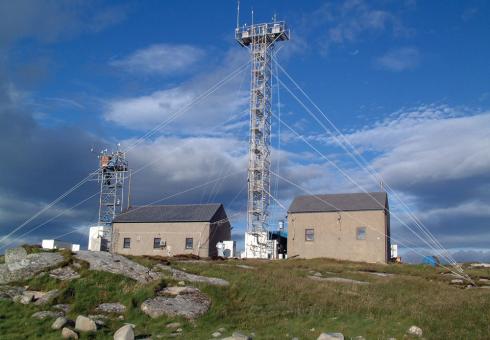
The Advanced Global Atmospheric Gases Experiment (AGAGE), meets this week in Boston for their biannual meeting and to celebrate their 35th anniversary.