
ABOUT THE LECTURE:
Downward swooping lines on the graphs say it all: The world’s fish populations, and hence its fisheries, are collapsing. Daniel Pauly has analyzed reams of data -- including number of boats fishing, their reported catch, the amount of fish thrown overboard -- from every significant fishing area of the world over 50-plus years, and has concluded that today, 30% of our fisheries have crashed, and that by 2048, if the trend continues, most will have disappeared.
This dismal turn of events comes courtesy of rampant over fishing, as well as wantonly wasteful fishing methods, says Pauly. Trawling rigs with miles of bottom-scraping nets may yield tons of desirable table fish, but also tons of byproduct—fish that don’t bring as much in the market. These get tossed overboard. In the early 90s, according to Pauly, 30 million tons of fish -- fully 1/4 of the world’s catch- -- was discarded. Improvements in technology such as GPS have only made matters worse.
There’s little awareness of the magnitude of the problem among Western countries, because there’s no sign of it in supermarkets, with fish department displays still spilling over. That’s because Europe and America have moved south for their fish, says Pauly. Europe is now plying the waters off Africa, leaving Guinea-Bissau, for instance, with only 7% of its fish. Americans increasingly eat South American and Asian fish. “The only place with no massive depletion is Brunei,” says Pauly, because “the Sultan doesn’t want boats between his oil wells.”
This collapse isn’t just a matter for fish eaters. As the top-paying table fish disappear, humans begin “fishing down the marine food web,” taking immature fish, and the fish that are prey to other species. Trawling in these already ecologically disturbed waters churns up sediment and takes out bottom dwelling fish, invertebrates and corals, which are essential to a healthy marine system. Biomass disappears, leaving dead zones. These ecosystems are primarily good for jellyfish and harmful algal blooms, says Pauly. The dead zone in the Gulf of Mexico is already the size of the state of Delaware.
Asked what fish it’s alright to eat, Pauly recommends chicken. In fact, he doesn’t believe “it’s an issue that can be fixed by private initiatives.” Effective action would mean eliminating fuel and other subsidies from the world’s fisheries, and permitting only small scale fisheries that engage in sustainable harvesting. But even this may not save certain species from extinction, as global warming pressures the world’s remaining fish species.
ABOUT THE SPEAKER:
Daniel Pauly became a professor at UBC's Fisheries Centre in 1994, after many years at the International Centre for Living Aquatic Resource Management (ICLARM), then in Manila, Philippines. Pauly has authored or co-authored more than 500 scientific articles, book chapters and shorter contributions, and authored, or (co-) edited about 30 books and reports. Two books, On the Sex of Fishes and the Gender of Scientist: A Collection of Essays in Fisheries Science (Chapman and Hall, 1994) and "Méthodes pour l'évaluation des ressources halieutiques (Cépaduès-Éditions, 1997) summarize much previous work, as do his articles "Fishing Down Marine Food Webs" (Science, February 6, 1998), and "Toward Sustainability in World Fisheries," (Nature, August 8, 2002). Two other books, In a Perfect Ocean: Fisheries and Ecosystem in the North Atlantic (Island Press, 2003); and Darwin's Fishes: An Encyclopedia of Ichthyology, Ecology and Evolution (Cambridge University Press, 2004) document his current interests.
In 2001, he was awarded the Murray Newman Award for Excellence in Marine Conservation Research, sponsored by the Vancouver Aquarium, and the Oscar E. Sette Award of the Marine Fisheries Section, American Fisheries Society. He was named a 'Honorarprofessor 'at Kiel University, Germany in late 2002. In 2003, he was named one of UBC's Distinguished University Scholars and elected a Fellow of the Royal Society of Canada (Academy of Science). In 2004, he received the Roger Revelle Medal from IOC/UNESCO, and the Award of Excellence of the American Fisheries Society.
Pauly received his Master (1974), Doctorate (1979) and 'Habilitation' (1985) in Fisheries Biology and Biological Oceanography from the University of Kiel, Germany.
Fisheries and Global Warming: Impacts on Marine Ecosystems and Food Security
Related Media and Events
Genevieve Wanucha
Program in Atmospheres, Oceans and Climate
IAP 2014 was bone-chilling, and thanks to 12.310, An Introduction to Weather Forecasting, 20 new amateur forecasters can tell you why.
Always offered between semesters, 12.310 reveals the principles of fluid dynamics that govern the atmosphere’s movement. In lectures, real forecasting exercises, and a trip to WBZ TV’s on-air weather center, students learn where newsrooms get their daily weather predictions — and how they can make their own.
“Our aim is that students come to understand that weather forecasting is not guessing and is based on real science,” says Lodovica Illari, senior lecturer in synoptic meteorology in MIT’s Program for Atmospheres, Oceans, and Climate (PAOC), who has taught the course for 20 years. “We hope the students get interested in fluid dynamics and come back and do some more.”
To reveal the laws governing the atmosphere’s motion “in action,” Illari used demonstrations with MIT’s Weather in the Tank materials. In one class, Illari rotated a cylindrical tank of water on a turntable to emulate the dynamics of Earth’s atmosphere. A bucket of ice at the tank’s center created a temperature gradient. As students peered in, Illari dropped ink into the water to make visible the small currents forming in the water, demonstrating the conditions that create weather systems.
12.310 stands as a yearly reminder of MIT’s distinguished history in weather forecasting. In fact, Carl-Gustaf Rossby, who transformed weather forecasting into an atmospheric science, founded the country’s first meteorology program at MIT in 1928. A line of prominent MIT faculty meteorologists followed, including Jule Charney, Norman Phillips, Victor Starr, and Edward Lorenz. The fundamental contributions to fluid dynamics made by these past professors resonate in MIT’s modern-day research into much longer-time-scale atmospheric phenomena such as climate.
As the students of 12.310 learned the basics of weather forecasting, they came to appreciate an insight of Professor Lorenz’s that changed meteorology forever. At MIT in 1961, Lorenz found that rounding a few digits off one decimal number in a computer weather simulation changed its projected long-term pattern. He had discovered the big implications of the chaos theory principle of “sensitive dependence on initial conditions” for weather prediction. Slightly imprecise measurements, even single-digit differences in dew point, can skew long-term forecasts. The chaotic nature of short-term weather places a limit of less than 10 days on accurate forecasts.
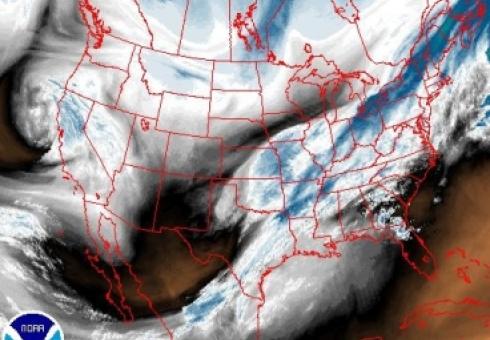
To make their own forecasts, the students used raw data spit out of weather prediction models run at the National Weather Service, which are read out in maps of the temperature, air pressure, dew point, wind, and moisture across the country. With that information, the students anticipated the likely passage of warm or cold weather fronts by searching for regions of strong gradients in temperature or moisture and shifts in wind direction. The class ended with a TV-style presentation of the day’s weather and a Boston weather forecasting competition. This year, Fiona Paine ’17 took home the prize of a digital indoor/outdoor thermometer.
The course was organized and taught by Illari and co-instructor Jeff Scott, a research scientist at PAOC and the Center for Global Change Science, along with teaching assistants Casey Hilgenbrink ’15 and PAOC graduate student Vince Agard ’11, who are both members of the MIT Weather Forecasting Team.
Many of the undergraduates signed up for 12.310 to get a taste of the kind of science they could pursue in PAOC. Others said that knowing how to predict the weather is just plain useful. And everyone found the class eye-opening. “It was surprising to me just how difficult it can be to predict tomorrow's weather, even when using the newest technology,” says Oren Katzen ’16. “I will be certain to be more forgiving to the weatherman in the future.”