User account menu

  • Log in
MIT Joint Program On The Science and Policy of Global Change

Main navigation

  • About Us
    • Our Purpose
    • Our History
    • Leadership
    • Personnel
    • Support the Center
    • Contact Us
  • Research
    • Interconnected Systems
    • Modeling and Data
    • Actionable Research
    • Research Projects
  • Publications
    • All Publications
    • Annual Report
    • Global Change Outlook
    • Peer-Reviewed Research
    • Reports
    • Other Publications
    • Publication Search
  • News + Media
    • News Releases
    • In the News
  • Events
    • Upcoming Events
    • Past Events
    • Global Change Forum
  • Sponsorship
    • About Sponsorship
    • Our Sponsors
    • Sponsor Login

News and Outreach: Stephanie Dutkiewicz

phytoplankton
In The News
Scientific American
Aug 9, 2013
Sweeping Change in Phytoplankton Populations Could Remake Oceans

By Mark Fischetti

As Earth’s atmosphere warms, so does the ocean. Scientists have demonstrated how rising ocean temperatures and carbon dioxide levels can stress marine organisms. But a new model developed by the Massachusetts Institute of Technology reveals a surprising conclusion: If global temperature trends continue, by the end of this century half the population of phytoplankton that existed in any given ocean at the beginning of the century will have disappeared and been replaced by entirely new plankton species. “That’s going to have impacts up the food chain,” says Stephanie Dutkiewicz, principle research scientist at M.I.T.’s Program in Atmospheres, Oceans and Climate.

Rising temperatures will force all kinds of sea creatures to adjust. Tiny phytoplankton, a major food source for fish and other sea creatures, could perish as temperatures rise in an ocean region. Most at risk are the organisms in the coldest waters, which lack the resilience to adapt to warmer homes. In theory, the phytoplankton could evolve to alter their body chemistry or they could migrate elsewhere, perhaps closer to the poles. Either way, such immense change may leave species higher up the food chain unable to feed themselves.

The new model does not specify precisely how phytoplankton will respond or which fish populations might flourish or flounder, but it is sufficiently detailed to indicate that the new ocean conditions will likely lead to widespread replacement of the phytoplankton now in place. Dutkiewicz’s model accounts for 100 different phytoplankton species whereas most other models include just three or four. “With such finer resolution,” Dutkiewicz says, “we can see how significantly ecosystem structures will change.”

The results depict a complex picture. As the temperature rises, many phytoplankton produce more offspring. But less mixing occurs between deep cold waters and warm surface waters—a phenomenon known as stratification. Most nutrients that phytoplankton rely on well up from the deep, so less mixing means less sustenance for the microorganisms. Oceans at low latitudes—already considered the deserts of the sea—will provide even fewer nutrients for microorganisms, leaving even less food for the fish that feed on them.

At higher latitudes, Dutkiewicz says, higher temperatures and less mixing could force phytoplankton to stay closer to the surface, where at least some nutrients are available. More sunlight in that top layer, however, could again change the mix of micro critters. “There is a huge range in size and type of phytoplankton, which can affect the fish that graze on them,” she says.

Dutkiewicz is now beginning to lend additional realism to the model by adding more factors, such as changing levels of nitrogen and iron. Ocean acidification is also high on her list—a chemical variable that could alter competition among phytoplankton, some of which are far more adaptable to changing pH levels than others. Any of these dials on the dashboard could significantly affect the fate of whole ecosystems.
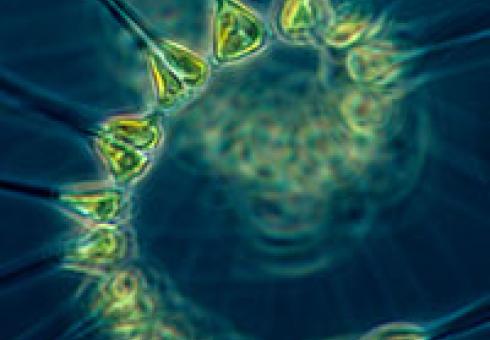

Phytoplankton
News Release
MIT News Office
Jul 29, 2013
Winners and losers in a warming ocean

July 29, 2013
Alli Gold Roberts
MIT Joint Program on the Science and Policy of Global Change

Phytoplankton — small plant-like organisms that serve as the base of the marine ecosystem — play a crucial role in maintaining the health of our oceans by consuming carbon dioxide and fueling the food web. But with a changing climate, which of these vital organisms will survive, and what impact will their demise have on fish higher up the chain?

Stephanie Dutkiewicz, a researcher with the MIT Joint Program on the Science and Policy of Global Change, and her colleagues developed a model that investigates the potential effects of climate change on phytoplankton.

“Our model is unique because we were able to include 100 different species of phytoplankton, where almost all other models include just three or four,” Dutkiewicz explains. “This diversity of species allows us to analyze the ecological effects of climate change and how species will shift, adapt, thrive or die off.”

Once Dutkiewicz and her team built their phytoplankton model, they integrated it with a 3-D model of the global ocean system that is part of the Joint Program’s Integrated Global System Model (IGSM) 2.3. This comprehensive model allows the researchers to study temperature, light and circulation in terms of both the large consequences to the ocean system as a whole and the small responses individual phytoplankton have with each other.

“This model gives a nice demonstration of the complexity of the system and how you can’t just look at one piece of it to see what’s going to happen,” Dutkiewicz says.

Dutkiewicz gives an example: If a researcher just looks at the effects from a change in temperature, they would find that phytoplankton would be more productive. But when studying the whole picture, that is not the case.

On a global scale, and in the most extreme climate scenario, Dutkiewicz finds that by the end of the century half the population of phytoplankton that existed at the beginning of the century will have disappeared and been replaced by entirely new phytoplankton species.

“There will still be phytoplankton in any part of the ocean, they’ll just be different and that is going to have impacts up the food chain,” Dutkiewicz says.

Globally ocean productivity may not change much, as different impacts of changing climate might balance each other out, Dutkiewicz’s research shows. But looking regionally paints an entirely different picture. In the tropics and higher latitudes, a decrease in the nutrients these small organisms need to survive will limit phytoplankton growth. Meanwhile, in the upper latitudes, the ocean temperatures are expected to rise, spurring phytoplankton growth.

“The take home message is, studying these complex climate interactions is not simple and trying to make it simple will give you the wrong answer,” Dutkiewicz says.

Now that Dutkiewicz has built this complex marine ecosystem model, she is planning to apply it to new research. In fact, she has already added an additional type of phytoplankton that’s a nitrogen fixer, meaning it converts nitrogen into a useable form to help feed other organisms. She plans to assess how this species has changed over time. Dutkiewicz is also assessing the impacts of iron, an important nutrient in absorbing CO2, on phytoplankton populations.

Joint Program Logo
MIT News
Mar 29, 2007
MIT Darwin Project will model ocean microbes

A new program to develop computational models of how marine microbes live and evolve in the global ocean has been launched to help researchers understand and simulate the relationships between climate change, marine ecosystems and the ocean carbon cycle. The collaborative effort is led by Mick Follows, and includes participants Penny Chisholm, Stephanie Dutkeiwicz, John Marshall and Chris Hill, among others. (More about the Darwin Project.)

Joint Program Logo
MIT News
Mar 29, 2007
Ocean model captures diversity of underwater forests

Simulation condenses 10 years' evolution into five days of computing - Scientists at MIT have created an ocean model so realistic that the virtual forests of diverse microscopic plants they "sowed" have grown in population patterns that precisely mimic their real-world counterparts.

Pagination

  • First page « First
  • Previous page ‹ Previous
  • …
  • Page 2
  • Page 3
  • Page 4

Inspired by our mission?

You can help to sustain our research by donating through Giving to MIT (search for fund 2045100).

Contact Information

MIT Center for Sustainability Science and Strategy
Massachusetts Institute of Technology • Cambridge, MA 02139

Follow Us

Quick Links

  • Contact Us
  • CS3 staff & students
  • Accessibility
  • Logout

Main navigation

  • About Us
    • Our Purpose
    • Our History
    • Leadership
    • Personnel
    • Support the Center
    • Contact Us
  • Research
    • Interconnected Systems
    • Modeling and Data
    • Actionable Research
    • Research Projects
  • Publications
    • All Publications
    • Annual Report
    • Global Change Outlook
    • Peer-Reviewed Research
    • Reports
    • Other Publications
    • Publication Search
  • News + Media
    • News Releases
    • In the News
  • Events
    • Upcoming Events
    • Past Events
    • Global Change Forum
  • Sponsorship
    • About Sponsorship
    • Our Sponsors
    • Sponsor Login

User account menu

  • Log in
Back to top