
News + Media

Grad student Jesse Jenkins and professor Valerie Karplus discuss challenges of emissions pricing in a new paper
In a new working paper titled "Carbon pricing under binding political constraints," MIT Institute for Data, Systems and Society doctoral candidate Jesse Jenkins and Sloan School of Management Assistant Professor Valerie Karplus discuss the political obstacles facing efforts to price carbon emissions and outline a set of starting points that are both politically palatable and steps toward effective policies to curb climate change.
Comprehensive fundraising initiative aims to raise $5 billion to advance Institute's work on some of the world's biggest challenges
MIT President L. Rafael Reif today announced the official launch of the MIT Campaign for a Better World, a comprehensive fundraising initiative that will amplify the Institute's distinctive strength in education, research, and innovation, and will advance MIT’s work on some of the world's biggest challenges.
MIT has a history of discovery, knowledge creation, and innovation. Through the MIT Campaign for a Better World, MIT aims to extend that track record, raising $5 billion in support of efforts that, as announced by Reif, will enable a future where fundamental science unlocks new knowledge; where climate change yields to climate action; where clean energy is universal; where everyone can count on clean water and nourishing food; where we detect disease before it has symptoms; where Alzheimer's itself is just a memory; where good ideas don’t languish in the lab but flourish in the marketplace; where daring companies create thriving industries and achieve lasting progress; where prosperity is measured not in dollars alone but in the currency of art, culture, and understanding; where quality education is radically more available; and where we offer the world's undiscovered talent a digital path to a creative future.
To ensure that MIT continues to attract a community of exceptionally talented students and faculty, and provides the infrastructure their pioneering work demands, the Campaign is also committed to strengthening the Institute's core — increasing resources for undergraduate financial aid, graduate fellowships, and professorships; reimagining residential living and educational spaces; and developing innovative research facilities such as MIT.nano.
"Humanity faces urgent challenges — challenges whose solutions depend on marrying advanced technical and scientific capabilities with a deep understanding of the world's political, cultural, and economic complexities," Reif said.
"We launch the Campaign for a Better World to rise to those challenges and accelerate positive change. In this effort, we seek the support of enthusiastic partners who share our sense of mission and infinite possibility — including our remarkable alumni, who do the great work of MIT in the world every day," he continued. "Together, through this Campaign, we will give the brilliant minds and hands of the MIT community the fuel and the focus to make inspiring progress for the world."
The Campaign is guided by six priority areas that span the full breadth of MIT:
- Discovery Science: Transforming our world through fundamental scientific research
- Health of the Planet: Addressing critical environmental and sustainability challenges facing humankind through science, technology, design, management, and policy
- Human Health: Defining the future of health through advances in basic science and engineering — informed by expertise in disciplines such as management, economics, and political science
- Innovation and Entrepreneurship: Accelerating the path from idea to impact
- Teaching, Learning, and Living: Reimagining education for the 21st-century learner
- The MIT Core: Attracting extraordinary students and faculty, and providing them with the resources they need to thrive
"The MIT Campaign for a Better World represents an important and historic undertaking," said Julie A. Lucas, MIT's vice president for resource development. "Its priorities transcend disciplines and reflect the breadth and depth of the Institute's commitment to bringing real change to the world. This is an extraordinary moment in the life of MIT."
As of the end of the first quarter of 2016, MIT has raised over $2.6 billion toward the Campaign goal, with gifts coming from more than 77,000 alumni and friends. The Institute's most recent comprehensive fundraising campaign ran from 1997 to 2004.
"This Campaign will have far-reaching positive implications for the world at large," said Robert B. Millard '73, chair of the MIT Corporation. "It is an opportunity to re-inspire, reenergize, and recommit the MIT community to our shared vision and values, while amplifying the power of our students, faculty, and staff to shape the future by providing them with the resources they need to do their best work.”
For more information on the MIT Campaign for a Better World, visit betterworld.mit.edu and follow #MITBetterWorld.
Joint Program research highlighted in the MIT Campaign for a Better World:
https://betterworld.mit.edu/better-climate-predictions-more-resilient-agriculture/
https://betterworld.mit.edu/the-nature-of-hurricanes/
https://betterworld.mit.edu/true-costs-energy-policy/
https://betterworld.mit.edu/the-oceanclimate-connection/
http://mitsloan.mit.edu/campaign/mit-sloan-campaign-priorities/health-of-the-planet/
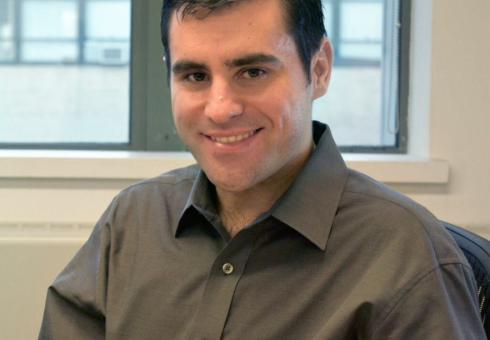
Steven Barrett probes the environmental impact of aviation and options for reducing it
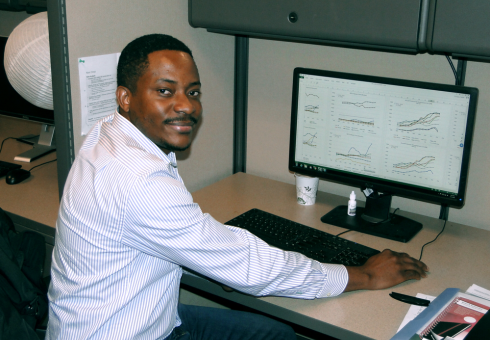
MIT graduate student Tochukwu "Tox" Akobi investigates the impact of technological innovation on the price of oil
Although the Paris agreement scheduled to be signed 22 April aims for a 2°C warming cap, new findings show that even a 1.5°C rise will hit glaciers hard.
To mark Earth Day, leaders from more than 165 countries are expected to gather at the United Nations tomorrow for a ceremony to sign the Paris climate agreement, reached last December. Under the historic deal, each country has set targets to reduce greenhouse gas emissions, with the ultimate goal to keep the rise in global temperatures below 2°C above the preindustrial average.
However, new research suggests that the emissions caps might not be low enough to prevent damaging impacts for parts of the world that are vulnerable to climate change. A study presented today at the 2016 European Geosciences Union (EGU) meeting in Vienna, Austria, shows big differences between a 2°C warmer world and a 1.5°C warmer world.
A 2°C temperature increase by 2100 would mean that all coral reef ecosystems in tropical regions would be at risk of degradation due to coral bleaching. The study, also published today in Earth System Dynamics, shows that tropical regions would be especially hard hit by a 2°C temperature increase. Warm spells would last up to 50% longer, resulting in corn and wheat yields half what they would be under a 1.5°C increase, the researchers found. What’s more, a 2°C temperature increase by 2100 would also mean that all coral reef ecosystems in tropical regions would be at risk of degradation due to coral bleaching, according to the study led by Carl Schleussner of Climate Analytics in Germany.
Greater Reductions Needed
To limit temperature increases to just 1.5°C, countries may need to strengthen their emission reduction pledges significantly. Even if the current Paris commitments are met and extended beyond 2030, global temperatures are on track to rise 3°C above the preindustrial average, said Massachusetts Institute of Technology climate scientist Erwan Monier.
He collaborated in another study, also presented at the EGU meeting this week, that combined a human activity model with a climate model to look at five different global warming scenarios through 2100. His team found that there is only a 5% probability that the Paris agreement will keep global temperatures below 2°C, even with the most optimistic outlook.
Nonetheless, Monier told Eos that it is still possible to limit temperatures to 2°C by the end of the century. However, that would require major changes in policy. “We’re not on that path right now, but it’s totally achievable,” he said. “I think most people know some policy tools that would get us there, like a carbon tax. But there’s unwillingness to actually use those.”
Possible 2.7°C Rise Scrutinized
Other researchers have focused on tipping points for severe climate impacts that may lie beyond 2°C. Climate scientist Robert DeConto of the University of Massachusetts Amherst published a paper in Nature last month that found that the Antarctic ice sheet would barely contribute to sea level rise if the average global temperature rise stayed below 2°C. Since writing that paper, DeConto has applied his same model to a temperature increase of 2.7°C. At a press conference at the EGU meeting today, DeConto explained that his preliminary results suggest that the Antarctic ice sheet would contribute about 80 centimeters of potential sea level rise in a 2.7°C warmer world. DeConto chose to scrutinize the effects of a 2.7°C increase because the Climate Action Tracker had warned ahead of the Paris agreement that the world is headed for that level of warming by 2100 even if governments fully implement their climate action pledges.
Glacier Loss Will Continue Under Cuts
Even a modest 1.5°C increase would still result in about half of glaciers melting. Another study finds that regardless of the success of the Paris agreement, some damaging aspects of climate change can’t be stopped. Glacier melt will continue to accelerate, explained Ben Marzeion, a climate scientist at the University of Bremen in Germany. He presented his results during an earlier session at the EGU meeting. If it were scientifically possible for global warming to stop today, glaciers would still lose 30% of their mass. Even a modest 1.5°C increase, according to Marzeion, would still result in about half of glaciers melting.
—Megan Gannon, Freelance Writer; email: megan.i.gannon@gmail.com
© 2016. The authors. CC BY-NC-ND 3.0
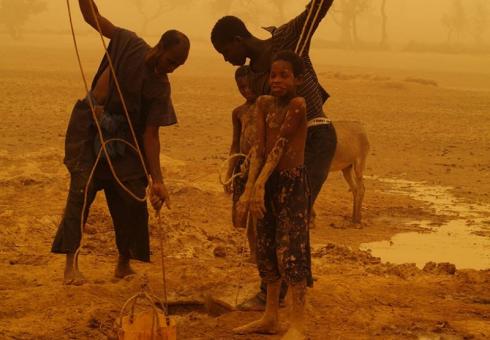
Photo: Men and children withdrawing water for irrigation in the Dogon plateau (Mali) during a sandstorm day. New research finds that warm spells in tropical regions will likely last 50% longer if warming exceeds the global preindustrial average temperature by 2°C rather than by 1.5°C. (Credit: Velio Coviello via imaggeo.egu.eu, CC BY-SA 3.0)
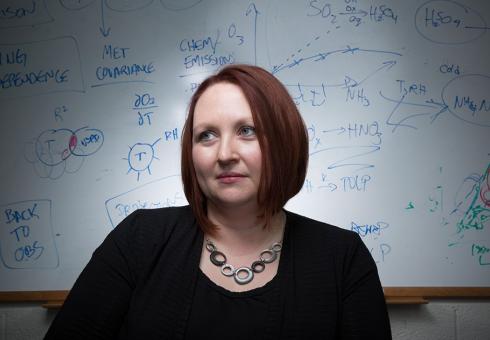
Colette Heald studies atmospheric gases and particles, and how they affect air quality and climate
Winds that blow across the Sahara desert in North Africa pick up particles of soil and sand, and typically carry them westward. Many of these grains travel across the Atlantic, leading to poor-visibility days in the southern U.S. and Caribbean, transporting nutrients to far-flung ecosystems in South America, and impacting hurricane formation in the Atlantic.
That’s just one example of the myriad ways that the behavior of tiny particles blown by the wind can have large-scale local, regional, and even global effects on the complex systems that govern Earth’s atmosphere. For Colette Heald, trying to unravel the intricate patterns of the atmosphere’s composition and chemistry, and the way these affect ecosystems, air quality, and even the climate itself, has been the driving force of her career.
Heald, who earned tenure at MIT last year, is the Mitsui Career Development Associate Professor in the Department of Civil and Environmental Engineering and also holds an appointment in the Department of Earth, Atmospheric and Planetary Sciences. Originally from Canada, she was born in Montreal and grew up in Ottawa, where her father was a paper industry executive and her mother a nurse. An older sister, who still lives in Canada, is an aerospace engineer.
Heald earned her BS in engineering physics at Queen’s University in Kingston, Ontario, and while there started doing summer research projects with faculty members at the University of Toronto. That’s when she got introduced to the field of atmospheric science. “I was so excited,” she says, to discover the deep connections between the kind of technical engineering research she had studied and the global environment. That led her to pursue a doctorate in atmospheric chemistry at Harvard University.
Coming from all directions
“That seemed like a flip from physics,” she recalls, “and I was concerned that I didn’t have the chemistry background for it.” But she soon discovered that the field “is so interdisciplinary; people come from a variety of directions” and bring different perspectives to the research.
She immediately became fascinated by the use of satellite data to study the atmosphere and its interactions. The timing was good: The first satellites measuring atmospheric pollution had been launched just a few years earlier.
One of the things measured by satellites was the concentration of carbon monoxide in the air. That compound “is produced from all kinds of combustion processes, and it’s a nice indicator because it stays in the atmosphere for about a month,” she says, “so we can use it to investigate the transport of plumes from sources to continents down-wind.”
Heald describes her current work as “trying to understand the sources, transformation, and impact of gases and particles in the atmosphere, which is very dynamic with a lot of chemical compounds that interact.” In a sense, she says, her focus is on figuring out what’s missing — where the holes are in models of the atmosphere, and how to fill those gaps. “I take an endpoint perspective,” she says. “I integrate the knowledge we have, and look for new ways to analyze the data to see what’s missing in our models.”
The effects are often subtle and hard to tease out from the chaotic mix of atmospheric processes. For example, in summer months the plumes of dust that constantly waft away from the Sahara desert end up in the North Atlantic and can make landfall in the United States and contribute to poor air quality in Florida. In the winter months winds blow the dust, which bears a complex load of assorted minerals, across to South America.
Trans-Atlantic fertilizer
One of those minerals is phosphorus, which happens to be a key limiting element for the growth of plants in the Amazon basin — so those African breezes are actually contributing to the Amazon’s fertility. That’s the kind of complex interaction, she explains, that would never be derived solely from theoretical modeling or experimental observation but requires the integration of different disciplines and approaches. “That gives you a sense of the challenge,” she says.
“There needs to be a strong coupling between observational work and modeling,” Heald says, “and these are models that take decades of development and a large community of scientists.” Much of her research focuses on aerosols, particles of matter so small that they virtually defy gravity and can stay aloft for weeks. Another major area of her research is the complex interaction between the atmosphere and the biosphere.
One thing that makes the modeling difficult is that many of the important processes in atmospheric chemistry involve transport across ocean basins, and “there are not a lot of observations available” over vast stretches of ocean. For example, for dust “we have long-term records in Barbados and in Florida, but we have to connect the dots” to extrapolate to the missing areas. Satellite data are helping to fill in the blanks, but careful calibration is required to make sure these measurements dovetail with the ground-based records.
Heald’s modeling work has showed, for example, that in recent decades winds have been slowing over Africa, and that could reduce the flow of those aerosols to the Americas. Since those particles have an overall cooling effect, by radiating back incoming sunlight, their reduction leads to an overall warming, she explains.
Heald says she has always been interested in many different subjects and had a hard time initially in college deciding what she wanted to major in, even considering art history. “My sister told me, you’ll always be able to experience art and literature, but it’s hard to pursue science and engineering as a hobby!”
While acknowledging that many women have experienced discrimination in their scientific education and careers, “I feel very fortunate,” Heald says, about the support and encouragement she received throughout her education and early career. “I was never discouraged, always only encouraged. I never felt that any doors were closed to me.”
The community of atmospheric chemists, she says, “is very collegial, and I’m grateful for the smooth path I’ve had and the friendly collaborations I’ve developed along the way. I know not all fields are like that, so when I have a chance to help or give back, I try to get involved.”
Photo: Colette Heald describes her current work as “trying to understand the sources, transformation, and impact of gases and particles in the atmosphere, which is very dynamic with a lot of chemical compounds that interact.” (Photo by Bryce Vickmark)