
News + Media
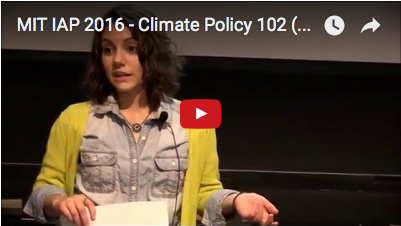
Katie Mulvaney - The 2016 Climate Policy 102 course surveys international, national and subnational climate governance, with an emphasis on COP21 and U.S. climate action plans.
Katie Mulvaney - The 2016 Climate Policy 102 course surveys international, national and subnational climate governance, with an emphasis on COP21 and U.S. climate action plans.
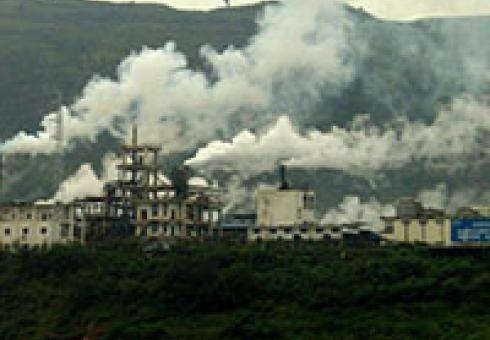
Auburn U., MIT researchers link lower crop yields to higher ozone levels
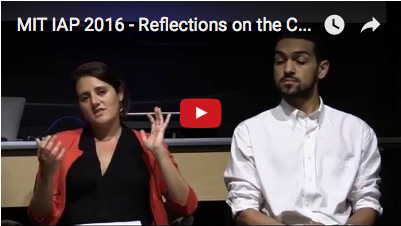
Amanda Giang - The 2016 course Dispatches from Paris: Reflections on the COP21 Climate Talks featured a panel discussion with members of the MIT community who participated as observers at the Paris climate negotiations.
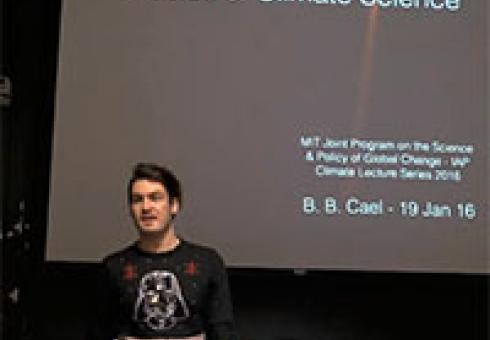
Mara Freilich - The 2016 Mechanisms of Climate Change course covers feedbacks and interactions among the water cycle, clouds, aerosols and ocean circulation in the climate system.
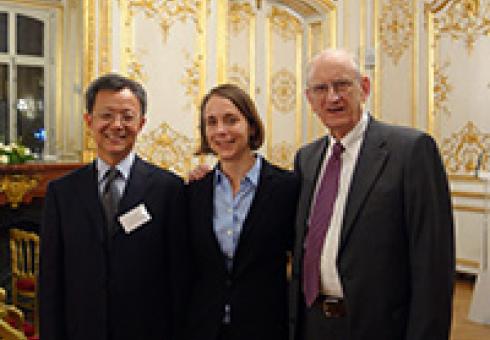
MIT attendees of COP21 share experiences, perspectives on outcomes
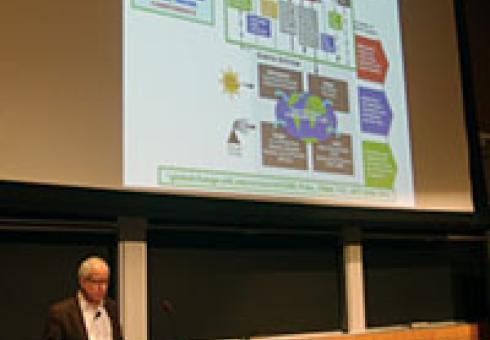
Experts examine how MIT can be most effective in addressing climate-change issues

John Reilly interviewed on PRI's The World
Jason Margolis | PRI’s The World
If you’re in the oil business, you might think your best days are in the rear-view mirror. Oil is selling for rock-bottom prices. Your product is blamed for destroying the planet. And here’s what the leader of the free world thinks of oil.
“We’ve got to accelerate the transition away from old, dirtier energy sources. Rather than subsidize the past, we should invest in the future,” said President Obama during his recent State of the Union address.
To state the obvious though, if you’re an oil company, you produce oil. Energy economist John Reilly at the MIT Sloan School of Management says companies like ExxonMobil and Chevron are facing a classic business challenge.
“Could the horse and buggy manufacturers become automobile producers? Or is some other company going to because they’re more innovative, or not bound by what they’re already doing?" asks Reilly.
But before we pity the poor oil companies, remember, these are the richest companies in the world.
“Most of them have lots of cash. And so, if there’s a successful alternative, if they don’t develop it, they probably can acquire those companies and transition that way,” says Reilly.
. . .
Read the full article and hear the broadcast at Public Radio International’s The World.
Photo: Norwegian company Statoil plans to build the first floating wind farm off the Scottish coast. (Photo courtesy of Statoil)
MIT will host a daylong symposium to address the nexus of science and action on climate change.
Helen Hill | EAPS
The MIT Department of Earth, Atmospheric and Planetary Sciences (EAPS), together with the Lorenz Center and the MIT Alumni Association, are hosting a climate symposium on Jan. 27 in the Kirsch Auditorium of the Stata Center (Room 32-123).
While this event is now fully subscribed, the day's proceedings will be available via a live webcast. (Register to watch.)
Taking action on climate change has become a dominating issue — globally, nationally, locally, and even here at MIT. Yet so many questions remain. How much and how quickly will climate change? How will these changes manifest, and where? What are the greatest risks posed by a changing climate and how likely are these worst-case outcomes? What is the science behind climate change, and how can basic research inform our efforts to avert, mitigate and adapt to its impacts?
Essential knowledge built through basic climate research lies at the core of all these questions. We would not even recognize that Earth’s climate is changing were it not for the cumulative efforts of climate scientists over the past five decades, many of them here at MIT. And we cannot hope to improve the climate outcome for ourselves and future generations without the vital, ongoing contributions of fundamental climate science research.
Touching on everything from the essentials of planetary climate through the complexities of Earth’s climate system to the challenges of finding the will to act on our knowledge to address current climate change, the symposium features talks and discussion by faculty experts from across the spectrum of climate research at MIT, plus keynote speakers Marcia McNutt (editor-in-chief of Science) and Justin Gillis (environmental science writer for The New York Times).
Speakers include:
Daniel Cziczo, MIT Department of Earth, Atmospheric and Planetary Sciences
Elfatih A. B. Eltahir, MIT Department of Civil and Environmental Engineering
Lindy Elkins-Tanton, Arizona State University
Kerry Emanuel, MIT Earth, Atmospheric and Planetary Sciences
John Fernandez, MIT Environmental Solutions Initiative
W. Eric L. Grimson, MIT Chancellor for Academic Advancement
Valerie Karplus, MIT Sloan School of Management
Thomas Malone, MIT Sloan School of Management
John Marshall, MIT Department of Earth, Atmospheric and Planetary Sciences
David McGee, MIT Department of Earth, Atmospheric and Planetary Sciences
Ronald Prinn, MIT Department of Earth, Atmospheric and Planetary Sciences
Sara Seager, MIT Department of Earth, Atmospheric and Planetary Sciences
Noelle Selin, MIT Institute for Data, Systems and Society and Department of Earth, Atmospheric and Planetary Sciences
Lawrence Susskind, MIT Department of Urban Studies and Planning
Dennis Whyte, MIT Department of Nuclear Science and Engineering
Maria Zuber, MIT vice president for research
For more information and a detailed agenda, visit the EAPS symposium website.
Image: Jennifer Fentress/EAPS