
News + Media

In this column for the Washington Post Wonk Blog, Michael Levi describes the significance of U.S.-China climate agreement, and research that may have influenced the agreement
In this column for the Washington Post Wonk Blog, Michael Levi, senior fellow for energy and the environment at the Council on Foriegn Relations, describes the significance of U.S.-China climate agreement, and research that may have influenced the agreement.
Read the article here.
The Advanced Global Atmospheric Gases Experiment tracks global emissions and atmospheric data, but lacks data on Africa. Jimmy Gasore, 4th-year MIT graduate student, is trying to change that.
by Zach Wener-Fligner, MIT News correspondent
All around the planet, high-frequency climate observatories are collecting atmospheric data around the clock as part of the Advanced Global Atmospheric Gases Experiment (AGAGE), a 35-year-old project to study emissions and climate change.
But there’s one problem: Despite a network of observatories that covers much of the globe, AGAGE lacks data on Africa — the world’s second-largest continent.
That’s something that Jimmy Gasore, along with other scientists, is trying to change. Gasore, a fourth-year graduate student in MIT’s Department of Earth, Atmospheric and Planetary Sciences under Ronald G. Prinn, the TEPCO Professor of Atmospheric Science, is working with research scientist Katherine Potter to build the first high-frequency climate observatory in all of Africa.
Once finished, the observatory will sit atop Mount Karisimbi, on the border between Rwanda and the Democratic Republic of Congo, at an elevation of nearly 15,000 feet. (Climate observatories are often built at high elevations so that researchers can cast a wider net, collecting data from a much larger surrounding region.) For now, it’s located at about half that elevation, on Mount Mugogo in Rwanda — making for more efficient work, since the hike up Karisimbi takes two days.
It’s a project that will fill a large hole in our current understanding of emissions of greenhouse gases — especially those coming from agricultural activities, wildfires, and deforestation. This will lead not only to better climate predictions, but also support regional and global climate-change mitigation strategies.
It’s also a highly personal project for Gasore, a citizen of Rwanda.
“We don’t know about African emissions, and we don’t have enough studies in Africa,” Gasore says. “It’s worth doing this study that has the potential to actually change people’s lives. It’s very gratifying to do research that actually affects people.”
Doing what felt right
Growing up in a village in southwestern Rwanda, Gasore used to watch the shadow cast by his house to predict when his mother would come home each day from her job as a schoolteacher — the first time he ever felt like he was really using science.
Gasore was also innately fascinated with how things worked: He was transfixed when he saw mechanics poking around car engines, and would stare as they struggled with the machinery.
“Even today I can watch road work, and tractors, for hours,” he says.
His father was trained as a nurse, but ran an electronics repair shop, fixing radios and televisions. Just from hanging around his father’s shop, a young Gasore learned about electronics by tinkering.
School wasn’t mandatory in Rwanda when Gasore was growing up, but his parents put a heavy emphasis on education for him and his five siblings. He learned to read French when he was 5, but didn’t attend school until he was 7. His father soon started to bring him books on computers and physics.
It just so happened that he had a knack for school — and for math, in particular. At the end of his primary schooling, Gasore was the best student in his district, and then placed third in a nationwide examination. He was awarded a scholarship to the National University of Rwanda, where he studied theoretical physics, graduating first in his class in 2007.
After finishing college, Gasore reached a crossroads. He stayed at the university and worked as a teaching assistant, but could feel himself growing disenchanted with the ethereal world of theoretical physics.
“When I finished I found that I wasn’t well connected with the real world,” he says. “I knew things, but couldn’t actually talk to people and tell them what I knew.”
Gasore was interested in climate science because it offered a mix of the theoretical and the practical. “I love using my theoretical knowledge on real-life problems,” he says.
Before long, an opportunity came knocking. Gasore was familiar with MIT, and the National University of Rwanda had partnerships with the Institute through OpenCourseWare and iLab. When Potter — now his colleague — came to visit Rwanda as part of her research, Gasore asked to meet her.
Potter was impressed with Gasore’s interests and intelligence, and advised him to apply to MIT. He did, and was accepted. The following fall, he moved to Boston.
Carving a path at MIT
Initially, Gasore was surprised by the freedom he found at MIT: “My previous school was sitting in a class and having someone teach you what to do. So I liked getting to choose what I got to study — to have 20 options for classes and to get to choose four.”
He quickly immersed himself in student opportunities surrounding his studies, joining the Weather Forecasting Team, the Joint Program on the Science and Policy of Global Change, and the Center for Global Change Science. Recently, he was also awarded a Martin Family Fellowship for Sustainability, which supports MIT graduate students in environmental studies.
Gasore realizes the importance of being able to talk to policymakers.
“Policy meetings are about climate-change mitigation and emissions abatement. So you have to talk in those terms,” he says. “I think the Center for Global Change Science is very strong in emphasizing strong mathematical skills, but also keeping in mind that we are doing this for policy.”
Above all, Gasore is passionate about his work: “I enjoy doing it. That’s the motivation. That’s why I can spend the night here in the lab troubleshooting,” he says. “There’s a reward when you spend five hours on something and then at the end you see it working and you say, ‘Wow.’ That’s what keeps me going.”
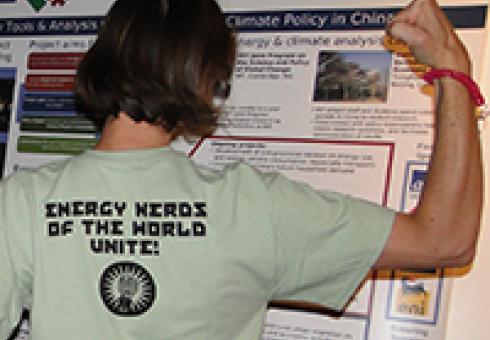
On Friday, October 17, 2014, CECP team participated in the MIT Energy Night at the MIT Museum between 6:00-9:00pm.
The MIT Energy Night provides an ideal opportunity to see what energy at MIT is all about and the CECP team presented two posters and interacted with hundreds of MIT students, faculty, energy companies, researchers and foreign business leaders.
See our posters and pictures below.


Learn how MIT researchers account for different sources of uncertainty in climate modeling, and what they're doing to reduce it.
Audrey Resutek and Erwan Monier
MIT Joint Program on the Science and Policy of Global Change
World Meteorological Organization Bulletin, October 17, 2014
The US National Climate Assessment, released this spring by the White House, describes a troubling array of climate woes, from intense droughts and heat waves to more extreme precipitation and floods, all caused by climate change. The report also describes how climate change is expected to impact regions across the United States in the future, yet it notes that exact regional forecasts are difficult to pin down. At the larger scale, it is clear that climate is changing, but local predictions can disagree on the extent to which temperatures will increase, and what regions will be hit the hardest by precipitation changes.
Researchers at the MIT Joint Program on the Science and Policy of Global Change examined four major factors that contribute to wide-ranging estimates of future regional climate change in the United States, with an eye toward understanding which factors introduced the most uncertainty into simulations of future climate. They find that the biggest source of uncertainty in climate modelling is also the only one that humans have control over – policies that limit greenhouse gas emissions.
In this context, the term “uncertainty” does not mean that there is a lack of scientific consensus that climate is changing. Instead, uncertainty refers to the fact that using different assumptions for the variables that go into a climate model – for example, the amount of greenhouse gases emitted over the next century, or how sensitive the climate is to changes in carbon dioxide levels – will produce a range of estimates. Overall, these estimates indicate that the Earth will be a warmer and wetter place over the coming century, but there is no single niversally agreed on amount of climate change that will take place.
In fact, estimates that point to a single number for changes in temperatures and precipitation may be misleading, precisely because they do not capture this uncertainty. It is more useful to think of estimates of future climate change as a range of possible effects. The range of potential warming, for example, follows a bell curve, with the most likely change in temperature falling at the highest point of the curve. The farther you travel from the curve’s peak, toward the tails, the more unlikely the temperature change. While the extreme temperature increases at the curve’s tails are unlikely, they still fall within the realm of possibility, and are worth considering because they represent-worst case scenarios.
Read the full article in the World Meterological Organization Bulletin
New committee aims to catalyze community discussion on how MIT can help address climate change.
MIT News Office
On Sept. 19, Maria T. Zuber, MIT’s vice president for research, announced the membership of a community committee to plan and implement the MIT Climate Change Conversation. As Zuber noted, “The Committee should seek broad input from the Institute community on how the US and the world can most effectively address global climate change. The Conversation should explore pathways to effective climate change mitigation, including how the MIT community — through education, research and campus engagement — can constructively move the global and national agendas forward.”
Roman Stocker, an associate professor of civil and environmental engineering and chair of the Committee on the MIT Climate Change Conversation, spoke with MIT News about the committee’s charge, its progress to date, and its next steps.
Q. What does the Committee on the MIT Climate Change Conversation aim to achieve?
A. We aim to explore and assess the broad range of actions that MIT could take to make a significant positive contribution to address climate change. The global nature of this problem and the amount of debate and polarization that surround it are daunting, but the premise of the committee is that the complexity of the problem is uniquely suited for MIT, given our strong problem-solving ethos, and that a leading technical institution can have unique roles to play in responding to the climate crisis. Identifying and evaluating these potential roles is the purpose of the Conversation.
Importantly, the committee will only be the catalyst of the Conversation: Its main actor will be the MIT community! In other words, what we really aim to achieve is the engagement of the widest possible fraction of the MIT community in developing and debating bold ideas — MIT-style! — to help identify the pros and cons of different options. We believe that this approach will allow us, as a community, to identify a broad spectrum of action items; estimate the effectiveness of each action in addressing the problem; and thereby determine how our Institute can most effectively drive forward the national and global agendas on climate change.
We will consider actions at all levels: from new educational initiatives at MIT and via its edX megaphone, to new opportunities for research that capitalize and expand on MIT’s presence in the field, to improvements to campus infrastructure and operations aimed at reducing MIT’s own carbon footprint, to leveraging MIT’s visibility to drive more effective policy. These are but examples, as we do not want to constrain the creativity of the MIT community. We will welcome any and all ideas through the multiple opportunities for input and feedback that we will construct. We look forward to this Conversation as a catalyst for original ideas, debate, and sound analysis.
Q. What has the committee done to date, since its membership was announced on Sept. 19?
A. Devising the right ingredients to make this MIT Conversation successful is what has kept us busy during this first month, and still is. Part of this effort consists of educating ourselves, within the committee, about the landscape of activities that already exist at MIT in the area of climate change, as some of these activities could represent important nucleation sites for bold ideas for action. At the same time, this knowledge will allow us to engage the MIT community in a more informed and meaningful way, through the Conversation activities we have begun to plan for the fall and spring.
Personally, this first month has also allowed me to appreciate the expertise we have on the committee, which I feel will be an invaluable asset in catalyzing this Conversation. The committee is composed of one faculty member per school, as well as representatives from the undergraduate and graduate student bodies, from the postdocs, and from the staff. Collectively, this group encompasses a wide range of expertise, covering both the science and the economics of climate change, as well as the on-campus infrastructural and operational aspects of a university planning for climate change.
The committee is unanimous in its feeling not only of the urgency of the problem — expressed with particular emphasis by the younger generations — but also of the unique opportunity that this Conversation represents for MIT to take on a visible leadership role in the solution of the problem.
Q. How can a member of MIT get engaged in this Conversation?
A. We will create multiple opportunities for engagement throughout the current academic year. In the next few weeks, we will launch both an Idea Bank and a survey. The Idea Bank intends to capture the expertise and creativity of the MIT community and to engage it in a campus-wide brainstorm about what actions MIT could take to address climate change. We will welcome input on the full spectrum of possible actions that MIT could take. We will particularly welcome bold, creative ideas, because we feel that the spectrum of options for action available to a leading technical institution has not been fully explored to date.
The survey is being designed to provide input for the committee in structuring the Conversation. With the survey, we aim to reach a wider fraction of the MIT community — hopefully, all of you! — and to understand how we can best support the community in this important Conversation.
We will carefully review the input we receive through both the Idea Bank and the survey, distill it into broad categories for potential action, and use it to inform the centerpiece of the Conversation, a series of high-profile forums to be held in the spring term. These forums will focus on the different action categories that MIT can consider investing in to further its role in addressing climate change, including education, research, financial actions, policy, campus operations — with specifics that will be refined based on community input. The months ahead will represent a vibrant time to discuss climate-change actions at MIT. We invite everyone in the community to be part of this Conversation!