
News + Media

By: Kate Galbraith
AUSTIN, TEXAS — The harm that can be caused by consuming or breathing mercury is well known and terrible. A pregnant woman, eating too much of the wrong kind of fish, risks bearing a child with neurological damage. Adults or children exposed to mercury can experience mood swings or tremors, or sometimes even respiratory failure or death.
In January, representatives of dozens of countries will gather in Geneva to discuss combating mercury emissions, which are rising in Asia even as Europe and the United States have tightened controls. The meeting is the last of five negotiating rounds — the first took place in 2010 in Stockholm — and a legally binding treaty on mercury contamination is expected to come together next year.
The signing of that treaty is set to take place in the Japanese city of Minamata, where widespread mercury poisoning occurred in the mid-20th century after discharges from a factory contaminated the seawater.
But the extent to which countries will commit to reducing mercury, and whether they will follow through on those commitments, are open questions.
“What remains to be seen is the stringency of the requirements,” said Noelle Eckley Selin, an assistant professor of engineering systems and atmospheric chemistry at the Massachusetts Institute of Technology.
The negotiations “appear to be going in the direction of voluntary compliance,” said Leonard Levin, an air quality specialist with the Electric Power Research Institute, a nonprofit organization with headquarters in Palo Alto, California.
The negotiations in Geneva are being conducted under the auspices of the U.N. Environment Program and are to be followed in the summer by a major conference on mercury in Edinburgh, where scientists and policy makers will discuss how to implement a treaty.
Roughly one-third of the world’s mercury air emissions come from human activity, like coal-fired power plants. Another third of emissions come from natural sources, like volcanoes or wildfires, and the final third are “re-emitted” after their initial release.
Within the human-generated category, Asia contributes nearly 50 percent of mercury emissions, with North America at 7 percent and Europe and North Africa at 12 percent combined, according to Jerry Lin, a professor of environmental engineering at Lamar University in Texas. In addition to coal-fired power plants, a major source of mercury emissions is small-scale gold mining. Miners working on their own often use mercury to help extract gold and then boil it off, leaving behind dangerous contamination.
The effects of mercury contamination are not limited to the local environment. Mercury finds its way into the sea, affecting fish like bluefin tuna, and airborne emissions can travel between continents.
“The mercury today will continue to circulate in the system for a long time,” Dr. Selin said. “We’re talking decades to centuries.” Methyl mercury, the toxic form, even poses a substantial problem for the Arctic, she said, because it can accumulate in polar bears and seals.
Meanwhile, research into the health consequences of mercury “has been finding adverse effects at lower and lower exposures,” Philippe Grandjean, chair of environmental medicine at the University of Southern Denmark, said in an e-mail. New research has found that some people may be more sensitive to the effects of mercury, he said, because of factors like genetics.
The European Union has moved aggressively to combat mercury exposure. A ban on mercury exports began in 2011, and the Union has issued rules on storing mercury and restrictions on some products containing mercury, like thermometers. It is currently considering additional rules on mercury in dental fillings and batteries.
Sweden has “been really out in front” on national mercury regulations, Dr. Selin said. The country banned mercury from dental fillings and other products several years ago.
Starting in January, the United States will ban the export of elemental mercury, whose uses include gold mining. (The ban covers the Department of Defense and the Department of Energy, which keep large stockpiles.) The new policy results from the Mercury Export Ban Act of 2008, which was introduced by two senators — including Barack Obama, who represented Illinois at the time — and was signed into law by President George W. Bush.
In another key mercury development, last year, the Environmental Protection Agency in the United States completed its first rule aimed at mercury emissions from coal plants. The effect on the power industry is unclear, however.
The mercury limits are “probably achievable for existing plants,” said Mr. Levin of the Electric Power Research Institute. Additional rules, not yet completed, would cover emissions from new coal plants, and their effect is still being evaluated, he said.
Other regulations in the United States have also affected coal plants. Controls required for pollutants like nitrogen oxide and sulfur dioxide can also reduce mercury emissions, as a “co-benefit.”
For China, which is building new coal-fired power plants at a rapid rate, such “co-benefits” could prove crucial, said Dr. Lin of Lamar University. That is because it would be economically difficult to control only for mercury.

By:Elizabeth Kolbert
It’s been almost a century since the British economist Arthur Pigou floated the idea that turned his name into an adjective. In “The Economics of Welfare,” published in 1920, Pigou pointed out that private investments often impose costs on other people. Consider this example: A man walks into a bar. He orders several rounds, downs them, and staggers out. The man has got plastered, the bar owner has got the man’s money, and the public will get stuck with the tab for the cops who have to fish the man out of the gutter. In Pigou’s honor, taxes that attempt to correct for this are known as Pigovian, or, if you prefer, Pigouvian (the spelling remains wobbly). Alcohol taxes are Pigovian; so are taxes on cigarettes. The idea is to incorporate into the cost of what might seem a purely personal choice the expenses it foists on the rest of society.
One way to think about global warming is as a vast, planet-wide Pigovian problem. In this case, the man pulls up to a gas pump. He sticks his BP or Sunoco card into the slot, fills up, and drives off. He’s got a full tank; the gas station and the oil company share in the profits. Meanwhile, the carbon that spills out of his tailpipe lingers in the atmosphere, trapping heat and contributing to higher sea levels. As the oceans rise, coastal roads erode, beachfront homes wash away, and, finally, major cities flood. Once again, it’s the public at large that gets left with the bill. The logical, which is to say the fair, way to address this situation would be to make the driver absorb the cost for his slice of the damage. This could be achieved by a new Pigovian tax, on carbon.
In the past several weeks, as New York and New Jersey have continued to dig out from under the debris left by Hurricane Sandy, the possibility of a carbon tax has come to seem more likely than ever, that is, not very likely, but also not entirely out of the question. The reason for this is not so much the terrible cost of the storm, now estimated at more than sixty billion dollars. (The other day, Governor Andrew Cuomo said that Sandy had caused forty-two billion dollars’ worth of damage in New York State alone.) It’s that, as Washington edges toward the fiscal cliff, it has become obvious to just about everyone, except maybe House Republicans, that Washington needs more revenue.
Not long ago, the Congressional Research Service reported that, over the next decade, a relatively modest carbon tax could cut the projected federal deficit in half. Such a tax would be imposed not just on gasoline but on all fossil fuels—from the coal used to generate electricity to the diesel used to run tractors—so it would affect the price of nearly everything, including food and manufactured goods. To counter its regressive effects, the tax could be used as a substitute for other, even more regressive taxes, or, alternatively, some of the proceeds could be returned to low-income families as rebates (although, of course, this would cut down on the amount that could go toward deficit reduction).
Shortly after the C.R.S. report came out, the conservative American Enterprise Institute teamed up with its liberal counterpart, the Brookings Institution, to host a seminar on the subject, a collaboration that prompted the Wall Street Journal’s Web site to declare, “CARBON TAX IDEA GAINS WONKISH ENERGY.” “I think the impossible may be moving to the inevitable without ever passing through the probable,” Bob Inglis, a former Republican representative from South Carolina and a carbon-tax backer, told the Associated Press.
Perhaps because a carbon tax makes so much sense—researchers at M.I.T. recently described it as a possible “win-win-win” response to several of the country’s most pressing problems—economists on both ends of the political spectrum have championed it. Liberals like Robert Frank, of Cornell, and Paul Krugman, of Princeton, support the idea, as do conservatives like Gary Becker, at the University of Chicago, and Greg Mankiw, of Harvard. (Mankiw, who served as chairman of the Council of Economic Advisers under President George W. Bush and as an adviser to Mitt Romney, is the founding member of what he calls the Pigou Club.) A few weeks ago, more than a hundred major corporations, including Royal Dutch Shell and Unilever, issued a joint statement calling on lawmakers around the globe to impose a “clear, transparent and unambiguous price on carbon emissions,” which, while not an explicit endorsement of a carbon tax, certainly comes close. Even ExxonMobil, once a leading sponsor of climate-change denial, has expressed support for a carbon tax. “A well-designed carbon tax could play a significant role in addressing the challenge of rising emissions,” a spokeswoman for the company said recently in an e-mail to Bloomberg News.
One key player who has not embraced the idea is Barack Obama. The White House spokesman, Jay Carney, was asked about the tax last month, en route, as it happens, to visit storm-ravaged areas of New York with the President. “We would never propose a carbon tax, and have no intention of proposing one,” Carney told reporters. This was taken by some to mean that Obama was opposed to the tax and by others to mean just that he was not going to be the one to suggest it.
In either case, the White House is making a big mistake. Pigovian taxes are rarely politically popular—something they have in common with virtually all taxes. But, as Obama embarks on his second term, it’s time for him to take some risks. Several countries, including Australia and Sweden, already have a carbon tax. Were the United States to impose one, it would have global significance. It would show that Americans are ready to acknowledge, finally, that we are part of the problem. There is a price to be paid for living as we do, and everyone is going to get stuck with the bill.

By: David Frum
Editor's note: David Frum, a CNN contributor, is a contributing editor at Newsweek and The Daily Beast. He is the author of eight books, including a new novel, "Patriots," and his post-election e-book, "Why Romney Lost." Frum was a special assistant to President George W. Bush from 2001 to 2002.
Global emissions of carbon dioxide hit a record high in 2011, scientists from the Global Carbon Project reported last week.
Another record is expected in 2012.
The earth continues to warm, and to warm fast, with serious consequences for human life and welfare. 2012 saw the worst drought in the United States in half a century. Russia suffered its second bad drought in three years. Climatic shocks to these two countries are raising food prices worldwide, posing an especially acute threat to the world's poorest. Major storm events strike harder and more often, because warming oceans create conditions for fiercer hurricanes.
The New York Times reported Friday:
"Emissions continue to grow so rapidly that an international goal of limiting the ultimate warming of the planet to 3.6 degrees, established three years ago, is on the verge of becoming unattainable."
This ominous news arrives as delegates gather in Doha, Qatar, for the latest annual round of climate talks sponsored by the United Nations. Few expect the Doha talks to produce much decision.
Yet there is good news on the environmental front, important news.
Carbon emissions in the United States have declined since 2009 -- not emissions per person (those have been declining for decades), but emissions in absolute terms. The weak economy explains part of the decline, but the real hero of the story is the natural gas fracking revolution.
A decade ago, half of all the electricity generated in the United States was generated by burning coal, the most carbon-dense fuel of them all. Today, coal's share of the electricity mix has plunged to one-third, as utilities substitute cheap natural gas. Gas production has become much cheaper with the growth of fracking -- forcing open rocks by injecting fluid into cracks. Gas emits about half as much carbon per unit of energy as coal.
Environmentalists have responded warily to the advent of gas. They prefer zero-emissions power sources like wind and solar -- sources made more uncompetitive than ever by ultracheap natural gas. (Today's price: about $3.50 per thousand cubic feet, down about 70% from the prices of the mid-2000s.)
Moreover, natural gas does little (as yet) to address emissions from automobile tailpipes.
But maybe there's a way to cheer environmentalists up. Take three worrying long-term challenges: climate change, the weak economic recovery, and America's chronic budget deficits. Combine them into one. And suddenly three tough problems become one attractive solution.
Tax carbon. A tax of $20 a ton, rising at a rate of 4% per year, would over the next decade raise $1.5 trillion, according to an important new study from the Massachusetts Institute of Technology. That $1.5 trillion is almost twice as much as would be recouped to the Treasury by allowing the expiration of all Bush-era tax cuts for upper-income taxpayers.
The revenues from a carbon tax could be used to reduce the deficit while also extending new forms of payroll tax relief to middle-class families, thus supporting middle-class family incomes.
Meanwhile, the shock of slowly but steadily rising prices for fuel and electricity would drive economic changes that would accelerate U.S. economic growth.
The average age of U.S. cars and trucks has reached nearly 11 years, a record.
Millions of Americans want new cars. They are waiting for market signals as to what car to buy. They want to know that if they choose a fuel-efficient vehicle, they won't feel silly three years from now when their neighbor roars past them in a monster truck because gas has plunged back to $2 a gallon.
After five years of depression, the housing market is also ready for renewal. Again, Americans are waiting for market signals: Should they buy smaller houses nearer to work? High and rising fuel prices will encourage developers to build more mixed-use complexes that allow more people to live car-free: walking to work, entertainment, and shopping. The surest way to reduce fuel costs is to drive less.
The return to more urban living is a trend big enough to sustain America's next great economic boom. To the extent researchers can measure, the daily commute appears to be the single worst recurring source of unhappiness in American life.
If changes in city shape can offer more Americans the opportunity to walk to work through an attractive shopping mall, rather than waste 50 minutes in a car in a traffic jam, those changes will advance human happiness, spur new construction work, and incidentally save the planet.
A carbon tax will also enable the United States and Europe to press China and India to reduce their carbon emissions. A properly designed tax would apply not only to domestic goods and services, but to imports as well.
China and India would discover that their products no longer seem so cheap when a carbon tax at the border adds back the environmental costs of dirty manufacturing. To export to the world's richest consumers, China and India will have to clean up their act -- an incentive more persuasive than a hundred Doha conferences.
More jobs and growth; reduced deficits without raising income taxes; lower taxes for middle-class families; a kick in the pants to Chinese polluters; and more happiness for American commuters -- one policy instrument can do it all. What's not to love about a carbon tax?


By: Vicki Ekstrom Fatih Birol, chief economist of the International Energy Agency (IEA), visited MIT on Wednesday, November 28 to present this year’s World Energy Outlook. While on campus, Birol met with researchers at the Joint Program on Global Change to learn about the latest developments on climate change policy and MIT’s Emissions Predictions and Policy Analysis (EPPA) model. The model is used by MIT researchers to make their own world economic and emissions projections.
“We had a very productive discussion about the future of the world’s energy system development and advances in modeling alternative pathways. We also shared information about our current projects and future directions,” said Sergey Paltsev, assistant director for economic research at the MIT Joint Program on Global Change, after the meeting. “IEA’s World Energy Outlook is one the most comprehensive and authoritative sources in energy projections and related carbon emissions.”
Birol also commented on the usefulness of the exchange:
"As our World Energy Outlook 2012 shows, the global energy system is undergoing fundamental, rapid change. MIT's proven, interdisciplinary approach to research and education in energy and climate issues will be even more important in the years to come,” Birol said.
Named by Forbes magazine as one of the most influential people on the global energy scene, Birol chairs the World Economic Forum’s Energy Advisory Board and is often called on to brief high-level political figures — including President Barack Obama.
Birol’s meeting with Paltsev, along with MIT Global Change researchers Henry Jacoby and Valerie Karplus, came prior to an MIT Energy Initiative-hosted event on the IEA’s World Energy Outlook. The Outlook projects that the United States will become the world’s leading oil producer within a few decades, while gas will continue to be a major player. It also turns attention to climate change.
“As each year passes without clear signals to drive investment in clean energy, the ‘lock-in’ of high-carbon infrastructure is making it harder and more expensive to meet our energy security and climate goals,” said Birol when IEA released the Outlook on November 9.
The Outlook finds that four-fifths of the total energy-related carbon emissions permitted under a scenario that limits warming to 2°C, the globally-agreed goal, are already locked-in by existing capital stock such as power stations, buildings and factories. It warns that without further action by 2017, the energy-related infrastructure in place would generate all the carbon emissions allowed up to 2035. Delaying action is a false economy, the report says, noting that for every $1 of investment in cleaner technology that is avoided in the power sector before 2020, an additional $4.30 would need to be spent after 2020 to compensate for the increased emissions.
Read more about the Outlook in a special MIT News interview with Fatih Birol here.
MIT researchers, using field practices, find emissions from shale gas production to be significantly lower than previous estimates.

While the United States lags in developing a broad-based climate policy, the nation’s carbon emissions reached a 20-year low this year. Many have attributed some of that drop to a booming supply of low-carbon natural gas, of which the United States is the world’s largest producer. But does natural gas – and specifically the quickly-developing production of shale gas – create other emissions, such as methane, that could be just as harmful? A new study by MIT researchers shows the amount of methane emissions caused by shale gas production has been largely exaggerated.
“While increased efforts need to be made to reduce emissions from the gas industry overall, the production of shale gas has not significantly increased total emissions from the sector,” says Francis O’Sullivan, a researcher at the MIT Energy Initiative and the lead author of the study released this week in Environmental Research Letters.
The research comes amidst several other reports on the impact of “fugitive” methane emissions – gas leaked or purposefully vented during and immediately after the stage of shale gas production known as hydraulic fracturing. While many of these reports studied the amount of potential emissions associated with the hydraulic fracturing process, the MIT researchers stress that this is only part of the puzzle. Consideration must also be given to how this gas is handled at the drilling sites, the study shows.
“It’s unrealistic to assume all potential emissions are vented,” O’Sullivan says, “Not least because some states have regulations requiring flaring as a minimum gas handling method.”
Sergey Paltsev, the study’s co-author and the assistant director for economic research at the MIT Joint Program on the Science and Policy of Global Change, says companies also have an economic reason for wanting to capture this “fugitive” gas.
“When companies vent and flare methane they are losing gas that they could have captured and sold” Paltsev says. “When we compared the cost of installing the right equipment to capture this gas to the loss in revenue if it isn’t captured, we found that the majority of shale wells make money by capturing the potential ‘fugitive’ emissions.”
In talking with industry representatives and officials at the U.S. Environmental Protection Agency (EPA), O’Sullivan and Paltsev found that companies are already capturing about 70 percent of potential “fugitive” emissions. In factoring that into their analysis, the researchers find emissions from shale gas production to be strikingly lower than previous estimates of potential emissions.
Their analysis was based on data from each of the approximately 4,000 wells drilled in the five main U.S. shale drilling sites during 2010. Wells in two of those sites, Texas’ Barnett shale and the Haynesville shale on the Texas-Louisiana boarder, had been studied by Robert Howarth from Cornell University last year when he looked at potential emissions released by the industry. His study garnered much attention because it claimed the greenhouse gas footprint of shale gas was larger than that of conventional gas, oil, and, over a 20-year time frame, coal. That study, however, used very limited well datasets.
In studying potential emissions, Howarth found 252 Mg of methane emissions per well in the Barnett site and 4,638 Mg per well in the Haynesville site. The MIT researchers, using their comprehensive well dataset, found that the potential emissions per well in the Barnett and Haynesville sites were in fact 147 Mg of methane (273 thousand cubic meters of natural gas) and 633 Mg (1,177 thousand cublic meters of gas), respectively. When accounting for actual gas handling field practices, these emissions estimates were reduced to about 35 Mg per well of methane from an average Barnett well and 151 Mg from an average Haynesville well.
According to Adam Brandt, an assistant professor at Stanford University, this analysis “provides an important contribution to the literature by greatly improving our understanding of potential shale gas emissions using a very large dataset.”
Brandt says, “Previous studies used much smaller and more uncertain datasets, while O'Sullivan and Paltsev have gathered a much larger and more comprehensive industry dataset. This significantly reduces the uncertainty associated with potential emissions from shale gas development.”
A U.S. Department of Energy study released in August confirmed that while electricity generated by gas produces half the emissions of coal generation, natural gas production does make up 3 percent of the nation’s total emissions. While the overall benefits far outweigh the small increases during production, Paltsev believes the EPA’s efforts to reduce those emissions through new air quality standards are a “step in the right direction.”
Read an op-ed by MIT researchers in response to the Howarth study here.

Watching the Arctic Melt: Adventures in Polar Oceanography
by Genevieve Wanucha
One hundred people packed into the Whitehead Institute on November 19th to attend the Oceans at MIT special symposium, entitled ‘Watching the Arctic Melt: Adventures in Polar Oceanography.’ Most people there already knew that the Arctic Ocean’s ice cover goes through a cycle of seasonal growth and decline. Everyone had already heard that the Arctic Ocean sea ice cover hit a record minimum this fall. More surprising was the news that the Arctic, which has warmed twice the global average, may experience ice-free summers before 2050.

WHOI’s Hanu Singh suprises the audience with stunning images of an autonomous underwater vehicle. Singh and his lab members send these robots down through holes in Arctic sea ice to explore the underside of sea ice.
“This melting has enormous implications for shipping, fishing, Arctic ecology, oil and gas exploration, national security, and geopolitics,” said John Marshall, professor of oceanography at MIT, who kicked off the afternoon. “There is likely to be a ‘Gold Rush’ as the oil and gas resources in the Arctic become more available as it thaws.”
The event was a quintessential example of the close and longstanding collaboration between MIT and Woods Hole Oceanographic Institution, bringing together Arctic experts who are all pushing technical frontiers to study the high-stakes Arctic ice loss.
Their ultimate goal, as it soon became clear, is to be able to predict and model the behavior of the Arctic melting. However, that’s far from straightforward. As Patrick Heimbach, a principal research scientist in EAPS, emphasized, scientific prediction requires understanding—an understanding of, for instance, how ice sheets break apart and how ice interacts with the warming air above and water below. And understanding requires observation.
Fortunately, these speakers are bringing observation in the Arctic to the next level, especially John Toole, a senior scientist and chair of physical oceanography at WHOI who studies how the shrinking ice cap affects Arctic Ocean circulation. “Satellite data is useful, but it’s only skin deep,” he said as he took the stage. “It doesn’t give you information about the ocean interior.” So, he’s created tools to figure out what goes on below the ice.
Toole’s innovation, the “ice-tethered profiler,” is a buoy that sits atop the ice sheet, sending a wire down through the ice. A vehicle crawls up and down the wire, sending high-resolution data up to a satellite. His team has deployed 60 profilers since 2004 and will launch more next year. The huge amounts of data the profilers collect are allowing any researcher to track seasonal patterns in Arctic through measures of salinity, oxygen, water velocity, and photosynthetic radiation.
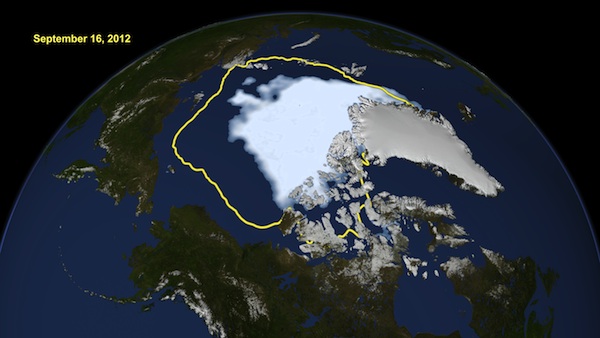
Satellite image of the new record low Arctic sea ice extent, from Sept. 16, 2012, compared to the average minimum extent over the past 30 years (in yellow). Credit: Credit: NASA/Goddard Scientific Visualization Studio
Art Baggeroer and Henrik Schmidt, both professors at MIT’s Ocean Seismo-Acoustic Laboratory MIT, reported on their efforts to observe the Arctic using sound. By recording the sound and seismic waves traveling in the Arctic Ocean, they can infer exactly how and why the sea ice is breaking up.
Carin Ashjian, a senior scientist in the biology department at WHOI, uses a range of acoustic and video methods to study the surprisingly active ecosystem alive under the ice sheet. She’s spent day traveling aboard icebreakers in harsh weather to collect data on zooplankton, the preferred food of Arctic fish and whales, in hopes of modeling how temperature changes will lower their reproductive success. One big issue stand in her way.
“We don’t have a whole lot of long term records, and this makes it difficult to detect changes in the ecosystem,” she pointed out. “We need to continue our ongoing efforts to understand the natural variability of the Arctic so we can detect change.”
Admiral Richard Pittenger (Ret.), former leader of WHOI’s Marine Operations Division, suggested that the US Navy will be central to providing the infrastructure for this research effort, more for national security reasons than the ecosystem. It’s been a long road to acceptance of climate change within government institutions, but, he noted, “The Navy is one hundred percent on board. They know there are many strategic disadvantages if we aren’t preparing for the effects.”
Perhaps the most memorable moment of the afternoon came when WHOI’s Hanu Singh and MIT’s John Leonard revealed video of robotic vehicle swimming through icy blue water, mapping the moving Arctic Ocean sea ice and floor. The audience now saw what scientists see in this footage: not beautiful, exciting images of adventure, but a glimpse at the first, slow steps in one of the most challenging research endeavors of our time.
MIT Researcher Receives Award for Forecasts of Vehicle Use in China

Paul Kishimoto, a research associate for the MIT Joint Program’s China Energy and Climate Project, was one of five winners of the Dennis J. O'Brian Student Paper Award sponsored by the U.S. Association of Energy Economics on November 6. His study, “Applying Advanced Uncertainty Methods to Improve Forecasts of Vehicle Ownership and Passenger Travel in China,” analyzes the uncertainty of China’s transportation sector.
“This paper grew from work I did for a graduate course in uncertainty, which included methods like those used to generate the Joint Program's Greenhouse Gamble wheels,” says Kishimoto, a recent graduate of MIT’s Technology and Policy Program (TPP). “I think the judges recognized that the application to transportation was novel, and as a result I was able to attend a very engaging conference.”
China is home to the world’s largest vehicle market – a market that is increasing each day because of the country’s growing, wealthier population. Annual vehicle sales in China have grown by as much as 38 percent a year – a pace unmatched by any other country. China is also deeply reliant on foreign oil. In 2011, the country imported more than 60 percent of the oil it consumed. Along with this growth and reliance comes much uncertainty: How accurate are the statistics coming from the Chinese government? What policies will the central and local governments put in place to restrict vehicle use, subsidize alternate fuel vehicles, or redirect demand to public transit? What path will the economic expansion take, and how will this affect households' travel?
Using a Monte-Carlo sampling method to evaluate uncertainty, Kishimoto lays out a range of vehicle ownership and travel volume forecasts. These forecasts could be used to successfully plan and manage large transport infrastructure projects in China. In the average forecast, four out of every ten people could own vehicles in 2050. But this outcome is highly uncertain. On the other hand, a more certain forecast shows that there could be an eventual peak of about six out of every ten people owning vehicles. Shares of different transport modes show narrower ranges, in which urban and inter-city rail continues to supply at least 26 percent of passenger miles.
“These results are a useful counterpoint to our modeling using the MIT EPPA model. They show, given recent trends, how Chinese people might prefer to travel in the future,” says Kishimoto. “With EPPA, we can model how government policy, increases in fuel prices due to high demand, and other effects will alter these choices and the related energy use and emissions.”
Kishimoto was presented with the award at the International Association of Energy Economics’ Annual North American Conference in Austin, Texas.

This week, a reinvigorated Barack Obama returned to the White House knowing that he was poised on the edge of a fiscal cliff. Rather than relishing his victory last week, Obama must immediately set about crafting a compromise on deficit reduction with congressional leaders. The stakes could hardly be higher — for science, for US citizens and, indeed, for the world. In the event of failure, a budgetary time-bomb of tax increases and sweeping budget cuts will detonate on 2 January. As well as resulting in indiscriminate cuts to funds for scientific research and many other areas, it could knock the United States back into recession and deliver yet another blow to an already fragile global economy.
Faced with such dire consequences, one might expect that all the financial options would be on the table, especially the good ones. Unfortunately, this is not the case, at least not yet.
So far, lawmakers have rehashed long-standing disputes about the size of government and the social safety net, but have ignored ideas that could transform the fiscal challenge into an opportunity. One such proposal is the carbon tax, which could bring financial and political benefits for all and chart a new course forward for energy independence and global warming (see page 309). It is a solution that is every bit as improbable as it is logical, but one should remember Winston Churchill’s assessment of the United States’ tendency to do the right thing — once all the alternatives have been exhausted.
Just consider the possibilities. To put a levy on carbon would raise revenues that could be used to offset lower tax rates for individuals and businesses. This is what conservatives say they want to do. It would put more income — and thus choice — in the hands of consumers. Economists like the idea for more fundamental reasons. Generally, it is best to tax things that one wishes to discourage (such as smoking) rather than those that should be encouraged (such as working). Environmentalists like the idea of a carbon tax because it could generate some much-needed revenue for clean-energy research and development while reducing carbon emissions.
The numbers are not negligible. An analysis conducted in August by economists at the Massachusetts Institute of Technology (MIT) in Cambridge showed that a carbon tax of US$20 per tonne of carbon from fossil fuels, if instituted in 2013 and increased by 4% per year, would raise $1.5 trillion over the course of a decade. Averaged out, this amounts to $150 billion annually — a sizeable chunk of the trillion-dollar deficits that the US government has been running in recent years. Scholars at the Brookings Institution, a centrist think tank in Washington DC, advocate ramping federal investments in energy research up from $3.8 billion now to $30 billion annually, to drive down the cost of low-carbon energy (including cleaner-burning coal). It is an ambitious proposal, and would leave a pile of cash that could be redistributed elsewhere for beneficial use.
Conservatives loathe taxes, and US politicians obsess over energy prices, but a revenue-neutral carbon tax would get around these problems. The MIT analysis found that the economy benefited regardless of whether the money was reinvested in social programmes or redistributed in the form of lower taxes and cash payments to offset higher energy costs for the poor. For environmentalists, the problem with a carbon tax is that it does not technically limit emissions, but the MIT model suggests that it would perform quite well: carbon emissions fall to 14% below 2006 levels by 2020 as consumers and businesses find ways to reduce their energy use in response to higher prices.
Opposition to the idea may not be what it was. For example, on 13 November, the American Enterprise Institute hosted a conference in Washington DC on the economics of a carbon tax. The institute is a conservative think tank, and its officials have previously raised doubts about climate science. The idea has also been bubbling up in other right-leaning think tanks as a conservative solution to reduce greenhouse gases.
The problem is that to enact a carbon tax would depend on political courage and a willingness to break with party orthodoxy, rare traits in Washington today. President Obama has made energy and climate part of his agenda for the second term, but his first — and perhaps biggest — opportunity to make good on that promise will come in the next few weeks. As US politicians contemplate diving into the fiscal abyss, they would be wise to consider a painless policy that benefits everyone.

By Keith Johnson
With the fiscal cliff looming and parts of the U.S. still digging out from the aftermath of Hurricane Sandy, calls for the U.S. to adopt a carbon tax are gathering steam–even though there’s little sign of interest from Congress or the White House.
Today the conservative American Enterprise Institute is holding an all-day, on-the-record discussion of the idea. And the Brookings Institution is unveiling a slate of new measures meant to make the government more effective, including a carbon tax that could raise $1.5 trillion over ten years. All that follows a cascade of carbon-tax advocacy in recent days from the chattering classes and a slate of academic work over the summer (not to mention our own two cents).
The idea of a carbon tax is simple: Put a price tag on the harmful emissions from fossil fuels, such as oil and coal, and use the revenues to fund clean-energy development, pay down the deficit or slash taxes. Proponents often describe it as a win-win-win policy, because carbon taxes would penalize things that are bad (pollution) and lower taxes on things that are good (labor and capital).
“The time seems ripe for this discussion. The president is committed both to raising tax revenue and to dealing with climate change. A carbon tax kills two birds with one stone,” said Gregory Mankiw, a Harvard economist who advised the Romney campaign and has long pushed for more efficient taxation, including a carbon tax.
The Brookings proposal would impose a $20 fee on each ton of carbon, raising an average of $150 billion per year over a decade. Congress and the president would have to decide exactly how to use the money. Research by MIT and Brookings suggests that business-related tax breaks, whether corporate taxes or taxes on investment, would provide the biggest boost to economic growth and job creation.
But at least $30 billion a year should be earmarked for energy research and development, says Mark Muro, a senior fellow at the Brookings Metropolitan Policy Program. That’s because even a price on carbon emissions would not automatically make low-carbon energy such as wind, solar, geothermal and the like economically competitive with traditional fuels. Some research indicates that a $20 carbon tax would actually amount to less support for clean energy than the existing panoply of tax breaks and subsidies.
Alas for the wonks, a carbon tax is a new tax, and that isn’t a popular idea in Washington. Opponents of carbon taxes are rolling out their own intellectual artillery, arguing that the tax would stunt economic growth for little benefit. Grover Norquist, president of Americans for Tax Reform, said taxing energy consumption “would inevitably lead to higher taxes … even if originally passed with offsetting tax reductions elsewhere.”
Even one-time proponents of a carbon tax in Congress have disavowed the idea. While President Barack Obama mentioned climate change in his victory speech last week and has let the Environmental Protection Agency clamp down on emissions from coal-fired power plants, he has yet to outline any comprehensive plan to tackle climate change in his second term.
The carbon-tax crowd is a big tent, bringing together deficit hawks, growth mavens and climate worriers. The ideological diversity could be a plus–but only if advocates can leverage it to win political support from both sides of the spectrum.

MIT researchers show merits of a carbon tax. New standards to strengthen vehicle fuel efficiency are considered one of the landmark environmental achievements of President Obama’s first term. Passed with the backing of automakers and autoworkers, the measure has been touted as a way to save consumers more than $1.7 trillion at the pump and cut carbon emissions from passenger vehicles in half. While the standards have many good merits, a more effective approach might be an economy-wide carbon tax, say researchers at MIT’s Joint Program on the Science and Policy of Global Change.
The researchers look at the full energy and economic impacts of the efficiency standards, which in their finalized form now require automakers to install pollution-control technology to improve the fuel efficiency of cars by 5 percent and light trucks by 3.5 percent with each new model year starting in 2017. Published this month in the journal Transportation Research Record, the study won this year’s Pyke Johnson Award for the best paper in the area of planning and the environment.
“Common thinking in Washington holds that any policy that seems to advance technology without creating new taxes must be a no brainer for the country. That misses the broader economic impact,” says Joint Program Research Scientist Valerie Karplus, the lead author of the study. “As my colleague says, you may see more money in your front pocket at the pump, but you’re financing the policy out of your back pocket through your tax dollars and at the point of your vehicle purchase.”
Instead, Karplus says a gasoline or carbon tax makes more sense economically by providing consumers a direct incentive to either reduce their driving or buy more efficient vehicles.
“From an economic perspective that’s very clear, but from a political feasibility perspective it’s very different,” she says. Unlike fuel standards that hide the true costs, “a tax on gasoline has proven to be a nonstarter for many decades in the U.S., and I think one of the reasons is that it would be very visible to consumers every time they go to fill up their cars.”
The one hope, Karplus and some of her colleagues at the Joint Program say, is that in the midst of deficit talks a tax on carbon emissions might be considered to help raise the money needed to slash the deficit and avoid some tax hikes and spending cuts. The program published a study in August that looked at the effectiveness of this approach. That study showed that with a carbon tax the economy could overall improve, other taxes could be lowered and pollution emissions would be reduced.
“Congress will face many difficult tradeoffs in stimulating the economy and job growth while reducing the deficit,” says John Reilly, the co-director of the Joint Program and an author of the carbon tax study. “But with the carbon tax there are virtually no serious tradeoffs.”
Conversely, when Karplus and her colleagues simulated the proposed fuel economy standards, they found that while drivers of these more efficient vehicles will likely save at the pump, they could on average spend several thousands of dollars more when buying their new car, consistent with EPA estimates. Even more troubling, diverting efforts toward improved vehicle efficiency distorts overall economic activity, adding to the indirect cost of the policy.
Estimates of how costly the policy would be — in terms of both direct costs to consumers and the larger rippling costs to the economy — hinge on the relative cost of the technology and other strategies available to improve efficiency. The shorter the time frame automakers have to develop the technology and produce more efficient vehicles, the less time there will be for technological progress and other factors to drive down costs — such as the cost of batteries — and the more consumers will need to pay upfront. Emissions and oil imports will initially drop, both due to increased fuel efficiency and as the higher vehicle costs weigh on consumer budgets. But as consumers face lower costs per mile traveled, they may drive more, offsetting reductions in emissions and oil imports.
Karplus hopes her results will help policymakers make more informed decisions going forward. She credits that to the innovative — and award-winning — method she used, which weaves engineering and technology constraints into a broad economic framework and allows researchers to test the cost and other impacts of a policy at different levels of stringency. This method inherently takes account of life-cycle emissions as well as impacts that transmit across fuel markets by affecting prices.
For example, a policy might only consider gasoline use by plug-in electric hybrids. But that “tailpipe measure” doesn’t take into account the emissions created from building, transporting and recharging those batteries. Her approach does.
“There are a lot of hidden costs to a policy like this,” Karplus says. “This model doesn’t allow you to ignore other important aspects of the economy and energy systems. It requires you to be explicit about your technology and cost assumptions. It provides a framework that allows lawmakers to look at all the available information on costs and the state of the technology and decide how to best create or update policies.”
Of this approach, University of Maine environmental economist Jonathan Rubin, says “The research of Dr. Karplus on the energy and climate impacts of the nation’s fuel economy standards for our cars and trucks makes an important contribution to policymaking based on science.”
Rubin is the chair of the Transportation Energy Committee of the Transportation Research Board, which will honor Karplus with the Pyke Johnson award at a ceremony in January.