
News + Media
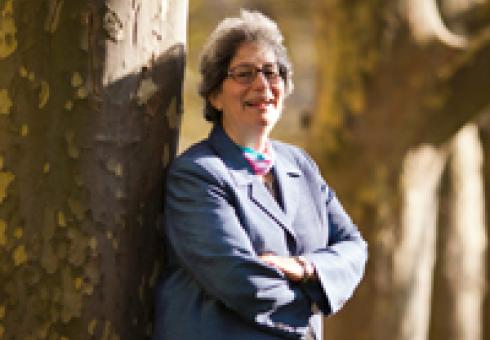
Susan Solomon has won both the Vetlesen Prize and a 2012 BBVA Foundation Frontiers of Knowledge Award.
The Vetlesen Prize is given “for scientific achievement resulting in a clearer understanding of the Earth, its history, or its relations to the universe” and is designed to recognize sweeping achievements on par with the Nobel. The Prize was established in 1959 and is given every several years by a selection committee appointed by the president of Columbia University. The most recent award was in 2008 to geologist Walter Alvarez. Previous winners include climate scientists Sir Nicholas Shackleton and Wallace Broecker, marine geologist Walter Pitman, seismologist Lynn Sykes, and founding director of Lamont Maurice “Doc” Ewing.
Soloman is being recognized for her work in identifying the cause of the Antarctic ozone hole. This research helped bring about a global ban on manmade ozone-depleting chemicals. She shares the award with French climate scientist Jean Jouzel who is being recognized for his work extracting the longest-yet climate record from polar ice cores. The pair will receive the award and accompanying medal at Columbia's Low Library on Thursday, February 21st.
The BBVA Foundation Frontiers of Knowledge Awards recognize, among other things, outstanding contributions that advance understanding or deliver material progress with regard to climate change, one of the key challenges of the global society of the 21st century.
The award citation states that Solomon "has contributed, through her research and leadership, to the safeguarding of our planet." Solomon's work over 30 years has succeeded in establishing and drawing together links between three key climate change variables: human activity, a profound and comprehensive understanding of the behavior of atmospheric gases, and the alteration of climate patterns globally.
IN THE NEWS: Changing with the climate
MIT News
January 25, 2013
MIT researchers, Massachusetts officials highlight strategies to adapt to climate change.
Just days after President Obama called for action on climate change in his second inaugural address, members of Massachusetts Governor Deval Patrick’s administration joined energy and environment researchers at MIT to discuss strategies for adapting to climate change. The panel discussion on Jan. 23 fostered a continued partnership between MIT and the Commonwealth to advance energy and environment innovation. More....
IN THE NEWS: Reporter's Notebook: An inside tour of the MassDOT
The Tech
January 30, 2013
MIT students frequently use the T and other MassDOT transit systems; since 2010, our IDs even come with a built-in Charlie Card chip. But most students are unfamiliar with the inner workings of the transit system.
Ethan Feuer, Student Activities Coordinator for the MIT Energy Initiative, organized the tour for twenty five students in order to learn more about large infrastructures and emergency preparedness in cities. More....
IN THE NEWS: Climate Research Showcase
MITEI and MIT Joint Program
February 11, 2013
MIT students, researchers help Massachusetts address a post-Sandy world.
MIT students and researchers brought their latest ideas and findings to the table at an event on January 29. The interdisciplinary group of young researchers presented to officials from the Commonwealth’s Executive Office of Energy and the Environment, in hopes that the state would be able to leverage the information for future planning and implementation. More...
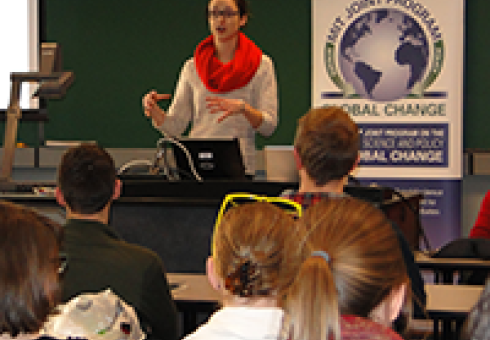
Last month, the United Nations Environment Programme agreed on the first major environmental treaty in over a decade. Its focus was reducing mercury pollution. There to participate in the events were ten MIT students and their instructor Noelle Selin, a researcher with the Joint Program on the Science and Policy of Global Change and an assistant professor of atmospheric chemistry and engineering systems.
To share their experiences and lessons learned from witnessing international environmental policy-making in action, Selin and the students hosted a panel discussion on Wednesday, February 6.
Selin kicked off the event by describing the problem of mercury in our environment and why an international treaty was essential to curbing the environmental and public health effects. She explained that mercury levels in the Earth have increased greatly due to the burning of fossil fuels, cement production, and more. Mercury then rains down into oceans, where it contaminates fish as toxic methylmercury.
"The health risks to consumers of fish include neurological effects, particularly in the offspring of exposed pregnant women," Selin explained. “Over 300,000 newborns in the U.S. each year are at risk of learning disabilities due to their elevated mercury exposure."
Mercury is an element that cycles in the environment, meaning that once it’s released into the atmosphere it can take decades to centuries for mercury to make its way back to ocean sediments.
“This becomes a global issue, this becomes a long term issue, and thus an issue for international cooperation,” Selin said.
There were five student teams on the trip that covered topics including: governing institutions, products and processes, emissions, waste/trade/mining, and finance. A member from each team presented on their issue at the panel and shared their thoughts and observations on the international negotiation process.
Philip Wolfe, a PhD candidate in the Department of Aeronautics and Astronautics, discussed the institutions and policy process of the negotiations. He explained that the treaty has to work on two levels: globally and domestically.
“Individual countries engage in regional, domestic, or bilateral agreements and they’ll only really sign on to a global convention if it also meets their own domestic goals,” Wolfe said.
The treaty, if nations decide to sign it, would require tightly controlling emissions – a major area of discussion during the negotiations.
Leah Stokes, PhD candidate in Environmental Policy and Planning, discussed the challenges with regulating emissions from the burning of fossil fuels and artisanal small-scale gold mining. She explained that when individuals want to mine gold and don’t have any equipment they use mercury because it binds with gold. When burned together, the mercury burns first, leaving gold behind. This process is estimated by the United Nations to be the largest global contributor of mercury emissions.
“We also come into contact with mercury through a lot of the products we use,” explained Ellen Czaika, a PhD candidate in Engineering Systems Division.
Examples of products with mercury that will be phased out under the treaty include some types of compact fluorescent light blubs, dental fillings, pesticides, thermometers, and batteries. There were important discussions at the conference about weighing the benefits of some of these products versus their mercury risks, Czaika said.
Mercury mining is another source of concern, and a major piece of the treaty. Danya Rumore, a PhD student in Environmental Policy and Planning, explained that this was expected to be a big area of contention, but an agreement was reached that gave time for a ban to come into effect over a 15-year period.
Julie van der Hoop, a PhD student in the MIT/Woods Hole Oceanographic Joint Program, followed financial and technical assistance issues at the negotiations. She discussed how the strength and effectiveness of the treaty will be shown through the technology transfer programs, a new funding mechanism for developing nations, and implementation plans.
Ultimately, she said, “We’re looking for a treaty to be effective…If you make a treaty and it’s not effective then what’s the point?”
Many of the panelists said that the treaty has relatively weak requirements, but that this is still a historic and impactful international environmental treaty. Selin recognized that it had to be an agreement that all 140 countries would be able to sign on to and that any limits on mercury will have long-term impacts because of the nature of the mercury cycle.
“This isn’t a thing that ends today,” Stokes, of Environmental Policy and Planning, said. “This is just something that keeps going and going and going. Even though we have a treaty—really, we’re going to decide everything [about implementation] at the next meeting.”
The students attended the conference as part of a National Science Foundation grant, with the idea being to train a cohort of graduate students for science policy leadership through a semester-long course and an intensive policy engagement exercise. The group had UN observer status and was able to observe all of the negotiations, breakout sessions, and meetings. The students also presented their latest scientific information about mercury through a poster presentation, and shared their experiences and observations through a blog and twitter feed.
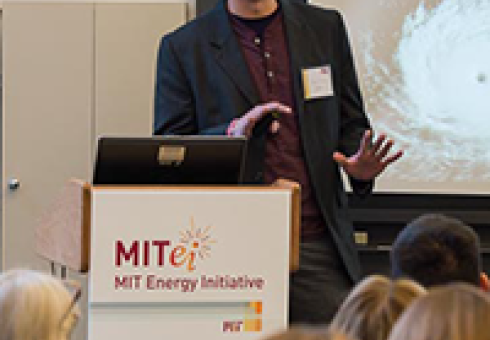
As Massachusetts and communities throughout the country face the realities of a world where severe weather events like Super Storm Sandy could become more common, smart adaptation strategies are needed. MIT students and researchers brought their latest ideas and findings to the table at an event on January 29. The interdisciplinary group of young researchers presented to officials from the Commonwealth’s Executive Office of Energy and the Environment, in hopes that the state would be able to leverage the information for future planning and implementation.
Going forward we will need to be thinking out-off-the-box, creatively for future planning ” Massachusetts Energy Undersecretary Barbara Kates-Garnick said at the event. “So much of what you’re doing is totally relevant to what we’re working on…I’m sure that we will be back in touch."
The student showcase was part of a series of events the MIT Energy Initiative organized during the MIT independent activities period to highlight what is being done – and what needs to be done – to face the realities of a post-Sandy world.
Included in the series of events was a panel discussion on January 23 featuring Massachusetts’ officials and MIT Professors Kerry Emanuel and Michael Greenstone. Learn more about the event, and watch the video of the panel, here.
The MIT Energy Initiative also organized a tour of the MBTA’s tunnels. Participants learned what the MBTA is doing to modernize and adapt to change. Read the MIT Tech story here.
 |
 |
|
Carri Hulet, Department of Urban Studies and Planning, presented on work she and Danya Rumore are doing on the New England Climate Adaptation Collaborative. As part of the effort, she and her partners engage stakeholders in communities throughout the region to devise creative adaptation ideas. |
Sebastian Eastham, Department of Aeronautics and Astronautics, presented on the health impact of geoengineering strategies and the moral consequences of choosing this approach. |
 |
 |
|
Megan Lickley, Joint Program on the Science and Policy of Global Change, presented on the need to protect coastal infrastructure under rising flood risks. She measured the costs associated with adding a sea wall to protect power plants off the coast of Galveston as an example of how her research could be applied. |
Rebecca Saari, Engineering Systems Division, presented on the co-benefits of a climate policy. Her research found that current ozone health costs fall hardest on the poor, but even a modest climate policy brings improvements. |
 |
 |
|
Dr. Tammy Thompson, Center for Global Change Science, expanded on Saari’s work and went into more detail on health benefits from climate change policy options. She compared the costs and benefits of several policy options and advised that policymakers should focus on both the costs and benefits when evaluating policies. |
Chris Mackey, Department of Architecture, presented on ways to counter the heat island effect by adding vegetation and reflective roofs to cool urban microclimates. His research showed the success such strategies could have, using the city of Chicago as an example. |
 |
 |
|
Jennifer Morris, Engineering Systems Division, presented on the added costs that come when combining a renewable portfolio standard (RPS) and a cap-and-trade policy. Her research showed that an RPS shifts investment away from least-cost emission reduction options and toward specific renewable technologies that could be more costly. |
Linda Shi, Department of Urban Studies and Planning, presented on local adaptation strategies in the Philippines as examples of how poorer countries have for many years been learning to adapt. One of her conclusions, however, found that short-term adaptive behavior may worsen long-term vulnerability. |
 |
 |
|
Dr. Justin Caron, MIT Energy Initiative, presented on emissions leakage from sub-national climate initiatives using California’s new cap-and-trade system as an example. He found that energy imports from neighboring states are the main cause of this leakage. To counter this, energy importers to California are now required to pay for a permit to sell their energy within the state. |
Daniel Chavas, Department of Earth, Atmosphere and Planetary Sciences, presented on the science of hurricane size, as larger storms (such as Sandy) can cause significantly more damage than smaller storms of comparable intensity. |

Research aimed at predicting future climate activity has primarily focused on large and complex numerical models. While this approach has provided some quantitative estimates of climate change, those predictions can vary greatly from one model to the next and produce doubts in the projected outcome.
In this Faculty Forum Online broadcast Professor Kerry Emanuel '76, PhD '78 discussed a new approach to climate science that emphasizes basic understanding over black box simulation. On Tuesday, Feb. 5, 2013, Emanuel presented an overview of his climate research and took questions from the worldwide MIT community via video chat. Watch the video and visit the Slice of MIT blog to continue the conversation in the comments.
About Kerry Emanuel
A Cecil and Ida Green Professor in the Department of Earth, Atmospheric and Planetary Sciences, Emanuel is a cofounder of the Lorenz Center, an MIT think tank devoted to understanding climate activity. He is the author of What We Know about Climate Change, which The New York Times called "the single best thing written about climate change for a general audience."
In 2006, Emanuel was named by Time magazine as one of the 100 most influential people in the world. He received his bachelor's degree in earth, atmospheric, and planetary sciences from MIT in 1976 and his doctorate in meteorology from MIT in 1978.

By Brad Plumer
February 6, 2013
Like it or hate it, policymakers in Washington are still obsessed with the deficit. That’s why think tanks keep churning out clever plans to cut spending and raise taxes.
And here’s a new paper from the Council on Foreign Relations offering an interesting twist on the theme. Using economic modeling, Michael Levi and Citgroup’s Daniel Ahn suggest that a tax on oil consumption could be one of the least harmful ways to trim the budget deficit.
How do they figure? Levi and Ahn first assume that Congress will enact a big deficit-reduction package over the next 10 years that cuts spending by 3 percent of GDP by 2020 and raises corporate and income taxes by 1 percent of GDP by 2020. That may be unlikely in the real world, but it’s fairly similar to the much-discussed Simpson-Bowles proposal.
Next, the authors look at what would happen if Congress scrapped some of those tax hikes and spending cuts and instead replaced them with a tax on oil consumption. This would could involve simply raising existing taxes on gasoline, diesel fuel, and jet fuel. They assume the oil tax would be phased in over time and come to about $50 per barrel of crude oil in 2020, or an extra $1.20 per gallon of gasoline.
After running their economic model, Levi and Ahn found that using the oil tax to fend off some of the spending cuts and income tax hikes could be beneficial to the U.S. economy. In other words, a deficit package with an oil tax could be less harmful than a deficit package without one. Here’s the key chart:
In Variation 1, the gold line, the oil tax is used to restore part of the government spending cuts in the big deficit-reduction deal. In Variation 2, the blue line, the oil tax is used to restore part of the spending cuts and keep taxes lower. In Variation 3, the red line, the oil tax revenue is used to keep income and corporate tax rates at their current levels.
The end result: The U.S. economy performs better when there’s oil tax revenue to fend off spending cuts and tax hikes. GDP rises faster and unemployment falls further.
Why might this be? For one, Levi explained in a phone interview, a portion of the oil tax would fall on foreign countries, since the United States still imports about 40 percent of its crude. What’s more, oil in the United States is relatively lightly taxed. “Raising taxes on something that’s under-taxed, like oil, rather than something that’s already heavily taxed, like income, can yield good results,” Levi said.
Of course, this is a rather simplistic scenario, and Levi and Ahn model a few other possibilities in their full paper (pdf). For instance, it’s quite possible that an oil tax would curb U.S. fuel consumption, which might in turn lower global oil prices. (Though that’s hardly certain; a lot would depend on how OPEC responded.) In that case, the U.S. economy could see a slightly bigger boost.
Meanwhile, there are distributional consequences to consider. An oil tax is likely to be quite regressive — many poorer Americans spend a greater fraction of their income on gasoline. So Levi and Ahn looked at what would happen if half of the oil tax revenue was kicked back to consumers as lump-sum rebates, while the other half was used to reduce taxes and maintain spending levels. Even in that case, the economy performs better than it does under a standard deficit-reduction plan.
In theory, a tax on oil could have other benefits as well — if it reduces domestic fuel consumption, that would make the U.S. economy less vulnerable to large swings in global oil prices. But those benefits aren’t factored in here.
Last year, a similar study from MIT looked at the effects of using a broader carbon tax to trim the deficit. That study found that carbon taxes only offered a slight advantage over other budget-cutting measures. But there’s an important difference here — unlike the MIT study, Levi and Ahn’s paper doesn’t assume that the U.S. economy will be running at full employment anytime soon. And in that case, finding ways to blunt the impact of deficit reduction over the next 10 years could have a big effect on the course of the economy.

MIT students frequently use the T and other MassDOT transit systems; since 2010, our IDs even come with a built-in Charlie Card chip. But most students are unfamiliar with the inner workings of the transit system. I was excited to take advantage of one of the opportunities offered this IAP and take a tour of several MassDOT (Massachusetts Department of Transportation) facilities, including an underground ventilation tunnel system, bus operator training school, and the organizational headquarters for the T.
MassDOT offers variations of this tour every other week to Boston residents. The locations on the tour change based on weather. Ethan Feuer, Student Activities Coordinator for the MIT Energy Initiative, organized the tour for twenty five students in order to learn more about large infrastructures and emergency preparedness in cities.
Our tour was led by two MassDOT veterans, Adam Hurtubise, Assistant to the Highway Administrator at Massachusetts Department of Transportation, and Darrin McAuliffe, Director of Communications and Coordination.
We boarded our privately-chartered MBTA bus and departed for our first stop: bus driver training school. Driving a 40 or 60-foot bus through the crowded streets of Boston is no easy task. The rigorous training program accepts applicants with a Certified Driver’s License permit, and begins testing them only eight days later to determine if they will qualify to become a bus operator. For their final exam, students must complete a serpentine maneuver, back up in a straight line, parallel park, and drive through the streets to the satisfaction of their examiner.
As part of the training program, students are introduced to the feeling of the bus driver’s seat in a simulator. We were able to give the simulator a whirl. When I first entered the simulator cab, I was surprised by the size of the steering wheel. Making tight turns with the bus required not only excellent timing but also rapid spinning of the wheel. The size of the bus and the seemingly countless rearview mirrors were disorienting and meant I was never entirely sure where the back of my simulated bus was. I successfully right-turned and merged into traffic, only to hit a taxi seconds later as I tried to pull over to the bus stop.
The bus instructors entertained themselves by introducing obstacles, such as ambulances and elderly pedestrians, into the simulated roadway, and by turning the roads icy or making it snow in the view screen. During one particularly unfortunate drive, they caused a boulder to roll into the middle of the road. After struggling with the simulator, I am much more impressed by the MBTA drivers’ ability to maneuver these behemoths.
The next stop on our tour was Vent Building 4, one of 13 major ventilation buildings located throughout Boston. These buildings take in fresh air from above ground, pump it into roadway tunnels, and expel the exhaust-filled air from within the tunnel. This system is key to keeping the MassDOT Central Artery roadway tunnel system pleasant to drive through, and safe from smoke buildup in case of a fire.
Some buildings are built around vent cores, including the upscale Intercontinental Hotel. Vent buildings can be identified by the large vents on the side of them, but the vents are designed to be inconspicuous and the building interiors are mostly unaffected. You might never guess that the basements of such buildings house several-story-high fans, backup generators and batteries, and tunnels that connect most of the city of Boston.
We visited the Haymarket T station vent building. Before beginning this part of our tour, they outfitted us in outrageous orange hard hats and vests, because we were going to see “live traffic coming at us.”
According to Hurtubise, the Haymarket building has so much basement space that it is deeper underground than it is high. We took an elevator down into a chilly series of rooms made entirely of cement and lined with pump machinery and gauges (in case of “water infiltration,” said our guides), wandered past two large 8- and 12-cylinder diesel generators, which the city keeps in order to light the traffic tunnels in case of a power outage, through rooms containing large arrays of backup batteries in case the generators fail, until we came to a flight of stairs leading further down. The ceilings were very high, and at this point, we began to suspect the basements were even colder than the frigid 15 degree air at ground level. “
Congratulations,” said McAuliffe, as he directed us into an enormous room with fans the size of the MIT chapel lined up on one side, “you’ve found the coldest place in Boston.”
We were in the supply plenum of the vent building. Every vent building has a supply and exhaust plenum. The supply plenum is full of fans to suck fresh air into the building. In the Haymarket plenum, we could stand in the center, look directly up, and see straight out of the skylight at the top of the building. We also visited the exhaust plenum, which was much darker, creepier, and more damaging to the lungs.
Our guides assured us the levels of carbon monoxide within the car tunnels are continuously monitored to maintain a safe level. The vent system can also react to smoke from a car fire by pressurizing one part of the tunnel more than the other in order to dispel the smoke.
While in the plenum, our guides showed us a place where the room narrowed into a car-size tunnel. They explained such tunnels connect most of the vent buildings together, meaning you can travel across Boston via them, in a similar way to traveling through the MIT tunnels, although perhaps not quite as luxurious. Sometimes, said Hurtubise, the tunnels get so narrow you have to crawl. The vent building also connects directly to the car tunnel it ventilates. So, it was time for us to see some “live traffic.”
Our guides opened a door which led to a narrow concrete platform in one of Boston’s car tunnels. I had seen maintenance doors countless times in traffic tunnels, but never imagined what was on the other side. From our position, we could look down to see cars driving through the tunnels and feel the freshly ventilated air blow into our faces.
At the ventilation building, we visited one of the emergency systems MassDOT has in place in case of superstorms like Hurricane Sandy. The low-point pump room, the deepest part of the building, deals with any flooding that may occur in that section of the tunnels. We could see evidence of the most severe flood experienced in Vent Building 4: a water mark about three feet high on the walls. According to our guides, MassDOT is unsure of how its systems would be affected by a sudden rise in water level, such as Hurricane Sandy caused in New York, and is currently conducting a study on how much their infrastructure could handle.
By now, we were ready to warm up and feel our extremities again, so we proceeded to the MassDOT Highway Operations Center. This office, housed on the second story of an inconspicuous office building, resulted from the merger of Massachusetts Highway Authority and the Turnpike Authority, which occurred during the formation of MassDOT in 2009.
Most of the office was a single large room that resembled spy headquarters from an action movie. The back wall of the office displayed multiple video feeds from some of the 900 video cameras dispersed along the Massachusetts highway system.
The Highway Operations Center monitors the video feeds with help from computer algorithms to identify traffic accidents and provide emergency responders with exact location and visual information. The cameras employ an accident-finding algorithm, which triggers an alert when one camera shows non-moving tail-lights, which means the camera is viewing the back-up behind an accident, or when a camera shows no traffic at all, which means the camera is trained on the roadway in front of an accident.
The manager of the operations center, Michael Fitzpatrick, shared stories with us about incidents the office handles. The center has over-height vehicle detection systems, which alert when a truck that is too tall for a tunnel is en route to pass through it. They respond by flashing warnings on digital signs on the side of the road. Fitzpatrick said once a driver ignored the warnings and scraped a video camera off the tunnel ceiling. Police followed him in order to retrieve the camera, which was dangling from the back of his trailer.
Being MIT students, we were especially interested to learn more about their computing systems. Another unique algorithm the Highway Operations Center developed works like the Google Maps traffic feature to track the speed of traffic. Sensors identify bluetooth devices in vehicles, mainly cell-phones, and record how long it takes the devices to go from checkpoint to checkpoint. Fitzpatrick explained the color coding on the traffic map. Since it was the middle of the day, most roadways were green; amusingly some stretches were blue, indicating the average car speed was above the posted speed limit.
Although the Highway Operations Center uses some clever algorithms, several issues from the merger remain. According to Fitzpatrick, many of their monitoring and data-collection systems run on different platforms, so they do not communicate with each other.
Our final stop on the tour continued to indulge our tech-oriented sides. We parked our bus outside of a inconspicuous office building. Most passerby did not give the building a second glance, but the security guard in the foyer made us realize this building was important.
“No one really knows where this building is,” said Hurtubise. “We don’t advertise it.”
We were inside the MBTA Operations Control Center, home to the logistics departments responsible for deploying T trains and MBTA buses. The operations centers for these two transit systems were located on separate floors.
In the bus headquarters, we learned more about the role of MBTA buses. They respond to emergency situations, such as building evacuations or natural disasters, by providing buses for shelter or egress. Employees in this office were responsible for tracking the location of buses and making calls to drivers to keep them within five minutes of schedule.
The T train operations center looked like the command center from a sci-fi ship. All the walls were painted black, employees sat at computers arranged on terraced platforms facing the front wall of the room. On this wall a huge projected graphic depicted the train lines, stops, and trains currently on the track.
This tour left me amazed the with amount of detail MassDOT manages every day and great respect for its employees. Feuer called it a “wonderful” and “holistic” tour which covered many aspects of the MassDOT system.
This is the first time the MIT Energy Initiative has organized such a tour with MassDOT. The tour fit in well with this month’s theme at the Energy Initiative, “Preparing for Climate Variability.”
Due to the New York subway shut-down in the aftermath of Sandy, Feuer wanted to find out how prepared Massachusetts’ transportation systems are for such an event.
Feuer said he was pleased by the feedback he received from both students and our tour guides, and, luckily for the many students on this tour’s waitlist, he hopes to do more tours in the future.
“One student said it was a real highlight of his seven years at MIT,” said Feuer, “and Adam [Hurtubise] has told me we were the best group, that people are telling him we brought our A game.”
This tour was a unique opportunity for students. As Feuer put it, “rarely do we get to see the underpinnings of public transit” and the “engineering marvels” involved.

By Henry (Jake) Jacoby
Introduction
Mitigating climate change doesn’t sound as monumental as ending, or reversing climate change. But with global phenomenon already “contributing to the deaths of nearly 400,000 people a year and costing the world more than $1.2 trillion… annually,” according to the Climate Vulnerability Monitor, MIT professor Henry “Jake” Jacoby explains why efforts to mitigate climate change may be crucial to determining the next generation’s quality of life.
Henry (“Jake”) Jacoby is William F. Pounds professor emeritus in the MIT Sloan School of Management, and former co-director of the MIT Joint Program on the Science and Policy of Global Change.
Talking about mitigating climate change risk is a bit like the story of the man arrested for murder whose lawyer said to him, “I’ve got good news and bad news. The bad news is the blood found at the crime scene matches your DNA. The good news is your cholesterol level is down to 160.”
First, the bad news about climate change: The quantity of greenhouse gases humans have pumped into the atmosphere since the dawn of the industrial age is already changing the earth’s climate and raising global temperatures. What’s not widely recognized is that simply stabilizing global greenhouse gas emissions at today’s levels will not stabilize their atmospheric concentrations and effects on climate. Much deeper cuts will be required. Moreover, even if we succeed in reducing future emissions drastically, our children and grandchildren will have to live with the consequences of global warming –not just higher temperatures, but more severe storms, sea level rise, fire, drought and other environmental changes.
With no additional mitigation policy, we estimate there’s about a 50/50 chance that global temperatures will rise by as much as 5 degrees Celsius by the end of this century. There’s almost a one in four chance global temperatures will rise by 6 C or more.
Over the past two decades, diplomats have tried to negotiate a deal to limit atmospheric concentrations of “Kyoto gases” (carbon dioxide, methane, nitrous oxide and other industrial gases). Their ultimate goal: to curb global temperature increases to 2 C by the year 2100. However, after analyzing the data, the objective looks daunting.
Whatever we and the other nations do, climate change will adversely affect future generations. By steadily pressing ahead to create a non-carbon-based economy by whatever means available, we can limit the damage.
For example, one specific target is to limit atmospheric concentrations to about 450 parts per million (ppm). But given that the concentration of these gases has already risen from 275 ppm in the late 18th century to around 440 ppm today, and is climbing steadily, it’s doubtful we can achieve that goal.
But all is not lost. According to our calculations at MIT’s Joint Program on the Science and Policy of Global Change, even if we limit atmospheric concentrations of the Kyoto gases to a more modest 650 ppm, the high-end risks of climate change — temperature increases of 5 to 7 C — disappear. In other words, our grandchildren would still have to live with the disruptive effects of climate change, but they wouldn’t have to face the most catastrophic scenarios.
That’s the good news about climate change: almost anything we do to limit greenhouse gas emissions has its biggest effect on the worst possible outcomes. That’s why it’s worth keeping up the fight to reduce greenhouse gas emissions even though some targets will be hard to meet.
Here in the U.S., despite the national gridlock on climate change policy, energy-related carbon dioxide emissions have dropped in recent years — in part because of the recession but also due to a shift from coal to natural gas as a power source. The fact that President Obama talked about climate change in his inaugural address, plus the effect of recent storms and drought on public understanding of the risk, may help shift the debate toward a more aggressive policy response.
Right now, the U.S. has a cobbled together quilt of state, regional and national policies — automobile mileage standards, appliance efficiency ratings, renewable energy subsidies — that indirectly limit greenhouse gas emissions. From an economic perspective, the cheapest and best way to reduce emissions would be with a carbon tax, or a cap-and-trade system that places a price on carbon emissions. It’s a win/win/win solution. It would 1.) lower greenhouse gases emissions and oil imports, 2.) increase revenue which could be used to cut other taxes, and 3.) have a neutral-to-positive effect on economic growth. If a price penalty for emitting greenhouse gases is not politically feasible, then more expensive regulatory measures are going to be the way forward.
Whatever we and the other nations do, climate change will adversely affect future generations. By steadily pressing ahead to create a non-carbon-based economy by whatever means available, we can limit the damage.
In this Faculty Forum Online broadcast Professor Kerry Emanuel '76, PhD '78 discussed a new approach to climate science that emphasizes basic understanding over black box simulation. On Tuesday, Feb. 5, 2013, Emanuel presented an overview of his climate research and took questions from the worldwide MIT community via video chat.
Dr. Noelle Selin of the MIT Joint Program on the Science and Policy of Global Change has been selected as one of 20 Leopold Leadership Fellows for 2013. She is the first fellow to be selected from the Massachusetts Institute of Technology.
Based at the Stanford Woods Institute for the Environment, the Leopold Leadership Program provides outstanding academic environmental researchers with skills and approaches for communicating and working with partners in NGOs, business, government and communities to integrate science in to decision making.
Selin is among the 20 mid-career academic environmental researchers named as fellows this year. The group was selected through a highly competitive process on the basis of their exceptional scientific qualifications, demonstrated leadership ability, and strong interest in sharing their knowledge beyond traditional academic audiences. The fellows will take part in intensive leadership and communications training designed to hone their skills in engaging with decision-makers, media, and the public. They also become part of a network of past fellows and program advisors who are working with leaders, both within and outside academia, to solve society’s most pressing environmental and sustainability challenges.
The 2013 fellows are doing innovative research in a wide range of disciplines, including ecology, marine science, economics, behavioral science, entomology, engineering and planning. They join a network of 175 past fellows who areengaged in broad-based efforts to solve society’s most pressing sustainability challenges.
MIT researchers, Massachusetts officials highlight strategies to adapt to climate change.
Just days after President Obama called for action on climate change in his second inaugural address, members of Massachusetts Governor Deval Patrick’s administration joined energy and environment researchers at MIT to discuss strategies for adapting to climate change. The panel discussion on Jan. 23 fostered a continued partnership between MIT and the Commonwealth to advance energy and environment innovation.
“We are so pleased to have the opportunity to utilize one of the Commonwealth’s greatest intellectual resources — MIT — to tackle this global challenge,” said Massachusetts Undersecretary for Energy Barbara Kates-Garnick, the moderator of the panel.
MIT professors Kerry Emanuel and Michael Greenstone kicked off the event with a discussion on the clear realities of climate change.
“When we’re talking about global climate change, no one really cares if the temperature goes up a few degrees. On a day like today it would seem to be a good thing,” said Emanuel, the Cecil and Ida Green Professor of Atmospheric Science. “What we really care about … is the side effects of that global warming.”
Side effects include increases in sea levels of as much as three feet by the end of the century, increased incidence of heat waves and drought, and more intense rain and snow storms and hurricanes.
When asked by MIT Energy Initiative Director Ernest Moniz how long we have to prepare, Emanuel said the time scale is negative. But he pointed out that part of the problem is policies that encourage people to live and build in risky places. “People are moving into hurricane-prone regions, including right here in Massachusetts,” Emanuel said. “For these people, this is bad news.”
Emanuel's colleague, Greenstone, then laid out some of the ways to confront the challenges of climate change.
Mitigation — i.e., reducing greenhouse gas emissions to reduce the severity of climate change effects — is one course of action. But, Greenstone noted, a comprehensive mitigation strategy hasn’t generated much enthusiasm around the world. “I say that as someone who listened to the president’s inaugural and thought, ‘This is fantastic. The president is making a big effort on this,’” said Greenstone, the 3M Professor of Environmental Economics. “Unfortunately, I’m not sure everyone in the country agrees with the president, and the politics have proven to be a little harrowing.”
Like President Obama, Greenstone believes the United States should be a leader, encouraging other countries to also confront climate change. Acting through adaptation measures can complement both mitigation initiatives and funding of basic research and development for low-carbon energy sources in the United States and abroad.
Greenstone said that in addition to contributing to the science of climate change, researchers can partner with policymakers and planners to try to find successful adaptation strategies. This collaboration is important because “the playbook of successful adaptation strategies I think is rather small,” Greenstone said.
Fortunately, Massachusetts is playing a key role in developing that playbook. Two years ago, the Commonwealth released the Massachusetts Climate Change Adaptation Report, which lays out strategies to help prepare for and respond to the impacts of climate change. Stephen Estes-Smargiassi, director of planning for the Massachusetts Water Resources Authority (MWRA), and the Department of Agricultural Resources Commissioner Gregory Watson spoke about some of their efforts.
Estes-Smargiassi used the Deer Island treatment plant as one example of their work to make adaptation part of their long-term strategy.
When the department began designing the plant in the 1990s, its engineers realized that if sea level rose, the plant's capacity would be compromised. To ensure they would have the capacity needed for the future, the MWRA decided to raise the design of the plant almost two feet. Estes-Smargiassi called this move the first significant and concrete effort at climate adaptation nationwide.
“When we’re making a renovation, we’re going to make sure climate change is a part of it. It’s built into our thinking,” Estes-Smargiassi said.
The department is also taking steps to be more efficient. Just this week, the MWRA was nationally recognized by the American Council for an Energy-Efficient Economy and the Alliance for Water Efficiency for its exceptional efforts to save both energy and water. The MWRA’s work contributes to the Commonwealth’s overall effort to reduce emissions by 25 percent by 2020 and by at least 80 percent by 2050 below statewide 1990 emissions. Mandated by the Massachusetts Global Warming Solutions Act of 2008, these emission reduction targets are the most ambitious in the nation.
With a third of global greenhouse gas emissions coming from the food system, Watson spoke on his department’s work. Calling large commodity-based agriculture “a thing of the past,” Watson said his department is turning to new, more sustainable techniques: composting, enriching soils with nutrients, increasing fertility with biochar (charcoal substitute made from organic material) and encouraging "grow local" campaigns.
“We’re creating a sustainable agricultural economy in Massachusetts,” Watson said. And that’s “the direction agriculture in this country is headed.”
While there are substantial efforts underway in Massachusetts, Kates-Garnick concluded the discussion by highlighting the need for continued work.
“We have a piecemeal approach. One administration leaves, another comes in. And while we may all be committed … what we really have to do now is put in place long-term consistent solutions ... I think we’re really focused on doing this in our administration,” Kates-Garnick said.
MIT researchers and Massachusetts officials will come together again next week to learn about cutting-edge strategies students are developing.
Watch the video of the event