
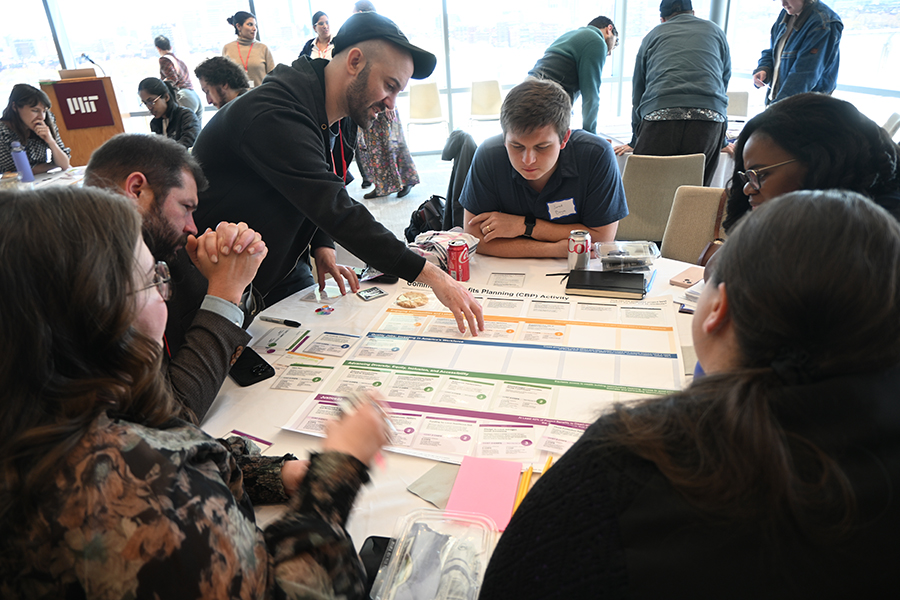
Living Climate Futures Symposium participants worked together to identify potential pros, cons and tradeoffs of allowing a data center to be built in a fictitious community. (Photo by Laura Frye-Levine)
Place-based pathways to a viable future
Living Climate Futures Symposium explores climate challenges and solutions at the community level
Aiming to transition away from fossil fuels and avert the worst consequences of climate change, world leaders aspire to achieve net zero global greenhouse gas emissions by 2050 and cap global warming at 1.5 degrees Celsius. But actions to meet such targets and minimize adverse impacts on lives, livelihoods and infrastructure are not one-size-fits-all; they will require different approaches in different places. To better understand the patchwork causes and effects of the climate crisis and elements of viable solutions to it, researchers in MIT's Living Climate Futures (LCF) initiative—20 MIT faculty and affiliates from across the Institute—collaborate with frontline communities in diverse physical and socio-economic landscapes around the world.
Funded by the MIT Human Insight Collaborative (MITHIC) and based at the MIT School of Humanities, Arts and Social Sciences (SHASS), LCF is a multi-disciplinary research hub and community of practice; focuses on how climate change impacts people’s everyday lives; and creates knowledge and research partnerships with community organizations. At MIT on April 23-25—just after Earth Day—LCF showcased several of these partnerships at its second Living Climate Futures Symposium, which brought together community environmental organizations with MIT researchers and students to explore how climate change challenges and responses to them are playing out in locations from New England to Mongolia.
“Across the next two days, we'll have conversations about community-based work and scholarly research that's aimed at understanding the structural causes and social effects of climate change as it's experienced in people's everyday lives,” said MIT Professor of Anthropology and MITHIC Faculty Co-Lead Heather Paxson in remarks at the start of the first full day of the conference. “I'm really excited for this symposium, and for where Living Climate Futures can go from here.”
Climate justice: Resistance and repair
Resisting environmental harm: confronting data centers
A session on data centers, energy concerns and community health in Greene County in Western Pennsylvania highlighted how stakeholders are attempting to proactively avert long-term threats to the environment and public health in and beyond their neighborhoods. Nicholas Hood, senior organizer at the Center for Coalfield Justice, which has worked to improve policy and regulations on fossil fuel extraction and use in the region since 1994, described local environmental and health impacts of these activities including fracking, which has increased water pollution, asthma and lymphoma. “We have coal mines, these old oil wells, and fracking on top of that, and now we're going to add data centers,” he said. “So, ask yourself, do you think we want that?”
CCJ community advocate Jason Capello noted that market forces compel data center developers to build as cheaply as possible in places where they believe the population is unlikely to raise concerns about adverse environmental and health impacts. These impacts include pollution from on-site water-based cooling systems, diesel generators and mini-power plants that run on natural gas, and fine particulate matter-linked illnesses such as childhood asthma, heart attacks, stroke and lung disease. But in a subsequent presentation, Livia Garofalo, a cultural and medical anthropologist on Data & Society’s Trustworthy Infrastructures team in Philadelphia, showed that many communities have pushed back against data center project proposals. “Through protests, canvassing, petitions and public hearings, communities have been able to resist and even stop data center projects,” she said.
To help communities resist or limit the impact of proposed data center projects, Michael Cork, postdoctoral research fellow in biostatistics at the Harvard T.H. Chan School of Public Health, described a tool he has developed to estimate emissions, model how pollution would spread, estimate who will be exposed, and assess likely health and economic impacts. To further explore how communities can respond to such projects, MIT Associate Professor of Anthropology Amy Moran-Thomas and Stanford University Postdoctoral Researcher Anjuli Jain Figueroa facilitated an educational game conceived by Northeastern University Associate Professor of Sociology and Health Science Sara Wylie.
The game helped teach participants how often-overlooked community stakeholders can negotiate Community Benefit Agreements (CBAs), or plans that specify project developers’ commitments to address their concerns and provide local improvements such as jobs and affordable housing. Gathered around several tables, symposium participants worked together to identify potential pros, cons and tradeoffs of allowing a data center to be built in a fictitious community. Offering another avenue for community advocacy, Moran-Thomas also moderated a workshop led by public anthropologist Ieva Jusionyte on how to write op-eds that inspire change.
Repairing environmental harm: more than a matter of money
A session on global perspectives and methodologies for climate reparations focused on the context for and definition of the term. Veronica Coptis, senior advisor at Taproot Earth, a U.S.-based NGO advancing climate reparations, framed climate justice as a movement about reducing not only excessive greenhouse gas emissions but also the systems of oppression that have produced them, all while building a world where everyone can live, rest and thrive in the places they love. “[Taproot Earth’s] mission is building power and cultivating solutions with frontline communities to advance climate justice through Black liberation, Indigenous sovereignty, and democracy,” said Coptis. “We seek to both repair harms and cultivate the frontline solutions needed to transform systems of extraction into ones of liberation.”
Eliane Lakam, Global Policy and Partnerships Specialist at Taproot Earth, described a two-decades-long process, sparked by Hurricane Katrina’s devastation of marginalized communities on the U.S. Gulf Coast, that led to a Global Climate Reparations Working Statement at the Global Climate Reparations Governance Assembly of 200 climate leaders in Nairobi, Kenya in 2024: “Climate reparations is the restoration of healthy and balanced relationships with all that comprise a shared global ecosystem. Reparative action begins with those who benefit most from the historic and current systems of oppression. It requires the abolition of debt, restitution for injustice, and the establishment of accountable systems rooted in Black and Indigenous liberation for all oppressed people and future generations.”
Regeneration and resilience
Urban agriculture: Reclaiming and revitalizing degraded land
A session on advancing urban agriculture in a changing climate featured a panel of four organizational representatives of various growing spaces in Greater Boston, many of which were formerly vacant lots and garbage dumps that were repurposed as farms and gardens. The panel included Sabrina Pilet-Jones, Urban Farm Manager at Haley House; Cecilia Del Cid, Director of Food Justice & Youth Programs at GreenRoots; Olivia Golden, Urban Agriculture Educator at UMass Extension; and Matthew Ellison, Assistant Farm Manager at the Urban Farming Institute.
The panelists showed how their efforts to grow food locally in an urban setting are challenging past and ongoing environmental injustice in myriad ways. These include preserving and expanding green spaces, increasing access to fresh produce, empowering their communities to become actively engaged in how their food is grown, building community connection and pride, and inspiring young people to grow food in their neighborhoods. They framed their organizations’ youth education programs as gateways for enabling the transfer of knowledge from elders to young people, promoting a strong work ethic and healthy lifestyles, and identifying pathways to livelihoods that address food access and sustainability. To provide participants with an opportunity to learn more about urban agriculture and do some volunteer farm labor, the symposium offered a field trip to The Food Project in Roxbury.
Rural and urban adaptation: Responding to a changing climate
A session on climate change as a place-based phenomena explored how communities are responding to a changing climate on Mongolian grasslands, in the greater Southwestern U.S., and along the Boston Harbor.
Munkh-Erdene Gantulga, a PhD candidate in Geography at the School of Geography and the Environment, University of Oxford, described his studies at the National University of Mongolia (NUM) on how pastoralists at two field sites are protecting their livelihoods as more frequent, severe weather events increase livestock mortality and pasture degradation. Perceiving climate change as a lack of rainfall, hotter temperatures and inadequate grass growth, herders at the two sites are either migrating to greener pastures or applying three strategies: not milking their animals so as to boost survival of mothers and their offspring, selling off parts of their herds, or specializing in more climate-resilient animals such as camels. A separate screening of the film If Only I Could Hibernate dramatized the environmental and economic obstacles faced by youth in Mongolia.
Breanna Lameman, an Indigenous Data Sovereignty doctoral scholar and graduate research associate at the University of Arizona, and Nekai Eversole, Wildlife Biologist and Program Lead with Climate Change Program - Navajo Nation Department of Fish and Wildlife, described how traditional Diné ecological knowledge and innovative technologies are helping Navajo Nation communities to adapt to hotter temperatures, long droughts and harsher soil conditions. Lameman cited Diné concepts of restoring balance and maintaining kinship with the natural world, as essential to the local response. “This reminds us that the plants, animals, water, and soils are relatives, not resources, and that we all need to work together,” she said. “Watching the stars, observing the winds, the plant cycles, and animal behaviors, really helps us predict seasonal shifts better than any app out there.” Eversole noted that this mindset is combined with innovative technologies ranging from hydroponics to wetland restoration structures. A separate screening of the film Climate Voices and Q&A with director Leslie Jonas, MLK Jr. Visiting Scholar/Elder Eel Clan member of the Mashpee Wampanoag Tribe, explored perspectives from Native experts and climate scientists working on the frontlines.
Elisa Guerrero, Community Engagement Manager at the Stone Living Lab and Sustainable Solutions Lab at UMass Boston, highlighted two examples of adaptation measures to protect vulnerable Boston Harbor infrastructure from sea-level rise, coastal storms and storm surges: testing seawalls designed to mimic natural habitat for how well they slow down wave action and preserve marine biodiversity; and monitoring salt marshes to better understand the factors that degrade and promote their health. A separate Stone Living Lab tour enabled symposium participants to visit a living seawall, nature-based flood protection infrastructures, and a community-based flood sensor project as Boston tries to address rising seawater levels.
The road ahead
Training the next generation in community-oriented research
In addition to highlighting LCF’s role as a research hub linking MIT researchers and students with community organizations in the U.S. and around the world, the symposium also sought to draw attention to efforts to train the next generation in this approach. The Saturday session “Experiential Learning, ‘Anthro-Engineering,’ and Learning to Do Community-Oriented Research” showcased some of the interdisciplinary classes that LCF supports. MIT students who participated in these classes engaged in activities ranging from building chicken coops with a Boston farming collective while learning about urban agriculture, to exploring how to decarbonize the steel industry in Pittsburgh and Southeast Chicago while creating well-paying green jobs, to spending time in Ulaanbaatar’s ger districts (informal residential areas) while working with Mongolian collaborators on non-coal methods for heating homes.
Student panelists shared highlights from their learning experiences through presentations, activities, artwork and written accounts from their travel notebooks.
"People have always been part of why I chose to study engineering,” said Nuclear Engineering PhD student Alina Jugan. “But learning how to integrate a human perspective, and one that accounts for multitudes of realities, is essential. The first step in making a solution is learning what the real problem is and how people experience it. This is what ‘Anthro-Engineering’ teaches us."
Panel and symposium co-organizer Laura Frye-Levine, a research scientist at MIT Anthropology and affiliate of the MIT Center for Sustainability Science and Strategy, concurred. "In building relationships in place-based contexts, the students on this panel demonstrate the value of engaging with social and cultural expertise in addressing climate change,” she said. “These projects are fantastic examples of collaborations that hold promise for MIT's approach to developing climate solutions."
Lessons in resilience from frontline community groups
In a session entitled “Xa xah Xechnging: A Sacred Obligation in a Time of Climate Chaos,” panelists from Se'Si'Le and Children of the Setting Sun Productions—two Indigenous-led environmental organizations from the U.S Pacific Northwest that have collaborated with LCF on experiential learning activities—described how they draw upon cultural, spiritual, scientific, legal and other resources in their efforts to heal and restore the planet amid political and corporate opposition. At the core of their work is a perspective in which everything has a spirit, and is thus worthy of love, honor, respect, dignity, pride and compassion.
Sundance Chief Rueben George, a board member of Se’Si’Le, recounted how this perspective energized the campaign he led against the development of the Trans Mountain Pipeline, a fossil fuel megaproject on Tsleil-Waututh Nation territories in British Columbia. “We just shared facts about what it is, and we led with our culture,” said George, who is also chair of Salish Elements, an Indigenous-run company that produces green hydrogen. “That's the biggest, most important thing, is we always led with our culture.”
At an earlier session, representatives of organizations that participated in the 2022 Living Climate Futures symposium, ranging from GreenRoots (which engages frontline communities of Chelsea and East Boston in environmental justice campaigns) to Se’Si’Le, said that they draw strength from the wisdom of ancestors, a growth mindset, and communal bonds among people who seek a better future for the places they call home. “I come back to the indomitability of the human spirit,” said Kurt Russo, co-executive director of Se’Si’Le. “Despite the cruelty of our time, we somehow find each other.”
Additional photos can be viewed here.