
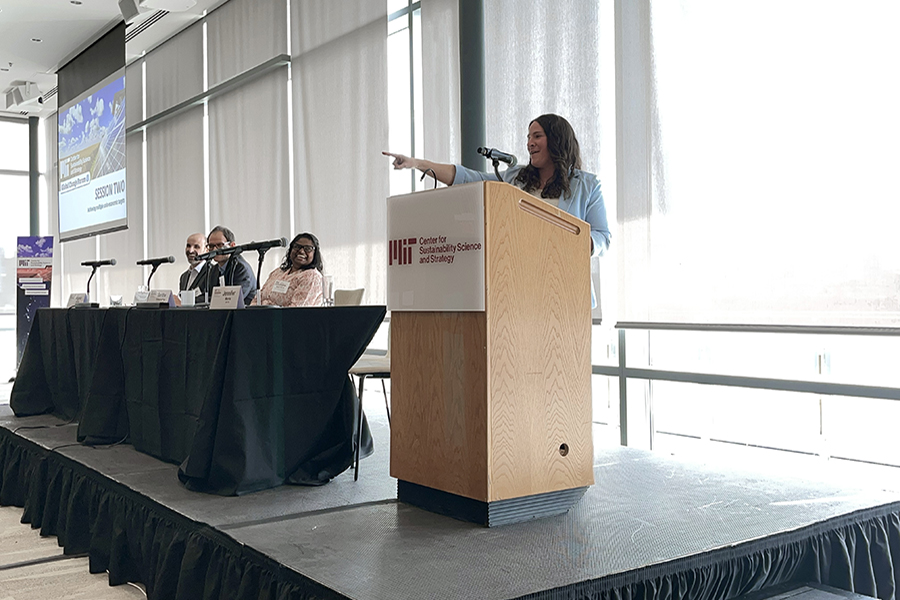
The 48th MIT Global Change Forum explored strategies that involve synergies in simultaneously addressing climate change and sustainability challenges, as well as those which involve tradeoffs. MIT CS3 Principal Research Scientist Jennifer Morris moderated Session 2: Achieving multiple socio-economic targets, featuring panelists Angelo Gurgel, Matthias Weitzel and Saritha Sudharmma Vishwanathan. (Source: MIT CS3/Jamie Bartholomay)
Connecting climate and sustainability: Synergies and tradeoffs
Key points from the 48th MIT Global Change Forum
Hosted on March 26-27 by the MIT Center for Sustainability Science and Strategy (CS3) at the Samberg Conference Center on the MIT campus, the 48th MIT Global Change Forum drew attendees from industry, academia, government and NGOs. Guided by the theme Connecting Climate and Sustainability: Synergies and Tradeoffs, Forum presenters and participants explored strategies that involve synergies in simultaneously addressing climate change and sustainability challenges, as well as those which involve tradeoffs.
“Our 48th Global Change Forum continues a long tradition of our working at the intersection of science and society, and convening a group of people who are interested in mobilizing basic research to inform action,” said MIT CS3 Director Noelle Selin, a professor at MIT’s Institute for Data, Systems, and Society and Department of Earth, Atmospheric & Planetary Sciences (EAPS), in introductory remarks. “Focusing on the challenges that impact all of us, we came up with this idea of synergies and tradeoffs—really understanding these systems and what can inform sustainability and promote well-being.”
This year’s Forum comprised six sessions: new approaches to understanding and attributing climate changes and extreme events; achieving multiple socio-economic targets; global challenges of plastic pollution; focus on planetary health; community engagement on sustainability issues; and incentives and strategies for decision-making.
Facilitated by MIT CS3 representatives and colleagues, each session consisted of the presentation of recent research results and insights on the topic, followed by a moderated, open discussion with all participants. In adherence to the “Chatham House Rule,” all sessions were off the record, with no press and no attribution of speakers’ comments without permission. Here, with permission from all speakers referenced below, we summarize key points from this year’s Forum presentations.
Session 1: New approaches to understanding and attributing climate changes and extreme events
Myles Allen, Professor of Geosystem Science at the University of Oxford, discussed the science and challenges of attributing extreme weather events to climate change. Framing climate change as “loading the weather dice,” such that certain events occur more frequently and/or with greater magnitude than they would otherwise, Allen stressed that reliable attribution needs models that realistically simulate the underlying physics of extreme weather. This requires representing these phenomena with sufficiently high resolution and large ensembles to reliably quantify rates of change in the occurrence-probability of classes of extreme events. He argued that climate attribution should be incorporated into weather forecasts, given its value for climate adaptation planning and insurance.
Ben Santer, Honorary Professor in the School of Environmental Sciences at the University of East Anglia, showed how changes in the vertical structure of atmospheric temperature, from the Earth’s surface up to an altitude of 50 kilometers—are a key piece of evidence for human effects on global climate. Santer noted that this “fingerprint” was predicted nearly 60 years ago, and has been identified with high confidence in weather balloon and satellite temperature data. He also provided scientific evidence to show that claims in a July 2025 U.S. Dept. of Energy report—that this human influence fingerprint is inconsistent with data—are verifiably false.
MIT Professor of Atmospheric Science Paul O’Gorman examined our latest understanding of regional and seasonal changes in extreme precipitation. When aggregated at large scales, observations confirm an overall increase in the intensity of precipitation extremes with global warming, said O’Gorman, but at the regional level this is not necessarily the case. Moreover, modeled projections of precipitation extremes are not uniform across world regions. To improve understanding of regional changes, he recommended scaling with both specific humidity (amount of water vapor in the air) and relative humidity (how close the air is to saturation), which captures observed precipitation extremes in current climate and projected changes in warm-season precipitation extremes.
Session 2: Achieving multiple socio-economic targets
MIT CS3 Principal Research Scientist Angelo Gurgel highlighted the rationale for and challenges in designing policies that achieve multiple socio-economic targets. Sometimes aligned with the United Nation’s Sustainability Development Goals, these targets go beyond climate, energy and GDP to include health, equity, food security, employment or other key societal concerns. Gurgel noted that while socio-economic co-benefits are key to gaining public support and stakeholder engagement, some socio-economic targets can conflict with one another, from bioenergy production and food security to carbon dioxide removal and climate justice. He described CS3 computational tools that enable decision-makers to assess multiple socio-economic goals, including the STRESS platform and MIT’s Integrated Global System Modeling framework.
Matthias Weitzel, Team Leader at the European Commission’s Joint Research Centre, explored best practices in designing climate policies that promote a transition to low- and zero-carbon energy sources without imposing economic harm on lower-income populations. To that end, Weitzel advised that decision-makers anticipate labor market shifts, understand distributional impacts from regulations and carbon pricing, and use carbon pricing revenues to fairly compensate those most impacted by higher fuel costs. Options for distributing those revenues include income tax reductions, lump-sum payments to consumers, and targeted investments that make clean energy choices more affordable. He emphasized the need to tailor policy design to accommodate regional, sectoral and income differences.
Saritha Sudharmma Vishwanathan, Assistant Professor of Urban Systems and Environmental Engineering at Kyoto University, introduced sustainability-oriented metrics that go beyond GDP, which focuses on economic production output. These include the Human Development Index (HDI) and Decent Living Standards (DLS). HDI focuses on human welfare and integrates social and economic aspects such as health, education and economic well-being, but does not: directly measure social and gender inequality, include the environment, or include all sustainability variables. Based on concepts of poverty and basic justice, and addressing many Sustainable Development Goals, DLS emphasizes essential needs to maintain decent living. She also emphasized that additional methods are required to capture development aspirations and inequity.
Session 3: Global challenges of plastic pollution
MIT CS3 postdoctoral associate Dominic White showed that economic modeling can help contribute to a reduction in plastic pollution, which causes ecosystem degradation and negatively impacts human health, the productivity of fisheries and other industries, and tourism. White explained how input-output data representing the flow of goods or services in different regions can be used to understand the use of plastics in multiple industries and the flow of plastics through the world economy, and thus identify industries, such as clothing and fabrics, to target in plastic pollution-reduction policies. He also demonstrated how economy-wide modeling tools can track plastic use and examine potential plastic policy impacts.
Maria Ivanova, Director and Professor of Public Policy at Northeastern University, observed that because plastics is a global material system, an important way to reduce plastic pollution is at the international level. Ivanova noted, however, that after five rounds of international negotiations since 2022, no treaty to reduce plastics production and waste has emerged due to vague mandates, a compressed timeline and a leadership vacuum. She maintained that a viable path forward entails expanding informal meeting spaces, building on areas of agreement, and establishing separate tracks for specialists and diplomats; applying a phased approach to implementation; and building leadership from “the middle out” by starting with cities, companies and campuses.
Jenna Jambeck, Professor of Environmental Engineering at the University of Georgia, focused her presentation on the global challenges of plastic pollution. These include a massive accumulation of plastic waste in the environment, and a rapid increase in microplastics harmful to marine life and human health. Using design principles to eliminate plastic waste, Jambeck has led development of the Circularity Assessment Protocol (CAP), which provides data for decision-making to reduce leakage of plastic waste and increase circular materials management. In more than 15 countries/60 cities, local partners work with the CAP team to inform prevention of plastic pollution using open-data tools such as the Debris Tracker.
Session 4: Focus on planetary health
Michelle Bell, Professor of Environmental Health at the Yale School of the Environment, explored the impacts of climate change on human health. Bell stressed that such impacts go far beyond traditionally studied exposures (e.g. reduced food and water security and degraded air quality), to include mental health (e.g. climate anxiety, heat stress and sleep loss) and community health (e.g. heat-related increases in violence and crime). Noting that much of the world still has comparatively little scientific evidence on climate change and health, she called for more investment in on-the-ground health data.
MIT Professor of Earth, Atmospheric and Planetary Sciences (EAPS) Arlene Fiore recommended three ways to tap synergies while identifying tradeoffs with air quality–health–climate connections. First, continue to expand observing capacity to include under-monitored world regions, reduce uncertainties in health studies, and exploit opportunities to extract process-level insights. Second, characterize and understand compound risks associated with extreme events at the nexus of climate-health-air quality, such as wildfires and heatwaves. And third, assess multiple impacts from health-motivated emission controls by placing climate/health/ecosystem/air quality changes in the context of natural variations, diagnosing system sensitivities and developing tools such as emulators to rapidly assess impacts.
MIT EAPS/CS3 Senior Research Scientist Stephanie Dutkiewicz explained how climate change is altering the health of marine ecosystems. Dutkiewicz cited satellite observations showing that 42 percent of the ocean has undergone a significant change in color over the past two decades. Driven by greenhouse gas emissions, a reduced nutrient supply and modified light fields, this color change reflects an alteration—in abundance and community structure—in the phytoplankton at the base of the marine food web. These changes may harm organisms higher up the food chain, from marine life to humans. Other changes that impact marine and human health include ocean acidification and de-oxygenation, plastic and mercury pollution, and overfishing.
Keynote
Kate Machet, Vice President of Systems Initiatives and Government Relations at the Essex County Community Foundation (ECCF), showed how community foundations like ECCF can drive local impact by pooling resources, using data and building coalitions to tackle complex challenges. Connecting data to lived experience, ECCF addresses issues such as climate resilience, digital equity and emergency preparedness, resulting in scalable, proactive solutions. Machet explained how ECCF utilizes quantitative and qualitative data to guide decisions and inspire collaboration without losing sight of the humanity behind that data by directly investing in community. In an uncertain funding landscape, community foundations play a critical role in sustaining resilience, innovation and long-term local impact.
Session 5: Community engagement on sustainability issues
Michael Steckler, Lamont Research Professor and Associate Director of Marine and Polar Geophysics at Columbia University’s Lamont-Doherty Earth Observatory, shared his journey through Bangladesh, home to the Earth’s largest river delta. Despite dire predictions of land loss due to sea-level rise, a huge sediment supply has been sufficient to maintain the low-lying delta. To measure subsidence and sedimentation rates, Steckler uses satellite observations and on-ground instruments hosted by local families, while his students assess the impact of flooding and cyclones on communities in the delta. Finally, as a participant in JO-CREWSnet and other projects, he is helping to secure water, livelihoods, and flood and heat shelters in coastal Bangladesh.
MIT Professor of Economic Geography and Planning Janelle Knox-Hayes showcased three examples of compound risks and multi-faceted climate collaboration. First, a study on the compound risk of heat and Covid-19 used a compound risk index to help New York City identify high-risk areas lacking critical infrastructure. Second, the New York Climate Exchange, a Governors Island-based hub advancing urban climate solutions, research and workforce development, was highlighted as an example of a living lab that tests, pilots and scales climate solutions in an urban environment. And third, a Boston Climate Community Collaborative was proposed to leverage higher education to support interdisciplinary, cross-sector solutions. Its core values include environmental justice, systems thinking, moving at the speed of trust, and meaningful partnership.
Katherine Antos, Undersecretary of Decarbonization & Resilience at the Massachusetts Executive Office of Energy and Environmental Affairs, discussed recent efforts to engage Massachusetts’ 351 cities and towns in climate action that advances the state’s commitment to achieve net-zero greenhouse gas emissions and prepares communities to withstand extreme weather. These include the Green Communities program to reduce municipal energy consumption and emissions; the Municipal Vulnerability Preparedness program to implement local resilience projects; creating new funding and finance tools through the Mass Ready Act; and the establishment of a Community Climate Advisory Council for local and regional leaders to work with the Commonwealth in shaping initiatives that advance climate action.
Session 6: Incentives and strategies for decision-making
Henrik Selin, Professor of International Relations at Boston University’s Frederick S. Pardee School of Global Studies, explored the implications of growing global disorder for international cooperation and sustainability. Selin maintained that while the global system is under a lot of pressure—due to the U.S. withdrawal from several sustainability-oriented forums, stiff resistance from oil-producing states, and other sources of conflict—it is not yet broken. He noted that some observers have argued that countries should consider creating environmental treaties outside of the UN system, but many countries continue to work within the system, embrace multilateralism, and convene decision-makers and researchers at international forums to apply the latest science to inform policy.
Mihaela Papa, Director of Research and Principal Research Scientist at the MIT Center for International Studies, highlighted sustainability strategies emerging from BRICS, an intergovernmental strategic partnership. Papa noted that sustainable development and emerging climate initiatives have become increasingly important areas of cooperation among BRICS countries, whose members are collectively responsible for the majority of global carbon dioxide emissions. She argued that BRICS will need to invest more deeply in three areas if it is to become a strategic sustainability actor with meaningful policy impact: sustaining development cooperation despite geopolitical tensions, developing shared norms and standards that shape national and international policy agendas, and strengthening its new institutions that support coordination and implementation.
Claire Walsh, Director of Policy and Communications at the MIT-based Abdul Latif Jameel Poverty Action Lab (J-PAL), highlighted two ways to amplify sustainability science in large-scale decision-making. To get research into policy, Walsh recommended investing in long-term partnerships, in-person engagement and local presence or partners; designing research to respond to policy windows and priorities; working with champions for evidence use in decision-making; and utilizing data implementers already collect. To build an enabling environment, she advised dedicating resources to translating science to action; establishing innovation funds or labs that competitively allocate funding to scale science-based innovations; rewarding or requiring evidence use for large-budget programs; and investing in systems for data-driven decision-making.
For the second time, this year’s Forum featured a poster session at which MIT CS3 students and postdoctoral associates showcased some of their latest research. All posters can be viewed on the Forum event page.
MIT CS3 Director Noelle Selin encouraged Forum attendees to engage in conversations with others in the room who are working in a different discipline or geographical area. “Here at CS3, that's one of the main ways we know to understand what the most important things to research are, and how we might shape our work in the next few years,” she said.