
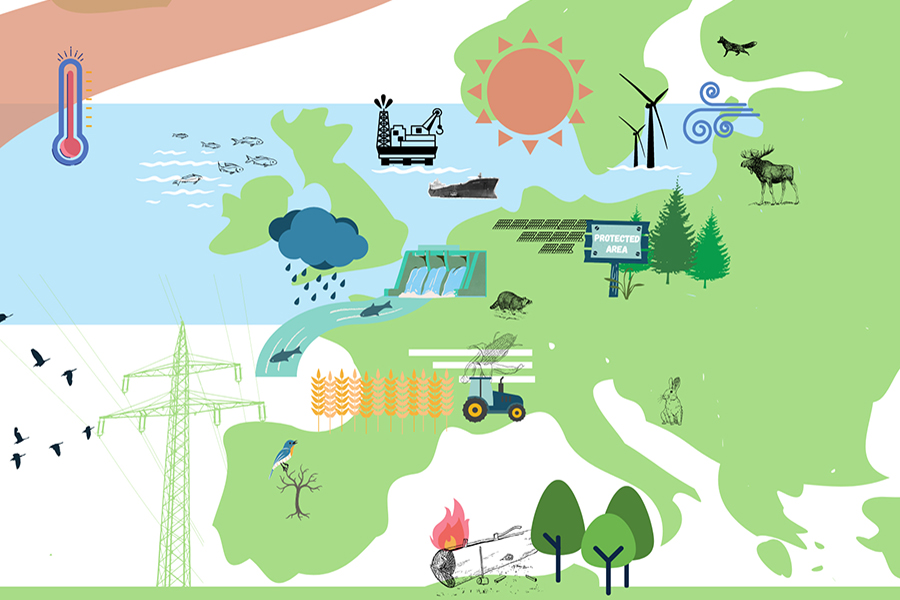
A new MIT CS3 study explores how to balance climate change and biodiversity goals. (Source: European Commission)
Can we limit global warming to 1.5°C while protecting 30% of the Earth’s land?
A new MIT CS3 study evaluates economic impacts of combining climate and biodiversity action
On first glance, the long-term goal of the Paris Agreement appears straightforward: to avert the worst impacts of climate change, cap global warming at 1.5 degrees Celsius by dramatically reducing anthropogenic greenhouse gas emissions. But achieving that goal will require not only a shift to cleaner, greener energy sources but also a massive repurposing of land. Significant acreage will be needed for the deployment of solar and wind energy technologies and the implementation of land-based carbon dioxide removal methods that range from bioenergy crops to reforestation.
Another major United Nations environmental goal, the Kunming-Montreal Global Biodiversity Framework’s “30-by-30” target—protecting 30% of land and oceans from human development by 2030 in order to minimize biodiversity loss and ecosystem degradation—also appears straightforward. But achieving that goal will likewise require substantial tracts of land.
The 1.5°C and 30-by-30 targets may sound good on paper, but policymakers tasked to implement them must contend with land scarcity pressures as well as stakeholders’ concerns about potential adverse social and economic impacts. Which raises the question: are there socially and economically viable and fair pathways by which the world can achieve both of the UN’s ambitious, land-intensive climate and biodiversity goals?
To address that question, a new study in the journal Land Use Policy by researchers at the MIT Center for Sustainability Science and Strategy (CS3) explores the land-use and socio-economic impacts of achieving the 30-by-30 target under two climate policy scenarios: “Current Trends” (CT), which extrapolates Paris-Agreement-determined present climate policies throughout this century, and “Accelerated Actions” (AA), which apply more ambitious and stringent decarbonization strategies to stabilize the Earth’s global mean surface temperature at 1.5°C.
Representing the 30-by-30 target in the MIT Economic Projection and Policy Analysis (EPPA) model, the CS3 researchers project global shifts in land use and regional economic impacts in response to the CT and AA scenarios. Under both scenarios, the India and Middle East regions experience the largest GDP losses (up to tens of billions of dollars, along with food price increases of 5% to 600% for selected agricultural products), whereas Brazil, Australia and New Zealand experience billion-dollar-scale GDP gains, largely from increased food exports.
“These results highlight potential economic losses for regions with scarce natural forest and grassland cover, and gains for those with robust agriculture and livestock sectors,” says Kevin Lin Yang, a master’s student in MIT’s Technology and Policy Program and the study’s lead author. “They also underscore the need for decision-makers to complement dual biodiversity/climate policies with measures that counter the likely effects of such policies, which include regional food price increases and agriculture-induced deforestation.”
Finally, the study’s projections show that accelerating climate action—e. g., aligning policy with the AA rather than the CT scenario—can lower the cost of achieving the 30-by-30 biodiversity target. Under AA, higher carbon pricing and investment in decarbonization reduces demand for land for development, thereby reducing the cost of repurposing land to protect biodiversity.