
2026 Living Climate Futures Symposium: Photo Gallery
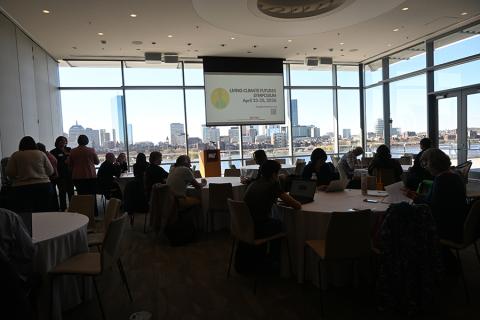
The second Living Climate Futures Symposium was held on the MIT Campus on April 23-25. (Photo by Laura Frye-Levine)
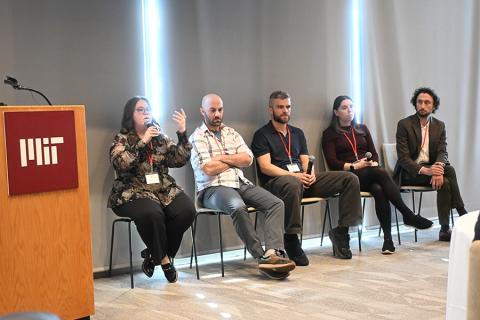
The session “Data Centers, Energy Concerns, and Community Health” featured panelists Sarah Sweeney, Center for Coalfield Justice; Nicholas Hood, Center for Coalfield Justice; Michael Cork, Harvard T.H. Chan School of Public Health; Livia Garofalo, Data & Society’s Trustworthy Infrastructures; and Jonathan Buonocore, Department of Environmental Health, Boston University School of Public Health. (Photo by Laura Frye-Levine)
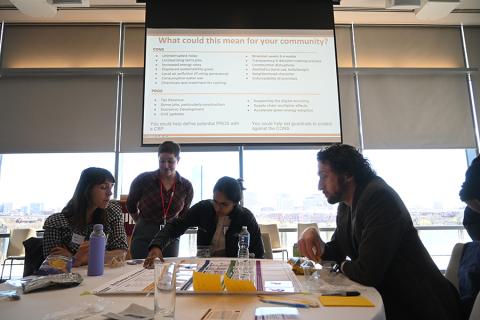
Gathered around several tables, Living Climate Futures Symposium participants worked together to identify potential pros, cons and tradeoffs of allowing a data center to be built in a fictitious community. (Photo by Laura Frye-Levine)
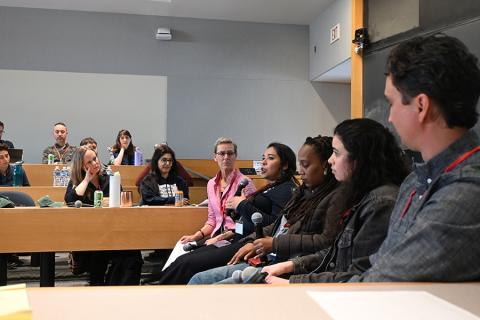
The “Advancing Urban Agriculture in a Changing Climate: Voices from Greater Boston’s Growing Spaces” session was moderated by Kate Brown and featured speakers Sabrina Pilet-Jones, Urban Farm Manager, Haley House; Cecilia Del Cid, Director of Food Justice & Youth Programs, GreenRoots; Olivia Golden, Urban Agriculture Educator, UMass Extension; and Matthew Ellison, Urban Farming Institute. (Photo by Laura Frye-Levine)
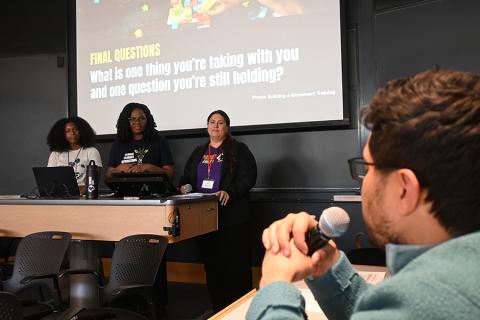
The session “The Work of Repair: Global Perspectives and Methodologies” featured speakers Veronica Coptis, Eliane Lakam and Sophia Andrews Maison, Taproot Earth. (Photo by Laura Frye-Levine)
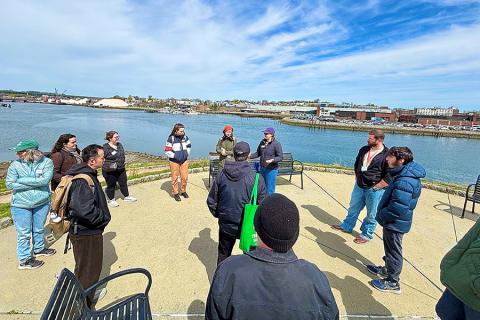
A Stone Living Lab tour enabled symposium participants to visit a living seawall, nature-based flood protection infrastructures, and a community-based flood sensor project as Boston tries to address rising seawater levels. (Photo by Chris Walley)
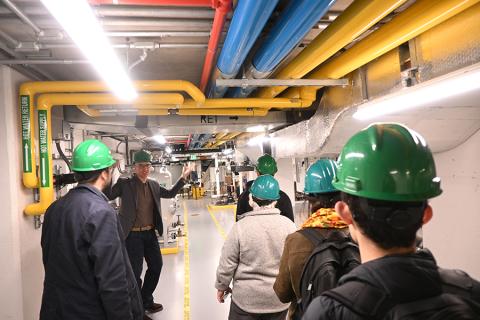
A tour of the MIT Campus highlighted ways that the Institute is working to decarbonize its buildings and operations. (Photo by Laura Frye-Levine)
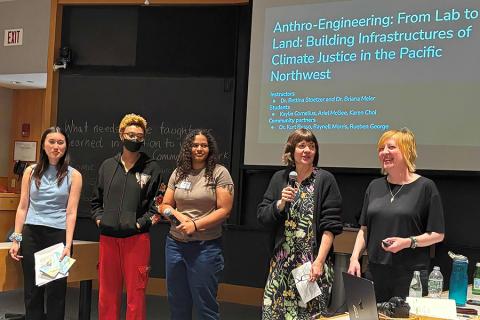
Presenters for the session “Anthro-Engineering: From Lab to Land – Building Infrastructures of Climate Justice in the Pacific Northwest” included MIT Anthropology students Karen Choi, Ariel McGee and Kaylie Cornelius; and MIT Associate Professor of Anthropology Bettina Stoetzer and MIT Anthropology postdoctoral associate Briana Meier. (Photo by Chris Walley)
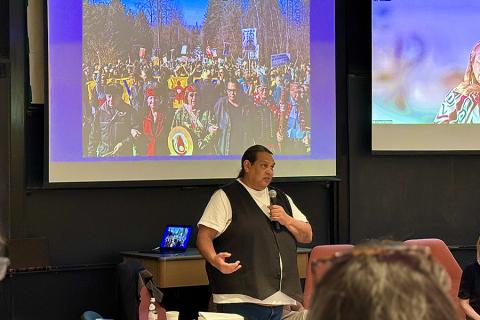
In a session entitled “Xa xah Xechnging: A Sacred Obligation in a Time of Climate Chaos,” Sundance Chief Rueben George, a board member of Se’Si’Le, recounted the role of Indigenous culture in energizing the campaign he led against the development of the Trans Mountain Pipeline, a fossil fuel megaproject on Tsleil-Waututh Nation territories in British Columbia. (Photo by Chris Walley)
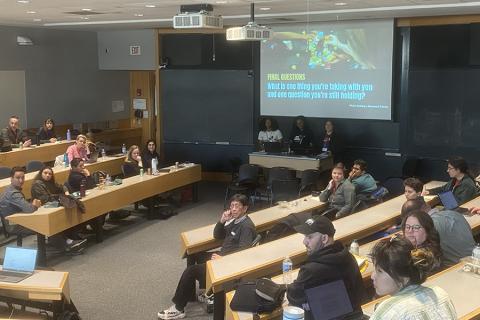
The Living Climate Future Symposium encouraged frequent interaction between panelists and participants (Photo by Mark Dwortzan)
Living Climate Futures Symposium explores climate challenges and solutions at the community level
Aiming to transition away from fossil fuels and avert the worst consequences of climate change, world leaders aspire to achieve net zero global greenhouse gas emissions by 2050 and cap global warming at 1.5 degrees Celsius. But actions to meet such targets and minimize adverse impacts on lives, livelihoods and infrastructure are not one-size-fits-all; they will require different approaches in different places. To better understand the patchwork causes and effects of the climate crisis and elements of viable solutions to it, researchers in MIT's Living Climate Futures (LCF) initiative—20 MIT faculty and affiliates from across the Institute—collaborate with frontline communities in diverse physical and socio-economic landscapes around the world.
Funded by the MIT Human Insight Collaborative (MITHIC) and based at the MIT School of Humanities, Arts and Social Sciences (SHASS), LCF is a multi-disciplinary research hub and community of practice involving researchers across the Institute; focuses on how climate change impacts people’s everyday lives; and creates knowledge and research partnerships with community organizations. At MIT on April 23-25—just after Earth Day—LCF showcased several of these partnerships at its second Living Climate Futures Symposium, which brought together community environmental organizations with MIT researchers and students to explore how climate change challenges and responses to them are playing out in locations from New England to Mongolia.