
For agricultural interests the world over, climate change is not a dim threat, but a reality with diverse long and short-term impacts, believes Cynthia Rosenzweig.
Without the agricultural revolution of eight to 10 thousand years ago, there would be far fewer people and “we’d all be out hunting and gathering.” The food surpluses that came from cultivation of crops and domestication of livestock “allowed the development of civilization as we know it,” says Rosenzweig. Agriculture has grown into a vast and varied enterprise globally, and now contributes its fair share to global warming. Greenhouse emissions began not 200 but thousands of years ago, with the clearing of land and forests, and the intensive planting of certain crops. Today, more than a third of nitrous oxide emissions are due to fertilizer use; farm energy needs and food transportation spews out carbon dioxide; and the rise of the factory feedlot and rice plantations have given us huge increases in methane.
Citing the latest models from international research groups, Rosenzweig offers projections of the impacts of climate change on agriculture. By the end of this century, the higher latitudes should expect more precipitation, the lower latitudes less. As we “march through time getting warmer,” the increases in CO2 will initially be better for crops, because it will increase photosynthesis. Regions with short growing seasons may see them lengthened, so for instance, Finnish farmers will be pleased they can plant early spring potatoes (which fetch a premium price).
But droughts and floods will become more frequent, and the change in seasonality will put great stress on irrigation schemes and planting schedules. A single, powerful hit during a growing season can destroy a crop. And expect “weeds and critters to change in response to the changing climate,” says Rosenzweig. Pests are already expanding their ranges. Not surprisingly, the most vulnerable to these fluctuations are developing countries, where greater populations are dependent on agriculture.
Warming in the last 30 years has already begun to affect the health of food crops and their yields across the globe. Strategies for solutions must involve both mitigation to reduce long-term risk, and adaptation to current conditions, says Rosenzweig. So we must turn to biofuels and reduce CO2 and methane emissions, while figuring out how to cushion crops against drought and flood, bioengineering those that can manage higher temperatures. In this way, climate change can function as “a transformative issue by which agricultural sustainability may be achieved.”
ABOUT THE SPEAKER:
Cynthia Rosenzweig heads the Climate Impacts Group at the Goddard Institute. She has organized and led large-scale interdisciplinary regional, national, and international studies of climate change impacts and adaptation. She is a Coordinating Lead Author of the chapter on observed changes for the IPCC Working Group II Fourth Assessment Report, and served on the IPCC Task Group on Data and Scenarios for Impact and Climate Assessment (TGICA).
Rosenzweig's research involves the development of interdisciplinary methodologies by which to assess the potential impacts of and adaptations to global environmental change. A recipient of a Guggenheim Fellowship, she has joined impact models with global and regional climate models to predict future outcomes of both land-based and urban systems under altered climate conditions. She is a Professor of Environmental Science at Barnard College and a Senior Research Scientist at the Columbia Earth Institute.
Rosenzweig received a B.S.in Agricultural Sciences, 1980, from Cook College; an M.S. in Soils and Crops, 1983, from Rutgers University; and a Ph.D.in Plant, Soil and Environmental Sciences, in 1991, from the University of Massachusetts, Amherst.
Climate Variability and Change and their Impact on the Global Harvest
Related Media and Events
Alli Gold Roberts
MIT Joint Program on the Science and Policy of Global Change
Despite global treaties and national regulations limiting toxic chemicals known as persistent organic pollutants (POPs), many of these chemicals still remain in the environment for long periods of time and accumulate in our land, water and air. These chemicals reach remote regions of the globe, like the Arctic, through air currents and have dangerous effects on humans and animals. Warming of the atmosphere and changing patterns of wind and rain, due to climate change, can affect where and when these pollutants travel. However, the impact of climate on POPs—how these patterns will change, and in what direction—is not well known.
In a new study published in Environmental Science and Technology, MIT researchers assess the impacts of both climate change and future emissions on a group of POPs called polycyclic aromatic hydrocarbons (PAHs)—toxic byproducts of burning wood, coal and oil. They are the first to address the influence of climate change on the transport of PAHs.
They find that decreases in human emissions are expected to cause PAH concentrations to decline by up to 37 percent by 2050. But, climate change can either reduce or enhance that decline depending on the physical and chemical properties of different PAHs.
“We are interested in PAHs because they continue to be released into the atmosphere and their concentrations have been increasing in Arctic marine life, in contrast to most other POPs,” says Carey Friedman, a postdoctoral associate with the MIT Joint Program on the Science and Policy of Global Change and the lead author of the study. “We find that projected decreases in human emissions will have a stronger impact on atmospheric PAH levels in the future than changes in climate.”
However, the authors find that this statement has important caveats. As temperatures rise, due to climate change, more volatile PAHs that are currently deposited in soil and vegetation are expected be emitted—actually re-emitted—into the atmosphere.
“This represents a ‘climate penalty’ for atmospheric concentrations of more volatile PAHs, meaning that emissions reductions will not be as effective as they would have been if the climate wasn’t changing,” explains Noelle Selin, co-author of the study and an assistant professor of engineering systems and atmospheric chemistry.
In contrast, atmospheric levels of non-volatile PAHs are expected to decrease under 2050 climate conditions because their ability to be deposited into the soil and land will be enhanced.
“Our results suggest that ratios of the different types of PAHs (volatile to non-volatile) in the Arctic can be used to diagnose whether the atmosphere is experiencing greater influence from climate change or reductions in human emissions,” says Friedman.
This raises the possibility that such a technique could be used to measure the effectiveness of emissions reduction activities in the context of ongoing climate change.
The study is part a series of NSF-funded research tracking how chemicals travel to remote Arctic environments and how they can be better managed. Researchers have presented the results of these studies to help inform policymakers on the most effective methods of addressing POPs like PAHs, which are affecting humans and the environment.
Read about the team’s earlier research results: http://globalchange.mit.edu/research/publications/search

Get the inside scoop and follow LIVE reports from Geneva by twitter and blog.
Ten MIT students are having an experience of a lifetime as they join officials from around the world for the fifth and final meeting to address global controls on mercury – taking place January 13-18 in Geneva, Switzerland. It is expected that a global treaty on mercury will be finalized during the talks.
Funded through part of a U.S. National Science Foundation grant, the students hope to help negotiators by presenting the latest scientific results (See more).
The students will be reporting on the progress of the talks and their experiences on their blog. Keep updated on the day-to-day action: mit.edu/mercurypolicy.
They’ll also be tweeting LIVE from Geneva. Follow them @MITMercury, #MITMercury.
They are joined by their instructor Noelle Selin, an assistant professor of engineering systems and atmospheric chemistry. Of the experience, Selin says: “Knowledge about the policy-making process is a critical skill for the next generation of scientists. This is a unique opportunity for science students to see treaty-making firsthand, at the history-making session that is expected to finalize a global mercury treaty.”
Student Leah Stokes, a PhD candidate in MIT’s Environmental Policy and Planning program says, "Attending the mercury treaty negotiations is a rare chance to see international environmental policy-making in action and learn how scientists and policymakers work together to produce results.”
Fellow student Julie van der Hoop, who is getting her doctorate in the MIT/WHOI Joint Program in Oceanography, adds, "As a doctoral student who studies human interactions with marine mammals, I’m excited to observe the role of scientists at these negotiations to learn how to best share my own research in the future. It's forums like this where I hope my work will have an impact someday. “
The other students attending include: Alice Alpert, PhD student in the MIT/WHOI Joint Program in Oceanography; Ellen Czaika, PhD candidate in the Engineering Systems Division; Bethanie Edwards, PhD student in the MIT/WHOI Joint Program in Oceanography; Amanda Giang, SM candidate in the Technology and Policy Program; Danya Rumore, PhD student in Environmental Policy and Planning; Rebecca Saari, PhD Candidate in Engineering Systems; Mark Staples, SM candidate in the Technology and Policy Program; and Philip Wolfe, PhD Candidate in the Department of Aeronautics and Astronautics. Learn more about the students and their instructor Noelle Selin Here.
Learn about the latest mercury research out of MIT: Strategies to Reduce Mercury Revealed Ahead of International Talks.
The Global Young Academy (GYA) is an international group of two hundred young (up to ten years post PhD) scientists selected based on research excellence and commitment to impact. Through GYA, members are linked to the senior international academy network IAP, meet outstanding leaders of the international science community and may be nominated to contribute to international policy statements and working groups. Appointments are for a period of four years.
Selin's research focuses on using atmospheric chemistry modeling to inform decision-â€making strategies on air pollution, climate change and toxic substances including mercury and persistent organic pollutants. She has also published articles and book chapters on the interactions between science and policy in international environmental negotiations, in particular focusing on global efforts to regulate hazardous chemicals and persistent organic pollutants.
Selin, who will be formally appointed at a GYA symposium on May 21st, says she is very much looking forward to leveraging her new appointment to expand the reach of her science-policy work and educational initiatives.
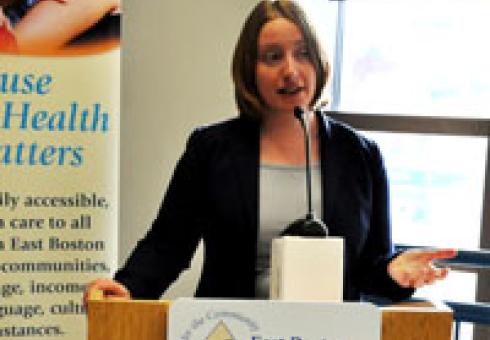
Dr. Noelle Selin of the MIT Joint Program on the Science and Policy of Global Change has been selected as one of 20 Leopold Leadership Fellows for 2013. She is the first fellow to be selected from the Massachusetts Institute of Technology.
Based at the Stanford Woods Institute for the Environment, the Leopold Leadership Program provides outstanding academic environmental researchers with skills and approaches for communicating and working with partners in NGOs, business, government and communities to integrate science in to decision making.
Selin is among the 20 mid-career academic environmental researchers named as fellows this year. The group was selected through a highly competitive process on the basis of their exceptional scientific qualifications, demonstrated leadership ability, and strong interest in sharing their knowledge beyond traditional academic audiences. The fellows will take part in intensive leadership and communications training designed to hone their skills in engaging with decision-makers, media, and the public. They also become part of a network of past fellows and program advisors who are working with leaders, both within and outside academia, to solve society’s most pressing environmental and sustainability challenges.
The 2013 fellows are doing innovative research in a wide range of disciplines, including ecology, marine science, economics, behavioral science, entomology, engineering and planning. They join a network of 175 past fellows who areengaged in broad-based efforts to solve society’s most pressing sustainability challenges.